
SBA Loan Philadelphia: The Ultimate Credit Mastery Guide for 2026
That dream of expanding your Philadelphia business is powerful. But the fear of a loan rejection-especially due to past credit mistakes-can feel paralyzing. You’re not just battling confusing federal paperwork; you’re facing the intense scrutiny of local banks, wondering if your personal credit will sink your business’s future. It’s a stressful, overwhelming position for any entrepreneur.
A past bankruptcy presents a challenge, but it is not an absolute barrier. Lenders will need to see that you have re-established good credit habits since the discharge. Generally, you must wait several years-often up to 10 years for a Chapter 7-before a lender will consider your application. You must demonstrate a history of responsible financial management and on-time payments to prove that the past will not be repeated. For businesses recovering from significant financial distress, it can also be beneficial to explore Turnaround Management options to stabilize operations before seeking new funding.
This guide is your plan to take back control. We will show you exactly how to master the credit profile required to secure the low-interest sba loan Philadelphia entrepreneurs like you deserve. By the end of this article, you will understand the critical FICO SBSS score, know how to find a local partner to fortify your application, and have the confidence to achieve the funding that will build your legacy. It’s time to turn that fear into financial freedom.
Key Takeaways
- Discover the specific FICO® SBSS score that acts as the true gatekeeper for SBA loan approval-and why it’s not the number you think.
- Pinpoint the right sba loan Philadelphia for your exact goal, from flexible working capital with a 7(a) to purchasing commercial real estate with a 504.
- Get a step-by-step action plan to build a “loan-ready” credit profile by systematically auditing your reports and disputing damaging errors.
- Understand the critical mistakes that cause most DIY applications to be rejected and learn how a professional strategy helps you avoid them.
Navigating the SBA Loan Landscape in Philadelphia
Securing the right funding is the critical first step to building your business legacy. For many entrepreneurs, the process feels complex and intimidating, but it doesn’t have to be. An SBA loan is not a direct loan from the government. Instead, the Small Business Administration (SBA) provides a guarantee on a portion of the loan, which reduces risk for local Philadelphia lenders and makes it easier for them to say “yes.” This government backing is why an sba loan Philadelphia businesses receive is often considered the “Gold Standard” for financing.
In the current 2026 lending climate, Delaware Valley lenders have become more risk-averse. This makes the SBA’s guarantee more valuable than ever. It provides the security lenders need to offer lower down payments and longer repayment terms, giving your startup the breathing room it needs to thrive.
The Philadelphia District Office: Your Local Resource
Your journey to funding is supported by a powerful local ally: the Philadelphia District Office. Based in King of Prussia, this office serves entrepreneurs across 40 counties in Eastern Pennsylvania. They connect you with vital resource partners like the Temple University Small Business Development Center (SBDC) to help you build an undeniable application. This local, “boots-on-the-ground” knowledge is your strategic advantage.
Why Philly Entrepreneurs Choose SBA Over Conventional Loans
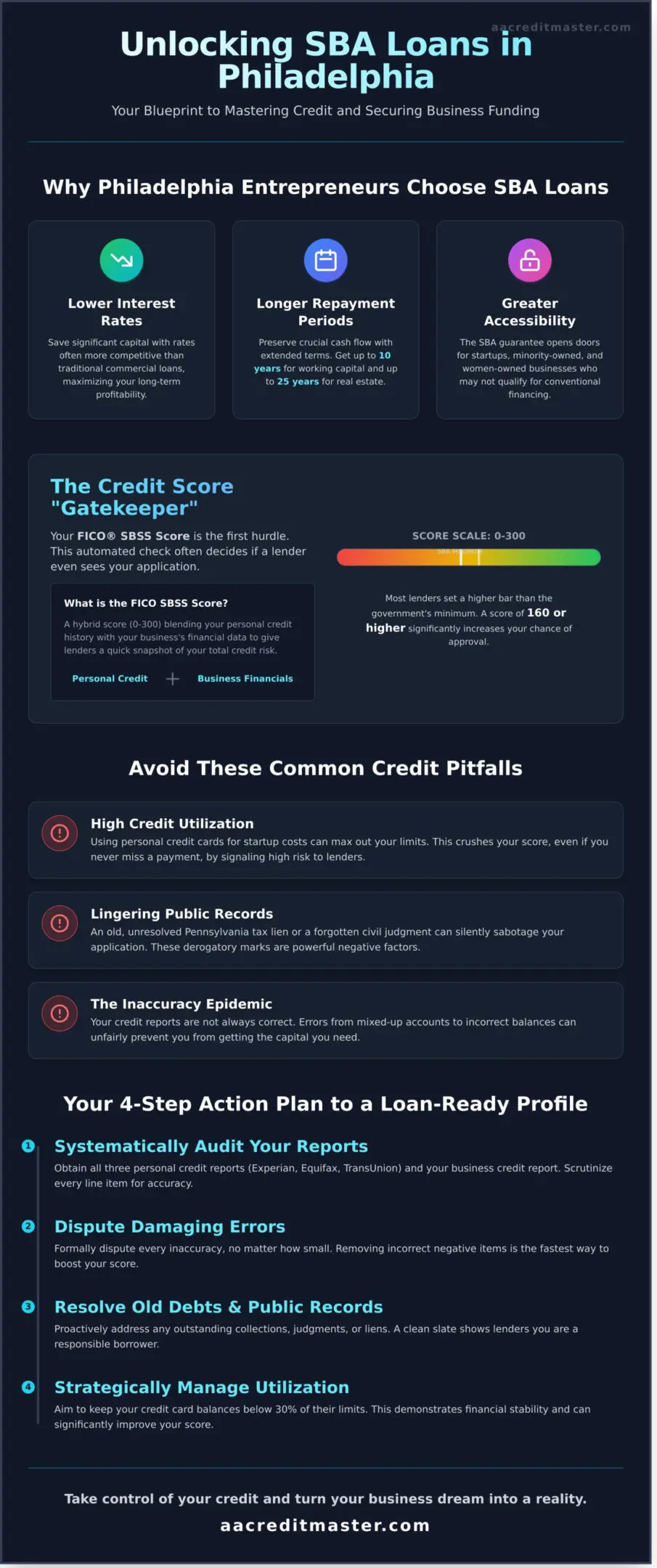
Achieve your growth goals with more favorable terms designed to protect your cash flow. Philadelphia business owners consistently choose SBA-backed financing because it offers a clear path to sustainable success. The key benefits include:
- Lower Interest Rates: Often more competitive than traditional commercial lines of credit, saving you significant capital over the life of the loan.
- Longer Repayment Periods: Preserve your cash flow with extended terms-up to 10 years for working capital and up to 25 years for real estate.
- Greater Accessibility: The SBA guarantee opens doors for many minority-owned and women-owned businesses in Philadelphia who may not qualify for conventional loans.
The Credit Score “Gatekeeper”: SBA Requirements and FICO SBSS
Before a lender reviews your business plan, an automated system checks one critical number: your FICO SBSS score. This single score acts as the first gatekeeper, often determining if your application moves forward. For many SBA 7(a) Small Loans, the government’s minimum prescreening score is 140, but most lenders set a higher bar-often 155 or 160. Seeing a low number can feel like a closed door, but it is not a final verdict. It is simply the starting point for your strategic comeback.
What is the FICO SBSS Score?
Achieve funding by understanding the system. The FICO SBSS (Small Business Scoring Service) score is a unique credit rating on a scale of 0 to 300. It is the SBA’s primary automated filter because it blends your personal credit history from Experian, Equifax, and TransUnion with your business’s financial data. For the most popular SBA loan programs, this hybrid score provides a quick snapshot of your combined personal and business credit risk.
Common Credit Pitfalls for Philly Business Owners
Securing an sba loan Philadelphia requires navigating specific credit challenges common in our region. We see hardworking entrepreneurs get stalled by the same preventable issues. Mastering your credit means identifying and correcting these pitfalls before you apply.
- High Credit Utilization: Many founders use personal credit cards to cover startup costs. This can quickly max out your available credit, crushing your score even if you never miss a payment.
- Lingering Public Records: An old, unresolved Pennsylvania tax lien or a civil judgment can silently sabotage your application. These derogatory items are powerful negative factors that must be addressed directly.
- The Inaccuracy Epidemic: Your credit reports are not always correct. Errors ranging from mixed-up accounts to incorrect balances can unfairly prevent you from getting the capital you need to grow.
A score below the lender’s threshold is not a permanent rejection; it is a clear signal to take action. By disputing inaccuracies, managing utilization, and resolving old debts, you can rebuild a powerful credit profile. You can master this system, meet the requirements, and position your business for approval. It’s time to take back control.
Comparing Popular SBA Programs for Philadelphia Businesses
Not all SBA loans are created equal. Mastering the differences is the first step to securing the right funding for your company’s future. Whether you’re expanding a restaurant on Passyunk Ave or launching a tech startup in University City, the right program provides the capital you need to thrive. Let’s break down the most popular options available for your Philadelphia business.
- SBA 7(a) Loans: This is the workhorse of the SBA. It offers the most flexibility for a wide range of needs, including working capital, inventory purchases, equipment financing, and even refinancing high-interest business debt.
- SBA 504 Loans: The powerhouse for major fixed-asset purchases. Use this to buy a commercial building in Fishtown, construct a new facility, or acquire heavy machinery for your manufacturing plant.
- Microloans: Targeted funding that makes a big impact. With loans up to $50,000, this program is designed to support underserved entrepreneurs and Philadelphia startups that need a smaller capital injection to get started.
- Disaster Loans: A critical lifeline for recovery. Should a federally declared disaster impact our region in 2026, this program provides essential, low-interest funds to help local businesses rebuild and recover.
SBA 7(a) vs. Conventional Commercial Loans
Unlock growth with less cash out of pocket. A primary advantage of the 7(a) loan is its lower down payment requirement-typically just 10%, compared to the 20-30% demanded for many conventional loans. The SBA’s guarantee reduces the risk for lenders, making them more willing to work with Philadelphia startups that may have limited collateral. This government backing makes you a much stronger applicant at local institutions like the United Bank of Philadelphia, though they will still have strict credit score requirements you must master.
Strategic Use of the 504 Loan for Philly Real Estate
Take back control of your largest expense: your location. An SBA 504 loan is specifically designed to finance owner-occupied commercial real estate in the Greater Philadelphia area. By securing long-term, fixed-rate financing, you lock in predictable payments and build equity, creating powerful financial stability against economic shifts in 2026 and beyond. To access this tool, you must partner with a Certified Development Company (CDC) in Pennsylvania, which will guide you through the unique application process for this type of sba loan Philadelphia funding.
Entrepreneurs in specialized industries, such as the senior care sector, often require niche expertise when purchasing property. For an example of the resources available for this type of real estate transaction, you can visit Assisted Living Real Estate Group.
How to Build a “Loan-Ready” Credit Profile in 5 Steps
Secure your business’s future by building a credit profile that lenders can’t ignore. A strong financial foundation is non-negotiable when seeking an sba loan Philadelphia lenders will approve. It’s time to take back control. Follow this methodical, 5-step process to transform your credit from a liability into your greatest asset.
Step 1 & 2: Identify and Dispute Inaccuracies
Your first move is to become a financial guardian for your business. Audit your personal and business credit reports with a level of detail that generic software simply cannot match. We find that nearly 80% of reports contain errors-derogatory items, misreported balances, or incorrect personal information-that can be challenged. Don’t just click a button; write professional, systematic dispute letters that demand verification from the bureaus. If they can’t prove it, they must remove it. Learn more about How to Remove Inaccuracies from Your Credit Report.
Step 3: Proactively Build Business Credit
A strong personal score is only half the battle. You must establish a separate, powerful credit identity for your business. Start by getting a free D-U-N-S number from Dun & Bradstreet-this is the “Social Security Number” for your company. Then, open “Net-30” accounts with vendors like Uline or Grainger. These vendors report your timely payments to business credit bureaus, building a history of reliability that lenders want to see. This is a critical step in mastering the Philadelphia business landscape. Discover our complete strategy in our guide on How to Build Business Credit in Philadelphia.
Finally, complete your loan-ready profile with these last two master strokes:
- Step 4: Optimize Your Personal Debt. Lenders will scrutinize your personal debt-to-income (DTI) ratio. Restructure liabilities and pay down high-interest consumer debt to demonstrate strong personal financial management. This shows you can handle the responsibility of an SBA loan.
- Step 5: Monitor Your Progress. What gets measured gets managed. Track your Dun & Bradstreet PAYDEX and Experian Business scores monthly. This allows you to see your progress in real-time and make strategic adjustments on your path to securing your funding.
Building a loan-ready profile requires a personalized strategy, not a one-size-fits-all solution. If you’re ready to master your financial future and secure an sba loan in Philadelphia, contact us for a professional credit analysis.
Mastering the Process with Philadelphia Credit Consultants
When your business’s future depends on funding, there is no room for error. DIY credit repair templates and automated dispute software often fail under the intense scrutiny of an SBA application. These generic tools lack the nuance to address complex derogatory items, leaving your approval to chance. Securing a competitive sba loan Philadelphia lenders offer requires a strategic, surgical approach to credit restoration-not a guess.
This is the Allen & Allen, Inc. difference: a personalized strategy over automated templates. Our process begins with a forensic audit of your credit reports, where a human expert identifies the specific, verifiable inaccuracies suppressing your FICO score. We then build a custom dispute plan designed to challenge these items with the credit bureaus, positioning you for the best possible approval odds and loan terms.
Choosing a Legitimate Philadelphia Credit Score Specialist
In an industry with many bad actors, knowing the red flags is your first line of defense. A legitimate credit consultant will never:
- Guarantee a specific score increase or loan approval.
- Demand large, upfront fees before services are rendered.
Federal law-the Credit Repair Organizations Act (CROA)-protects consumers by mandating a post-performance fee structure. A local office right here in Philadelphia provides another layer of trust, offering the accountability of face-to-face consulting. Explore our compliant and effective Credit Repair Services Philadelphia.
Your Path to Financial Freedom Starts Here
Imagine the transition from “un-loanable” to “SBA-approved.” This is the emotional shift from financial anxiety to the confidence of empowered ownership. Mastering your credit profile isn’t just about securing one loan; it’s about building a powerful financial foundation for your business’s legacy and long-term growth. It’s time to take back control and secure the funding your business deserves.
Schedule your expert credit consultation at our Market Street office today.
Master Your Credit and Secure Your Philadelphia SBA Loan
Securing the capital to grow your business is within your reach. This guide has shown that a strong FICO SBSS score is not just a number-it’s the key that unlocks your sba loan Philadelphia funding. Building a loan-ready credit profile is a deliberate, strategic process, not a game of chance. You have the knowledge; now it’s time for action.
You don’t have to navigate this complex landscape alone. At AACreditMaster, we specialize in demystifying the FICO SBSS and building powerful business credit profiles. From our office at 1515 Market Street, Suite 1200, we provide Philadelphia entrepreneurs with a personalized strategy. Our CROA-compliant, post-performance fee structure means we are fully invested in your success.
Master your credit and secure your Philadelphia SBA loan today. The legacy you’re building deserves the right financial foundation. Take back control.
Frequently Asked Questions
What is the minimum credit score for an SBA loan in Philadelphia?
Achieve your funding goals with a strong credit profile. While the SBA does not set a hard minimum, partner lenders in Philadelphia typically require a personal FICO score of at least 680. A score above 700 will significantly increase your chances of approval and help you secure more favorable terms. If your score is below this threshold, a robust business plan and strong revenue can help, but improving your credit is the most direct path to success.
How long does the SBA loan approval process take in Pennsylvania?
The timeline for SBA loan approval can vary, but you should plan for a multi-week process. For a standard SBA 7(a) loan, expect the process to take between 30 and 90 days from application submission to funding. This includes the lender’s underwriting and the SBA’s final review. An organized application with all necessary documents is the best way to prevent delays and accelerate your path to capital. Your chosen lender’s efficiency also plays a major role.
Can I get an SBA loan with a bankruptcy on my credit report?
A past bankruptcy presents a challenge, but it is not an absolute barrier. Lenders will need to see that you have re-established good credit habits since the discharge. Generally, you must wait several years-often up to 10 years for a Chapter 7-before a lender will consider your application. You must demonstrate a history of responsible financial management and on-time payments to prove that the past will not be repeated. This is a critical step in rebuilding trust with lenders.
What is the FICO SBSS score and why does it matter for Philly businesses?
Master the numbers that matter most to lenders. The FICO Small Business Scoring Service (SBSS) score is a key metric for your sba loan Philadelphia application. It combines your personal credit history with your business’s financial data to generate a single risk score. For many smaller SBA loans, a minimum SBSS score of 155 is required to even pass the pre-screening phase. A strong score proves your business’s creditworthiness and can significantly speed up the approval process.
Do SBA loans require a personal guarantee from the business owner?
Yes, this is a non-negotiable requirement to secure the lender’s investment. The SBA requires an unconditional personal guarantee from any individual who owns 20% or more of the business. This means that if the business defaults on the loan, you are personally responsible for repaying the debt. This policy ensures that business owners are fully committed to the success of the venture and the repayment of the government-backed loan.
How can I fix my credit quickly to qualify for an SBA 7(a) loan?
Take back control of your credit and qualify for the funding you deserve. To quickly improve your score, start by disputing any inaccuracies or derogatory items on your reports with all three credit bureaus. Next, focus on lowering your credit utilization by paying down high-balance credit cards. Finally, ensure a perfect on-time payment history going forward. These actions demonstrate financial discipline and can create a significant positive impact on your score in just a few months.
Are there specific SBA lenders in Philadelphia for minority-owned businesses?
While all SBA-approved lenders are open to every qualified applicant, certain institutions focus on empowering underserved communities. Look for Community Development Financial Institutions (CDFIs) and Minority Depository Institutions (MDIs) in the Philadelphia area. Organizations like The Enterprise Center and the African-American Chamber of Commerce of PA, NJ & DE can also provide resources and connect you with lenders committed to supporting minority entrepreneurship and building community wealth.
What documents do I need for a Philadelphia SBA loan application?
A complete and organized application is your key to a fast approval. You will need to prepare a detailed business plan, including financial projections for at least three years. Gather personal and business tax returns for the last three years, year-to-date financial statements like a profit and loss (P&L) statement and balance sheet, and legal documents such as your business license, articles of incorporation, and commercial lease. Having these ready proves your professionalism to lenders.