
Business Credit Score Factors: A Philadelphia Entrepreneur’s Guide to Financial Mastery
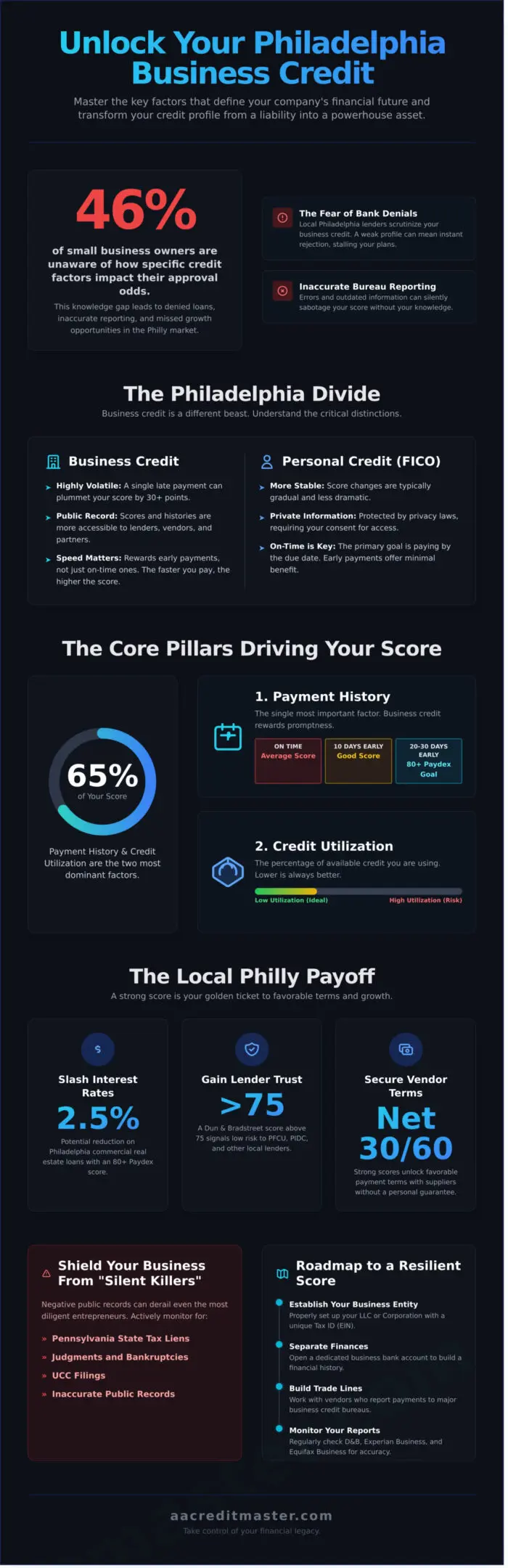
What if the reason your last equipment loan was denied had nothing to do with your bank balance and everything to do with a single missing trade reference? It’s a harsh reality for 46% of small business owners who remain unaware of how specific business credit score factors influence their approval odds. You’ve worked hard to build your reputation in Philadelphia, yet you still face the fear of local bank denials and the headache of inaccurate bureau reporting. It’s frustrating when your personal financial success doesn’t automatically open doors for your company’s expansion.
You deserve to take back control of your financial future. By mastering the variables that dictate your creditworthiness, you can transform your profile from a liability into a powerhouse asset. We’ll show you how to achieve an 80+ Paydex score, which can slash interest rates on Philadelphia commercial real estate loans by as much as 2.5%. This guide provides the exact roadmap you need to command your reporting, secure your legacy, and finally win the funding your business earned.
Key Takeaways
- Unlock the “Golden Ticket” to your company’s growth by understanding how your Philadelphia business credit defines your financial reputation.
- Take back control of your financial future by mastering the essential business credit score factors that dictate your access to capital.
- Shield your business from the “silent killers” of credit scores, including Pennsylvania state tax liens and public records that derail Philadelphia entrepreneurs.
- Build a resilient financial foundation for your startup through a methodical approach to establishing your LLC and monitoring major credit bureaus.
- Move beyond generic software and embrace a personalized strategy designed to help you master the complex Philadelphia credit ecosystem.
Demystifying Business Credit Score Factors for Philadelphia Entrepreneurs
Your Philly business credit score is the financial heartbeat of your LLC or Corporation. It represents your reputation in the eyes of lenders, vendors, and the Philadelphia community. For a tech startup in University City or a family-owned boutique on Market Street, a high score is the Golden Ticket. It opens doors to favorable terms that would otherwise remain locked. Achieving this status requires a shift in mindset. You are not a victim of the credit bureaus; you are the master of your own data. By identifying the primary business credit score factors, you move from financial uncertainty to total control.
Business credit operates differently than the personal FICO score you’ve managed for years. It’s faster, more public, and significantly more volatile. While a personal score might dip slightly after a hard inquiry, a business score can plummet 30 points because of a single late payment to a supplier. Success begins with understanding business credit reports and how they aggregate data from public records, trade lines, and collection agencies. We provide the expert reassurance you need to navigate this landscape. We help you transform your credit profile from a liability into a powerful asset for growth.
The Impact of Your Score on Local Philadelphia Lending
Local lenders like the Philadelphia Federal Credit Union (PFCU) or American Heritage look beyond your balance sheet. They scrutinize your business credit report to gauge your reliability. According to the 2023 Federal Reserve Small Business Credit Survey, only 47% of businesses received the full amount of financing they sought. This gap is often due to poor credit health. The Philadelphia Industrial Development Corporation (PIDC) has managed over $15 billion in economic development; they prioritize firms with transparent, strong credit histories. When your first major loan application is pending, knowing your business credit score factors are optimized provides the confidence to negotiate from a position of strength rather than desperation.
- Lender Trust: A score above 75 on the Dun & Bradstreet scale signals low risk to local Philly credit unions.
- PIDC Approval: Strong scores accelerate the due diligence process for city-backed growth grants.
- Vendor Terms: High scores allow you to secure Net-30 or Net-60 terms with East Coast suppliers without personal guarantees.
Business vs. Personal Credit: The Philadelphia Divide
A Philadelphia business entity functions as a separate legal organism with its own tax ID, isolating business debts from the owner’s personal financial record. You must respect this boundary to protect your future. Co-mingling credit in the early stages of a startup is a dangerous path that leads to personal financial ruin if the venture faces a downturn. As of January 2024, lenders increasingly use the FICO SBSS score, which blends both profiles. This means your personal score still acts as a secondary factor for Philly lenders. You must maintain a clean personal record while aggressively building your corporate identity. We guide you through this separation, ensuring your business stands firmly on its own feet.
Take back control of your legacy today. Financial literacy isn’t a temporary fix; it’s the permanent foundation of your Philadelphia success story. When you master your data, you master your future.
The Core Pillars: Payment History and Credit Utilization in the Philly Market
Your business credit profile relies on two primary engines. Payment history and credit utilization drive approximately 65% of your total score. Mastering these business credit score factors allows you to secure the capital needed to scale from Fishtown to Center City. You must view your credit report as a living document of your reliability. It tells a story to every lender in the Delaware Valley before you even shake their hand.
If you pay your bills exactly on the due date, your score stays average. This is a common trap for Philadelphia entrepreneurs. Unlike personal credit, business credit rewards speed. If you pay 10 days early, then your score reflects maximum reliability and can reach the upper tiers of the Paydex scale. This proactive approach transforms you from a standard borrower into a preferred partner for local banks.
Managing trade references with local Philly suppliers and vendors is your next tactical move. Many regional wholesalers don’t automatically report your positive data. You must request that they trade-reference your account. This manual step ensures your consistent payments to local food distributors or construction material yards actually build your legacy. Understanding the SBA’s five factors of business credit provides the framework for this professional discipline.
Mastering the Paydex Cycle
Dun & Bradstreet calculates your Paydex score on a scale of 1 to 100. A score of 80 is the “Philadelphia standard” for unsecured business credit. Achieving an 80 requires you to pay every bill on time. To exceed this, you must pay 15 to 20 days in advance of your terms. This speed signals financial health to creditors. Set up “Early-Pay” triggers for your recurring Philly utility bills, like PECO or the Philadelphia Water Department. These triggers ensure you never miss a window to boost your numbers. You can master your credit profile by automating these cycles to work in your favor 24/7.
Strategic Credit Utilization for Growth
Philadelphia banks monitor your utilization with a strict 30% rule. If you use more than 30% of your available business line of credit, your score will drop. This signals a lack of liquidity to the Financial Guardian reviewing your file. High utilization during seasonal Philly peaks, such as the summer tourism surge or the December holiday rush, can cause a temporary 15-point dip in your score. You must anticipate these shifts. Request a limit increase 60 days before your busy season begins. This proactive move keeps your ratio low even when your spending increases. It proves you are in control of your growth rather than being consumed by it. Take back control by keeping your balances lean and your limits high.
Consistency is the only path to financial freedom. A single late payment can slash a Paydex score by 20 points in one reporting cycle. This creates a ripple effect that can take 6 to 12 months to repair. By focusing on these core pillars, you build a fortress around your business. You stop being a victim of the system and start becoming its master. This is how you secure the 4% interest rates instead of settling for 12% or higher.
Public Records and Industry Risk: Navigating Pennsylvania’s Regulatory Landscape
Public records act as heavy anchors on your profile. A single judgment filed in the Philadelphia Court of Common Pleas can slash your score by 50 points or more instantly. These records signal to potential partners that you’ve failed to meet legal or financial obligations. Lenders view these filings as a lack of control over your operations. When you understand the weight of these records, you can begin to take back control of your financial narrative.
Pennsylvania state tax liens are the silent killers of business credit. The Philadelphia Department of Revenue is efficient; a missed Business Income and Receipts Tax (BIRT) payment can result in a lien that appears on your report within 90 days. These filings don’t just sit there. They scream “high risk” to every bank in the Tri-State area. These public records are one of the most critical business credit score factors because they represent a legal claim against your assets. You must address these with precision rather than relying on generic fixes.
The Danger of Derogatory Items in PA
Derogatory items like bankruptcies and liens stay on your business report for 7 to 10 years. However, data from 2023 indicates that 15% of public records on business reports contain clerical errors or outdated information. Automated “credit repair” software often misses these nuances. A specialist’s manual review is the only way to ensure a settled lien in Philadelphia isn’t still dragging down your score. Understanding how lenders measure credit allows you to see your business through their eyes. This perspective is vital for the restoration of your financial legacy. You aren’t just a number; you’re a story that needs to be told accurately.
SIC and NAICS Codes: Your Philly Business Identity
Your industry code is your digital DNA. It tells lenders exactly how much risk you carry before they even look at your cash flow. If your 19104-based HVAC company is miscoded as a high-risk speculative investment firm, your capital access will vanish. These codes are essential business credit score factors that most owners overlook. A simple coding error can misrepresent your risk level to every lender in the city. You must verify your code accuracy today. It’s a 5-minute task that secures your borrowing power for the next 5 years.
- Transportation: Often flagged due to volatile fuel costs and high insurance requirements.
- Construction: Viewed as seasonal and prone to payment delays.
- Real Estate Investing: Frequently scrutinized for high leverage ratios.
Is your industry considered too high-risk for a good score? This is a common worry for Philly contractors and truckers. The answer is no. Mastery of your credit isn’t about changing your industry; it’s about proving stability within it. Even in “flagged” sectors, you can achieve a score above 80 by maintaining perfect payment hygiene and low credit utilization. If you’re in a high-risk field, your trade references become your greatest shield. We position you as the exception to the rule. You don’t have to be a victim of your SIC code. By focusing on financial literacy and proactive management, you transform from a “risky bet” into a “secure investment.” This is how you master the system and build a permanent solution for your business’s future.
Building a Resilient Score: Strategic Steps for Philadelphia Startups
You must build your business on a rock-solid base to secure the best interest rates. Start by registering your LLC with the Pennsylvania Department of State and obtaining your EIN from the IRS. Your address matters more than you think. Using a professional virtual office at 1515 Market Street instead of your home address signals stability to lenders. Home addresses often trigger high-risk flags in automated underwriting systems. You also need a dedicated business phone line listed in the 411 directory. This verifies your company’s legitimacy during the 15-second digital scans used by modern creditors. Don’t overlook the human element. Walk into a Center City branch and meet the manager. A personal relationship can bypass a “no” from a computer. This foundation is the first of many business credit score factors that determine your future borrowing power.
Your next move involves securing your D-U-N-S Number through Dun & Bradstreet. It’s free, but it’s the primary identifier for your company’s financial identity. Once you have this, you must monitor your reports with Experian and Equifax monthly. Data shows that 25% of business credit reports contain errors that can lower your score. Catching these mistakes early saves you from paying an extra 3% or 4% in interest on future loans. By 2026, AI-driven lending will make these reports even more critical, as algorithms will pull data in real-time to make instant approval decisions.
The Philadelphia Business Foundation
Lenders at institutions like PNC or TD Bank in Center City look for signs of a “real” business. A 1515 Market Street address carries more weight than a residential street in Manayunk because it suggests a dedicated commercial operation. When you list a dedicated business line in 411 directories, you fulfill a verification step that 60% of new startups skip. This simple act of transparency builds immediate trust with the bureaus. It’s about mastery over the small details that others ignore. You’re not just a freelancer; you’re a Philadelphia business owner building a legacy.
Leveraging Business Tradelines
Tradelines are the lifeblood of your score. You need vendors who report your on-time payments to the bureaus to see any movement. Start with “Tier 1” vendors like Uline or Grainger. These companies provide essential office and industrial supplies and typically offer Net-30 terms to new entities. When you pay these invoices 10 days early, you create a trail of reliability that boosts your Paydex score toward the ideal 80+ range. Use our Business Tradelines Philly Guide to find specific vendors that report to all three major bureaus. This proactive strategy puts you in the driver’s seat of your financial journey.
The 2026 approach to credit is about treating your education as a permanent business asset. Financial literacy ensures you never feel the sting of a surprise rejection again. You’re building more than a number; you’re building freedom and control. Mastery of business credit score factors allows you to scale when your competitors are stuck waiting for approvals. It’s time to stop guessing and start growing with a strategy that works for the long haul.
Ready to move beyond basic tips and start seeing real results in your profile? Take back control of your business credit today
Mastering Your Financial Legacy: How AA Credit Master Guides Philly Businesses
Philadelphia is a city built on grit, but grit alone won’t convince a Tier 1 lender to approve your expansion loan. Generic online templates fail because they ignore the specific economic pressures of the Delaware Valley. You need a strategy that reflects the local reality of the 2024 market. We analyze the specific business credit score factors that actually move the needle for Philly entrepreneurs, moving beyond the surface-level advice found on basic blogs. Understanding the business credit score factors that lenders prioritize in the Philadelphia area is the first step toward true financial mastery.
The Allen & Allen, Inc. difference lies in our refusal to use automated templates. Most credit repair firms rely on bots that send identical letters to bureaus. These are easily flagged and ignored. We provide a personalized strategy that treats your business like the unique entity it is. Our experts dive deep into your reports to find the leverage points that others miss. We’ve helped local owners move from “denied” to “funded” by focusing on high-impact restoration techniques. You aren’t just a file number to us; you’re a partner.
Your business credit isn’t just a number on a screen. It’s the bridge to your financial freedom. It determines whether you pay 5% or 15% on your equipment financing. By mastering this system, you take back control from the institutions and put it back in your own hands. We don’t just fix your past; we prepare your future. You deserve a financial guardian who understands the high stakes of running a company in this city.
Tailored Solutions for Philadelphia Business Owners
Our “Post-Performance” fee structure means our goals align perfectly with yours. We only win when you win. This model ensures that 100% of our focus stays on your results. We go beyond the numbers to provide education for the long haul. Since 82% of small businesses fail due to cash flow issues, we teach you how to use credit as a strategic tool rather than a last resort. Take back control of your business credit today with a Philly specialist.
The Path Forward: From Restoration to Mastery
Consider a Philly entrepreneur who cleared four inaccuracies from their 2023 reports. This single move allowed them to secure a $250,000 SBA 7(a) loan that was previously blocked. As we look toward the 2026 economic climate, consistent monitoring is your best defense against market shifts. You are the guardian of your company’s future. Mastery is a permanent skill, not a temporary fix. You have the power to rebuild, scale, and thrive.
Take Command of Your Philadelphia Financial Future
Mastering business credit score factors moves your company from a state of uncertainty to a position of absolute power. You now understand that maintaining a credit utilization ratio below 30% and securing a FICO SBSS score above 155 are non-negotiable steps for local growth. Navigating the 1996 Credit Repair Organizations Act (CROA) landscape ensures your enterprise remains protected while you dispute inaccuracies. If you prioritize these core pillars today, then you’ll secure the capital needed to scale across Pennsylvania tomorrow.
AACreditMaster serves as your Financial Guardian from our local office at 1515 Market Street. We provide the specialized expertise required to navigate the clinical reality of credit reporting with a personalized human touch. Our team focuses on restoration and long-term mastery rather than temporary fixes. It’s time to stop feeling overwhelmed by bureaus and start leveraging your financial profile as a competitive advantage. You’ve worked too hard to let a three-digit number stand in your way.
Master your business credit today-consult with our Philadelphia specialists
Take back control and build the resilient legacy your business deserves.
Frequently Asked Questions
What is the most important business credit score factor for Philly lenders?
Payment history is the single most critical business credit score factor for Philadelphia lenders. If you pay your vendors 30 days early, your Paydex score will hit the maximum of 100. Most local banks require a score of 80 or higher to approve a conventional commercial loan. This simple habit secures the lowest interest rates and ensures your business remains a top candidate for capital.
Can my personal credit score affect my business credit score in Pennsylvania?
Your personal credit score directly influences your business creditworthiness in Pennsylvania, particularly during the first 24 months of operation. Lenders use the FICO SBSS model, which combines personal and business data into one score. If your personal FICO is below 680, you may face a 15% higher rejection rate for SBA 7(a) loans. Maintaining a strong personal profile creates a safety net for your enterprise.
How long does it take for a new Philadelphia business to build a credit score?
It typically takes 6 to 12 months for a new Philadelphia business to establish a visible credit profile. You need at least 3 trade lines reporting to the bureaus for 90 days before a score like Paydex generates. If you open 5 net-30 accounts today, you’ll likely see a formal score by the start of the next fiscal quarter. Speed up this process by working with vendors who report monthly.
Do Philadelphia utility companies report to business credit bureaus?
Most Philadelphia utility companies don’t report positive payment data to business credit bureaus. While PECO or the Philadelphia Water Department won’t help your score grow, they’ll report a delinquency if you’re 60 days past due. You can use services like Experian Business Boost to manually add these 12 months of utility history to your report. This proactive step turns a standard bill into a powerful asset.
How do I remove an inaccurate tax lien from my Philly business credit report?
You must submit a formal dispute to the credit bureau along with a “Certificate of Release” from the Philadelphia Department of Revenue to remove an inaccurate tax lien. Inaccurate public records can drop your score by 40 points instantly. Once the bureau receives your 10-page supporting packet, they have 30 days to investigate and update your status. Clearing these errors restores your reputation and unlocks frozen lines of credit.
Is there a difference between FICO SBSS and a Paydex score?
The Paydex score measures how fast you pay bills while the FICO SBSS score predicts your total likelihood of default. Paydex uses a 1 to 100 scale, but FICO SBSS ranges from 0 to 300. If your Philly business targets a federal contract, you’ll need an SBSS score of at least 155. Understanding these distinct metrics allows you to master the specific requirements of different lending institutions.
What happens if my Philly business is in a “high-risk” industry code?
Being categorized in a high-risk industry code like 7999 (Amusement and Recreation) can result in a 25% increase in your insurance premiums and limited loan options. Lenders use North American Industry Classification System codes to determine your risk profile before they even look at your balance sheet. If your code is incorrect, you’ll face higher costs for the same capital that a “low-risk” consultant receives.
Can AA Credit Master help me dispute business credit report errors?
AA Credit Master provides the personalized strategy you need to dispute errors and optimize your business credit score factors. We don’t rely on generic software; we offer a human-led approach to navigate the 3 major bureaus. If you find a derogatory item on your report, our team steps in as your financial guardian to help you take back control. Mastery over your credit is the first step toward building a lasting legacy.