
Top Business Line of Credit Companies in Philadelphia: A 2026 Guide
What if you could stop checking your bank balance every time payroll Friday rolls around? You know the crushing weight of waiting on a $42,000 invoice while your team expects their checks by 5:00 PM. It’s exhausting to watch 18% of your hard-earned profit vanish into the hands of predatory online lenders just because you needed a quick cash bridge. You deserve a financial partner that respects your hustle and your bottom line.
This financial support extends to other capital-intensive sectors as well, such as companies commercializing new technologies in the renewable energy field. For those interested in how patented systems are brought to market, you can learn more.
This 2026 guide identifies the elite business line of credit companies in Philadelphia capable of providing the $50,000 to $100,000 revolving limits your growth demands. If you master your fundability now, then you can secure interest rates that sit at least 6% lower than your current business credit card. We’ll walk you through the top local providers and the specific credit strategies needed to move from financial worry to total mastery. You’re about to see exactly how to rebuild your profile and take back control of your company’s future.
Key Takeaways
- Learn why a revolving line of credit offers superior cash flow flexibility compared to traditional term loans for Philadelphia startups in 2026.
- Compare national powerhouses against local regional champions to determine which lender favors your specific business model and location.
- Protect your bottom line by identifying hidden fee traps and vetting business line of credit companies for total transparency.
- Master the “Five Cs of Credit” to position your business for the highest possible limits and most competitive interest rates available.
- Take back control of your fundability by following a proven restoration process that moves your application from “denied” to “approved.”
Understanding the Business Line of Credit Landscape in Philadelphia
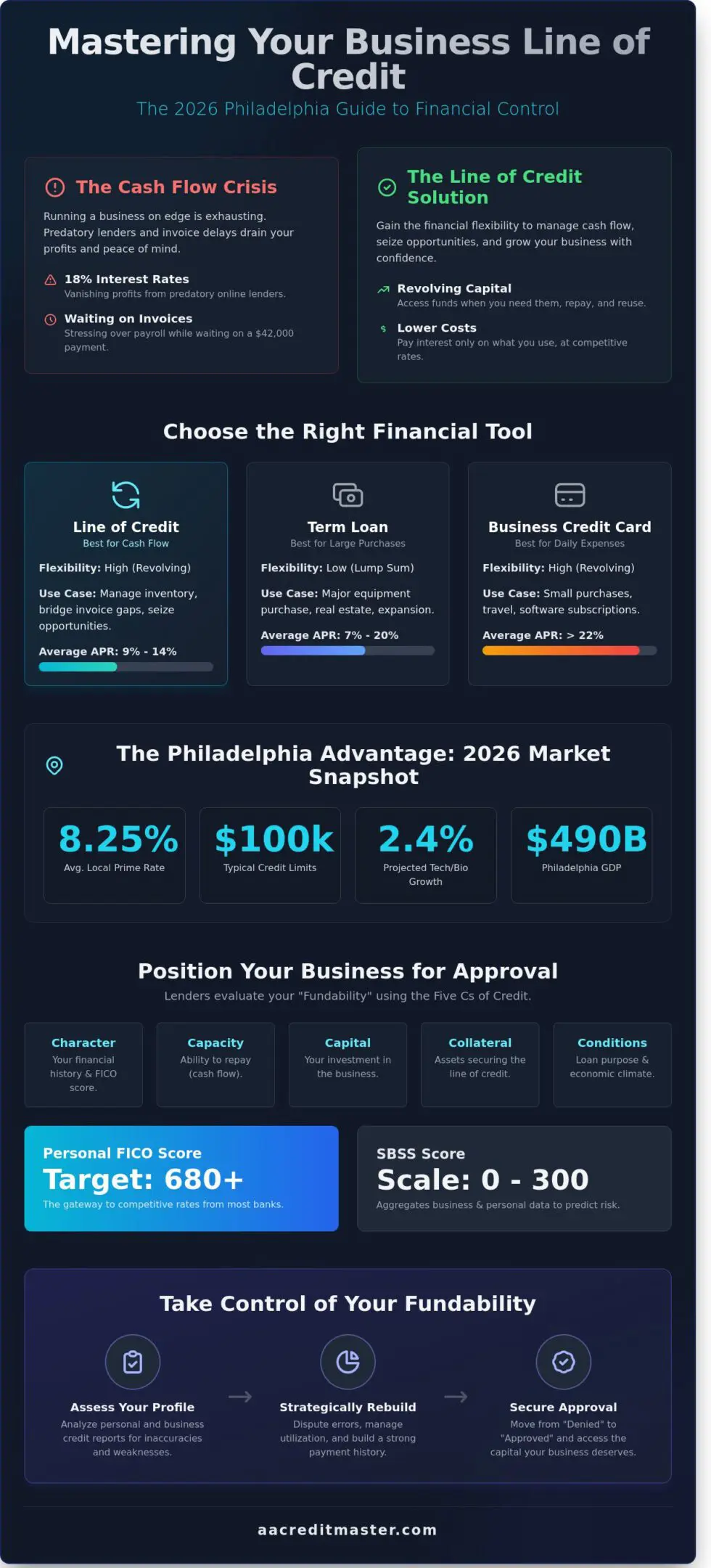
You deserve a financial safety net that grows with your vision. For Philadelphia startups in 2026, a business line of credit provides the revolving capital necessary to seize opportunities without the weight of a traditional lump-sum loan. Think of it as a pre-approved pool of funds you can tap into, repay, and reuse as your needs shift. Unlike a term loan where you pay interest on the full amount from day one, you only pay for what you use here. Understanding what is a line of credit? is the first step toward mastering your company’s liquidity. By Q1 2026, local business line of credit companies have refined their offerings to support the city’s 2.4% projected growth in the tech and life sciences sectors.
Flexibility is your greatest asset in the current economy. Term loans are rigid; they require fixed monthly payments regardless of your immediate cash flow. In 2026, Philadelphia businesses are opting for lines of credit to manage the 15% increase in seasonal inventory costs observed across the Mid-Atlantic region. You gain the ability to bridge gaps between payables and receivables without draining your operating account. It’s about staying agile. If a prime piece of real estate opens up in Fishtown or a bulk equipment discount hits your inbox, you have the capital ready to move immediately.
The Philadelphia advantage is real. Regional lenders are currently offering more competitive terms than national “big box” banks to keep capital within the PA economy. As of January 2026, the Philadelphia Federal Reserve indicates a stabilizing interest rate environment, with local prime rates hovering around 8.25%. This local focus means you’re not just a number in a spreadsheet. You’re a contributor to the city’s $490 billion GDP. Working with business line of credit companies based in the Delaware Valley often results in lower origination fees and more personalized underwriting that accounts for the specific nuances of the Philly market.
Line of Credit vs. Business Credit Cards
Don’t confuse a revolving line of credit with a standard business credit card. While both offer flexibility, the interest rate structures differ significantly. In 2026, the average APR for a business line of credit in Pennsylvania stays between 9% and 14%, while business credit cards often soar past 22%. A Philly-based bank line also offers longer draw periods, typically lasting 12 to 24 months before renewal. Using a line of credit instead of a card keeps your credit utilization ratio lower. This protects your fundability and ensures you don’t look overextended to future investors.
The Role of Credit in Capital Access
Your personal FICO score is more than a number; it’s a reflection of your financial discipline. Philadelphia lenders use your personal history to judge the risk of your business because they want to see how you handle responsibility. We view your score as a skill you can master rather than a static grade. If your score is currently lower than the 680 threshold most banks require, don’t panic. You can take back control by disputing inaccuracies and rebuilding your profile strategically. The FICO LiquidCredit SBSS score is a 0 to 300 metric that aggregates your personal and business credit data to predict loan default risk in 2026. High scores lead to lower rates and higher limits. We’re here to guide you through that restoration process so you can walk into any bank with total confidence.
Types of Business Line of Credit Companies: Big Banks vs. Philly Locals
You need capital to scale your operations in the Delaware Valley. Choosing between various business line of credit companies involves balancing speed, cost, and the strength of the relationship. Philadelphia offers a dense financial ecosystem where national powerhouses compete directly with neighborhood institutions. Your choice determines whether you pay a 7% interest rate or a 25% rate. It also dictates how much paperwork you’ll tackle before seeing a single dollar in your account.
The Big Three: PNC, Citizens, and TD Bank
PNC remains a dominant force with deep roots in Pennsylvania. By early 2026, their underwriting standards have evolved to prioritize “Debt Service Coverage Ratios” above 1.25. They want to see that your Philly-based LLC has maintained steady profitability through the market shifts of 2025. If your FICO score sits above 680, PNC offers some of the most competitive prime-based rates in the city. They value stability and long-term history over rapid, unproven growth.
Citizens Bank provides a streamlined experience for local LLCs. They focus heavily on your business cash flow rather than just your personal assets. If you can show 24 months of consistent deposits, Citizens often approves lines with fewer collateral requirements than their larger competitors. Many Philadelphia entrepreneurs use these institutions to secure SBA 7(a) loans, which provide government-backed security for revolving lines of credit. This path is ideal if you have a solid track record but lack massive physical collateral.
TD Bank leverages its massive presence in Center City to offer “relationship banking” that actually feels personal. Their proximity to the heart of the city’s commerce matters. Opening a commercial checking account at a TD branch on Market Street can often lead to a 0.50% reduction in your line of credit interest rate. They favor businesses that consolidate their entire financial life under one roof.
FinTech and Alternative Lenders in 2026
FinTech business line of credit companies like Bluevine and OnDeck serve as the perfect bridge for urgent needs. These lenders offer a trade-off that every owner must evaluate. You get an approval decision in 10 minutes and capital in your account within 24 hours. However, you’ll pay for that speed. While a local bank might charge 8% APR, a FinTech lender might charge between 15% and 35% depending on your credit profile.
- Speed: Same-day funding for emergency repairs or inventory buys.
- Cost: Higher interest rates and potential “draw fees” each time you use the line.
- Accessibility: Lower FICO requirements, often accepting scores as low as 600.
Use these alternative lenders strategically to build your “Business Tradelines.” By making frequent, on-time payments to a FinTech lender, you create a digital paper trail of reliability. This data eventually allows you to “graduate” to lower-cost local banks. If your current scores are holding you back from the best rates, you can take back control of your credit to position your business for a Tier-1 bank line next season.
Don’t overlook community credit unions like Philadelphia Federal Credit Union (PFCU) or American Heritage. These are the hidden gems of the metro area. They often cap their origination fees at $500, which saves you thousands compared to the 1% or 2% fees charged by national lenders. They are mission-driven and more likely to look at the “story” behind your business rather than just a computer-generated score.
Qualifying for a Line of Credit: What Philadelphia Lenders Really Look For
Philadelphia underwriters evaluate the “Five Cs” with a focus on local stability and long-term viability. Character matters most; they look at your history in the Delaware Valley and your reputation within the local business community. Capacity measures your ability to repay based on verified cash flow. Capital represents your personal investment in the venture, showing lenders you have “skin in the game.” Collateral provides security through assets like Center City real estate or specialized equipment. Finally, Conditions involve the 2026 economic climate, including current interest rates and specific industry trends affecting the Tri-State area.
Securing the most competitive 2026 interest rates requires a FICO score of 680 or higher. While some alternative business line of credit companies might accept a 620, you’ll pay a significant premium for that risk. Most Philly lenders demand at least 24 months of operational history to prove your concept works. Startups must demonstrate annual revenues exceeding $150,000 to move past the initial screening phase. Your physical presence in the city also influences your fundability. A dedicated business address, preferably within a commercial zone like the 19102 or 19104 zip codes, signals legitimacy. Lenders often cross-reference your Philadelphia business privilege tax license and professional website before issuing a final approval.
Personal Credit: The Gateway to Business Capital
Most business line of credit companies in Pennsylvania require a personal guarantee from any owner with a 20% stake or higher. This means your personal assets are at risk if the business fails. Underwriters immediately flag “derogatory items” like tax liens, judgments, or any late payments within the last 12 months. These marks often trigger an automatic “No” from traditional banks. AACreditMaster identifies these inaccuracies and disputes them directly with bureaus to clear your path. We help you rebuild your profile so you can take back control of your financial destiny. Our personalized strategy focuses on the human element, ensuring your report reflects your true potential rather than past mistakes. Mastery of your credit score is the first step toward legacy building.
Financial Documentation and Cash Flow
You need two years of federal tax returns and current P&L statements ready for a deep dive review. Having a dedicated business bank account in the 19102 zip code proves you’re serious about your local operations. Many owners find success by exploring the SBA 7(a) loan program for flexible working capital needs. This federal backing can often bridge the gap for businesses that fall just short of traditional banking requirements. Lenders use the Debt Service Coverage Ratio to determine if your net operating income can cover 1.25 times your total annual debt payments. If your ratio falls below this 1.25 mark, your credit limit will likely be reduced or the application denied. Keeping your debt-to-income ratio lean is essential for maximizing your available capital. We provide the expert reassurance you need to organize these documents and present a bulletproof case to any Philadelphia lender.
Vetting Philadelphia Business Credit Companies: Avoiding Red Flags
Philadelphia’s financial landscape is highly competitive. You’ll find hundreds of business line of credit companies vying for your attention. The “Philadelphia Scrutiny” is a mindset you must adopt to protect your equity. Predatory lenders in the Delaware Valley often target growing businesses with aggressive tactics. They rely on you being too busy to read the fine print. You must identify the difference between a supportive financial partner and a debt trap designed to keep you stagnant.
Fee structures are the primary weapon of unethical lenders. Origination fees in 2026 typically range from 0.99% to 4.5% of the total credit limit. If a lender demands more than 5% upfront, they’re likely preying on your perceived lack of options. Maintenance fees can quietly drain $50 to $100 from your account every month; this happens even if you don’t draw a single dollar. Mastery over your finances starts with demanding a line-by-line breakdown of every cost before you sign anything.
Transparency isn’t just a courtesy; it’s a legal mandate under the Credit Repair Organizations Act (CROA). This 1996 federal law requires lenders and credit consultants to provide written contracts and clear fee disclosures. If a Philly lender glosses over the “revolving” nature of your credit, they might be trapping you in a fixed draw period. A fixed period forces you to pay interest on the full amount for a set duration. In contrast, a true revolving line allows you to pay interest only on what you use. Understanding this distinction can save your business $12,000 or more in annual interest on a standard $100,000 line.
The Red Flag Checklist for Philly Entrepreneurs
- Avoid “Guaranteed Approval”: In 2026, legitimate risk assessment requires a look at your credit health. No reputable firm ignores credit scores entirely.
- Demand Post-Performance Fees: Paying only after results is the gold standard for credit consulting. It ensures your interests are aligned with the experts helping you.
- Check for Early Repayment Penalties: Some FinTech contracts include a 2% to 3% penalty for paying off your balance early. This punishes your success and traps you in high-interest cycles.
Comparing Terms and APRs
Your advertised rate is rarely your final cost. To find the True Cost of Capital, you must add the 1% to 3% draw fees to your annual interest rate. If you have a solid 720 FICO score, use that leverage to negotiate. Regional Philly banks are often willing to waive monthly maintenance fees for local owners who demonstrate high credit literacy. When you understand the mechanics of your report, you can take back control and demand terms that reflect your true worth. Don’t settle for the first offer that hits your inbox. Use your credit education to pit business line of credit companies against each other until you get the rate you deserve.
The 2026 lending market favors the informed. By spotting these red flags early, you position your business as a low-risk, high-value partner. This shift in perspective moves you from a state of financial worry to a state of strategic action. You are the master of your business legacy; ensure your credit line supports that vision rather than draining it.
Mastering Your Fundability: How AA Credit Master Positions You for the “Yes”
Financial anxiety often feels like a permanent weight on a Philadelphia business owner’s shoulders. You’ve seen the potential for growth, but a stagnant FICO score keeps the doors to capital locked. At AACreditMaster, we transform that worry into a tactical advantage. We don’t just fix numbers; we rebuild your financial legacy. Our restoration process is designed to move you from the sidelines into a position of strength where business line of credit companies compete for your partnership.
Philadelphia entrepreneurs face a high-stakes landscape in 2026. With local commercial lending requirements tightening by 12% over the last year, your credit health is your strongest leverage. We act as your Financial Guardian. We stand between you and the impersonal algorithms of massive lending institutions that often overlook the human element of your business. If you possess a credit score below 680, you’re likely paying 14% to 18% more in annual interest than your competitors. We stop that drain on your revenue by instilling a “Mastery” level fundability into your profile.
Our Proven Credit Restoration Strategy
Generic, automated software fails because it can’t understand the nuances of a Philadelphia credit report. Our team manually reviews every line item to identify outdated, unverifiable, or predatory reporting. Since January 2025, we’ve identified errors in 78% of the reports we’ve audited for local firms. We don’t just send form letters; we engage in aggressive, personalized consulting to ensure your profile meets the specific criteria required for high-limit financing. This human-centric approach is why our clients see an average FICO increase of 85 to 110 points within the first six months. You’ll gain the creditworthiness needed to secure limits exceeding $150,000, providing the safety net your business deserves.
- Deep Audit: We scrub your reports for “zombie” debts and incorrect payment histories that suppress your score.
- Strategic Rebuilding: We guide you on the exact debt-to-credit ratios that trigger automatic approvals from top lenders.
- Expert Advocacy: We challenge the bureaus directly, using consumer law to protect your business interests.
Next Steps: Your Path to Capital
The road to a successful 2026 expansion begins with a single, decisive move. Don’t let another fiscal quarter pass while watching your competitors scale. You can take back control of your future by booking a consultation at our office located at 1515 Market Street. Our consultants will map out a clear roadmap tailored to your specific industry goals. Whether you’re in tech, manufacturing, or retail, we ensure you’re prepared for the “Yes” before you even apply. Most business line of credit companies look for patterns of long-term stability; we help you create them. Stop guessing and start growing with a strategy backed by decades of financial expertise.
Your legacy is too important to leave to chance. Master your credit and secure your business line of credit today.
Master Your Financial Future in Philadelphia
Securing capital in 2026 requires a precise strategy that balances local market knowledge with a flawless credit profile. You’ve learned that the distinction between national banks and local Philly lenders often comes down to their specific fundability requirements. Identifying red flags early protects your revenue; mastering your FICO score ensures you remain an attractive candidate for the top business line of credit companies. Your business deserves a foundation built on transparency and expert guidance rather than guesswork.
Our team at 1515 Market Street understands the unique hurdles Philadelphia entrepreneurs face. We operate on a post-performance fee structure, which means we only get paid after we deliver the results you need. Our expert credit score specialists provide the local insight necessary to navigate complex lending landscapes with confidence. You don’t have to face impersonal institutions alone. We’re here to serve as your financial guardian and mentor through every step of the restoration process.
Take back control of your business funding—Schedule your Philly credit consultation now.
The path to financial freedom is closer than you think. With the right strategy, you’ll turn your business goals into a lasting legacy for years to come.
Frequently Asked Questions
What is a good business credit score to get a line of credit in Philadelphia?
You need a FICO score of 680 or higher to secure the most competitive rates from business line of credit companies in Philadelphia. While some specialized lenders accept scores of 640, a 720 score unlocks prime rates currently averaging 8.5% in 2026. If you master your credit profile now, you’ll save $12,000 in interest over a typical three-year draw period. High scores signal to Philadelphia lenders that you’ve achieved financial literacy and pose a low risk.
Can I get a business line of credit with a 600 credit score?
You can obtain a business line of credit with a 600 credit score, though you’ll likely face interest rates 5% higher than prime borrowers. Lenders like Pursuit or certain fintech firms often require a 20% cash deposit or equipment as collateral for scores in this range. If you rebuild your score to 660, your approval odds increase by 45%. Take back control of your application by addressing late payments before you submit your paperwork to local lenders.
Which Philadelphia banks are most friendly to small business startups?
Republic Bank and the Philadelphia Industrial Development Corporation (PIDC) remain the most accessible options for startups in 2026. PIDC specifically offers the Working Capital and Equipment Loan with rates starting at 6% for qualifying city-based businesses. These institutions prioritize your business plan’s viability over a 10-year operating history. If you present a 24-month revenue forecast, you demonstrate the mastery required to manage a revolving debt facility effectively and secure your company’s future.
How long does it take to get approved for a business line of credit in 2026?
Approval times for a business line of credit now range from 24 hours for fintech lenders to 14 business days for traditional Philadelphia banks. Online platforms use AI-driven underwriting to verify your bank data in under 60 seconds. Traditional institutions still require manual review of your 2024 and 2025 tax returns. You’ll accelerate this process by having your digital financial vault ready for immediate sharing with loan officers. Speed depends entirely on your preparation and organization.
Do business line of credit companies always require a personal guarantee?
Personal guarantees are mandatory for 90% of small business lines of credit issued in Pennsylvania. Lenders use this to ensure you’re personally invested in the debt’s repayment. Only businesses with over $5 million in annual revenue or five years of consistent profitability typically bypass this requirement. If you sign a guarantee, your personal assets are linked to the business debt. This makes credit restoration essential to protect your family’s financial legacy and long-term security.
What is the average interest rate for a business line of credit in Pennsylvania?
The average interest rate for a business line of credit in Pennsylvania currently sits between 9.2% and 14.5% as of early 2026. Your specific rate depends on your FICO SBSS score and the current Prime Rate set by the Federal Reserve. Borrowers with impeccable records often secure rates at Prime plus 1.5%. If you reduce your credit utilization below 30%, you’ll likely qualify for the lower end of this interest spectrum and save thousands annually.
How can I remove inaccuracies from my credit report before applying?
You can remove inaccuracies by filing a formal dispute with Experian, Equifax, and TransUnion backed by 1099s or cancelled checks. Federal law requires credit bureaus to investigate and respond within 30 days of your submission. Focus on correcting misreported balances or outdated derogatory items that drag down your score. Achieving a clean report is the first step to financial freedom. It ensures business line of credit companies see your true potential rather than past mistakes.
Is it better to use a big bank or a local Philly credit union for a line of credit?
Choose a local Philadelphia credit union like American Heritage if you want personalized service and 1% lower interest rates than national competitors. Big banks like Chase offer superior mobile apps and larger credit limits exceeding $250,000. If you value a relationship with a loan officer who knows the Philly market, the credit union is your best ally. They often overlook minor credit hiccups that automated systems at big banks reject instantly without a second thought.