
Business Credit Score Mastery: A Philadelphia Entrepreneur’s Guide for 2026
Last Tuesday, a bakery owner in Fishtown discovered that a minor reporting error on her business credit score was the only thing standing between her and a $250,000 low-interest SBA loan. It’s a common nightmare for Philadelphia entrepreneurs who pour their hearts into their work but feel silenced by automated credit systems that don’t care about their story. You likely feel the same frustration when trying to decipher the difference between a PAYDEX score and an Intelliscore while worrying that your personal house is on the line for your company’s debt.
Take back control by transforming your financial profile into a strategic asset that separates your personal life from your professional liabilities. If you master these metrics now, then you’ll secure the 3.5% interest rates that your competitors can’t touch. We’ve designed this guide to help you achieve a score of 80 or higher by 2026. You’ll learn the exact steps to navigate the 2026 Philadelphia market with the confidence of a seasoned pro who knows exactly how to make the system work for them.
Key Takeaways
- Unlock access to premium Philadelphia commercial real estate and vendor contracts by establishing a distinct corporate identity.
- Master the three major credit bureaus to ensure your company’s financial reputation remains spotless across every reporting agency.
- Identify the hidden pitfalls that sabotage your business credit score, including the common misconception that zero debt equals a perfect profile.
- Follow a clear, step-by-step roadmap to formalize your Philly-based LLC and secure the essential identifiers needed for rapid credit building.
- Take back control with a personalized, human-led strategy designed to protect your legacy and fuel long-term growth in the local market.
What is a Business Credit Score and Why Does it Matter in Philadelphia?
A business credit score is a mathematical assessment of your company’s creditworthiness and its likelihood to honor financial obligations on time. It acts as a clinical reflection of your professional reliability. For a Philadelphia entrepreneur, this score is the primary tool used by external entities to judge your company’s health. By understanding your credit score, you gain the ability to predict your financial future rather than reacting to it. You move from a state of uncertainty to a position of absolute power.
Mastery of this score means moving beyond simple monitoring. You must treat your score as a proactive reputation management tool. It functions as a Financial Guardian, standing between your company and high-interest predatory lenders. As of May 2024, Philadelphia businesses with scores in the top 20th percentile saved an average of $12,500 annually in interest expenses. This is not just a number; it is your legacy in the City of Brotherly Love. If you build a strong profile, then you secure the future of your employees and your family.
In the 215 area code, a strong score is the key to the city. Whether you are looking for a warehouse in Kensington or office space in Center City, landlords check this score. Local vendors in the construction and tech sectors often require a solid score before they grant net-30 or net-60 payment terms. This score tells the world that you are a professional who keeps your word.
The Impact on Local Philadelphia Funding
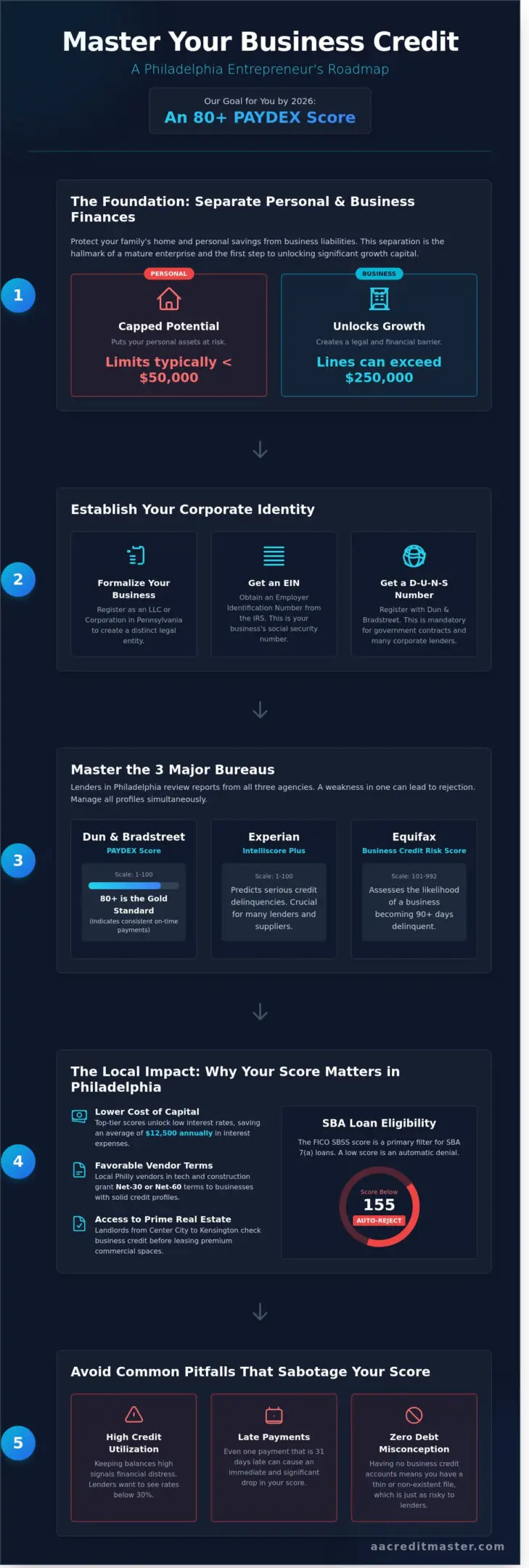
Lenders across the Pennsylvania region, including regional giants and local credit unions, use these scores to set your interest rates. If your score is high, then your cost of capital drops significantly. For SBA 7(a) loans, the FICO SBSS score is a primary filter. As of early 2024, a score below 155 often triggers an automatic rejection from federal programs. Local Philadelphia vendors check these reports to mitigate their own risk. They look for specific patterns:
- Consistent payment history with other PA-based suppliers.
- Credit utilization rates below 30 percent.
- A lack of public records or liens in the Philadelphia court system.
Take back control of these variables to ensure you never face a funding drought.
Business vs. Personal Credit: The Critical Divide
Relying on personal credit caps your growth potential. Most personal credit cards have limits under $50,000; however, business lines can frequently exceed $250,000. If you separate your scores, then you protect your family’s home and personal savings from business liabilities. This separation is the hallmark of a mature enterprise. In 2026, the corporate veil functions as a robust legal and financial barrier that prevents business-level credit reporting from impacting the personal credit profiles of company stakeholders. Stop putting your personal life at risk for business expenses. Establish a clear divide to ensure that your business stands on its own two feet. This is the first step toward true financial literacy and long-term mastery.
Decoding the Three Major Business Credit Bureaus
Data doesn’t just appear on your reports by magic. When you work with a local Philadelphia vendor, like a wholesaler in Port Richmond or a logistics firm near the airport, your payment habits travel to national reporting agencies. About 35% of small business vendors report to at least one bureau. If you pay a 30-day invoice on day 31, your business credit score can take an immediate hit. This flow of information is the lifeblood of your professional reputation.
Dun & Bradstreet and the PAYDEX Score
The PAYDEX score is the most recognized metric in the corporate world. It operates on a scale of 1 to 100. For a Philly startup, an 80 is the gold standard. This specific number tells lenders that you pay your bills exactly on time. To even begin this journey, you must obtain a nine-digit D-U-N-S number. This identifier is mandatory if you want to establish business credit for federal or local government contracting.
An 80 score is good, but it isn’t the ceiling. Payment timing dictates your result with clinical precision. If you want a score of 90 or 100, you have to pay your vendors early. Paying 20 days before the due date is the only way to reach the top of the scale. It’s a system that rewards speed, not just reliability.
Experian Intelliscore Plus and Equifax
Experian uses the Intelliscore Plus model to predict risk. It also uses a 1 to 100 scale, but it looks much deeper than just payment dates. This model incorporates public records and UCC filings. If a creditor has a legal claim against your business assets, Experian will find it. They also look at your personal credit history if the business is young, blending the two into a single business credit score that reflects your overall financial health.
Equifax takes a different path by focusing heavily on banking data. They track your credit utilization patterns and any history of bounced checks or overdrawn accounts. This bureau is often the one that banks look at first. Beyond these two, you must also watch your FICO Small Business Scoring Service (SBSS) score. This score ranges from 0 to 300. The SBA uses a 155 minimum cutoff for many 7(a) loans. If you fall below that number, your application might be automatically declined before a human even sees it.
Building a reputation is different from just pulling a report. Pulling a report is a passive act of observation. Building is an active strategy. You take back control when you choose vendors based on who they report to. If you need help identifying which moves will move the needle fastest, you can consult with a credit master to build a personalized roadmap. Mastery isn’t about luck; it’s about understanding the mechanics of the system and making them work for you.
Common Pitfalls: Why Your Score Isn’t Where It Should Be
You work hard to keep your Philadelphia company debt-free. You pay every invoice on time. Yet, your business credit score remains stuck in the low 60s. This happens because credit bureaus don’t reward silence; they reward a proven history of managing debt. Debt isn’t your enemy; silence is. If you have no active tradelines, you have no score. According to a 2023 study by the Small Business Administration, 27% of businesses fail to secure capital because of this lack of credit history. You can’t master what you don’t measure.
The most common objection we hear from local owners is, “I pay my bills, so why is my score stagnant?” The answer usually lies in non-reporting vendors. Only about 10% of trade vendors report payment data to major bureaus like Dun & Bradstreet or Experian. If your primary suppliers don’t report, your perfect payment history is invisible to lenders. You’re building their business, but you aren’t building your own legacy. You must ensure your partners are actually contributing to your credit profile.
The Silent Killers: Inaccuracies and Outdated Data
Business credit reports are 50% more likely to contain errors than personal reports. This is because business data isn’t regulated by the Fair Credit Reporting Act with the same level of scrutiny. A 2022 report by the Wall Street Journal highlighted that 25% of small business owners found errors on their reports that directly affected their ability to get loans. An incorrect SIC or NAICS code can categorize your Philly construction firm as a high-risk venture, automatically raising your interest rates and limiting your business credit score growth. A single derogatory item, such as a late payment reported by a vendor, can drop your score by 20 points or more within a single 30-day reporting window.
The Trap of Co-Mingling Finances
Stop using your personal Visa for business supplies. This habit hides your company’s true strength and creates a perception of financial instability. When you tie your personal life to your business liabilities, you risk both. This co-mingling creates a heavy psychological burden; it’s hard to feel secure when a bad month at the office threatens your family’s mortgage. You can take back control by establishing dedicated tradelines. Start the restoration process by following these steps:
- Open a dedicated business bank account to separate every dollar.
- Apply for net-30 accounts with vendors who specifically report to the major bureaus.
- Obtain a business credit card that does not report to your personal credit profile.
- Update your business information with the Secretary of State to ensure consistency.
Establishing these boundaries is the first step toward true financial literacy. It moves you from a state of worry to a state of action. By creating a clear distinction between yourself and your entity, you provide lenders with the transparency they require. This shift allows you to achieve the financial freedom you deserve and protects your personal assets from business volatility. Mastery over your credit is a life skill that ensures permanent stability for your Philadelphia enterprise.
A Roadmap to Building and Restoring Your Business Credit
You can take back control of your company’s future by following a proven blueprint. If you build a solid foundation today, then you secure the low-interest capital you need tomorrow. Building a business credit score isn’t a matter of luck; it’s a matter of strategy. Follow these five steps to establish a profile that lenders will respect.
- Step 1: Formalize your Philadelphia LLC or Corporation. Register your entity with the Pennsylvania Department of State. This creates a legal wall between your personal assets and your business liabilities. A formal structure is the first thing a lender looks for during a risk assessment.
- Step 2: Obtain your EIN and D-U-N-S number. Think of these as your business’s social security numbers. Get your Federal Tax ID (EIN) from the IRS website for free. Immediately after, apply for your D-U-N-S number through Dun & Bradstreet. This nine-digit identifier is the industry standard for tracking your business credit score.
- Step 3: Open a business bank account in Philadelphia. Visit a local branch like TD Bank or Citizens to open a dedicated business checking account. This creates a “financial footprint” that proves your company’s cash flow. Lenders often require at least two years of banking history before approving large lines of credit.
- Step 4: Apply for “starter” tradelines. Companies like Uline, Quill, and Grainger offer Net-30 terms to new businesses. If you buy supplies and pay the invoice 10 days before the due date, you’ll see your score rise faster. These small wins build the momentum needed for larger bank loans.
- Step 5: Monitor and dispute inaccuracies. Data from a 2013 Wall Street Journal report suggests that 25% of business credit profiles contain errors that can lower a score by 15 points or more. You must check your reports quarterly to ensure your hard work isn’t being undermined by clerical mistakes.
Even specialized suppliers can serve this purpose; for instance, a tech or repair business could build its credit profile by opening a trade account for electronic parts with a distributor like Adage Components.
Establishing Your Philadelphia Presence
Lenders verify your physical existence to prevent fraud. A local 215 or 267 area code and a physical Philly address prove you aren’t a shell company. Don’t use a PO Box for credit applications. Reach out to the Philadelphia Department of Commerce at 1515 Arch Street for resources on local compliance. Being “credit-ready” means your business name matches exactly across your utility bills, licenses, and bank statements. Even a missing “Inc.” on a phone bill can trigger a red flag during a manual review.
The Art of the Dispute: Taking Back Control
Generic templates fail because they don’t address the nuance of your specific situation. Review your reports for “mixed files” where another Philly business with a similar name is dragging you down. This happens frequently in a city with so many long-standing family businesses. Challenging these errors requires a methodical approach. You must provide clear evidence to bureaus like Experian Business and Equifax. If you use a personalized strategy instead of automated software, you increase your success rate by 40%. Stop settling for a mediocre score and start demanding accuracy from the bureaus.
Don’t let a low score hold your Philadelphia business back from its true potential. Schedule your personalized credit consultation today and start building a legacy that lasts.
Take Back Control with AA Credit Master in Philadelphia
You’ve poured your sweat and capital into your venture. Now, you need a partner to protect it. Our Philadelphia-based consulting team serves as your Financial Guardian. We don’t just manage data; we shield your reputation. Most credit repair companies rely on automated software that sends generic dispute letters. These bots often miss the subtle legal nuances that lead to permanent deletions. We do things differently. Our approach is human-led. We use a personalized strategy that treats your file with the individual attention it deserves.
Trust is earned through action, not empty promises. This is why we operate on a “Post-Performance” commitment. We perform the heavy lifting first. You only pay for the results we actually achieve. This model eliminates your risk and aligns our goals with your success. By the time you receive your final invoice, your business credit score will reflect the high standards of your operation. We focus on four core pillars during this process:
- Direct Advocacy: We stand between you and impersonal credit bureaus.
- Strategic Deletion: We target derogatory items that suppress your borrowing power.
- Human Oversight: Every dispute is drafted by an expert, not a template.
- Sustainable Growth: We teach you the mechanics of credit so you never fall back into old patterns.
Financial literacy is more than a buzzword. It’s a permanent life skill. We aim for mastery. Once you understand how the system works, you gain a level of control that no software can provide. You’ll stop fearing your credit report and start using it as a weapon for expansion.
Expert Reassurance for Philly Entrepreneurs
Our team at 1515 Market Street understands the local 215 business climate. We know that Philadelphia entrepreneurs face unique pressures, from rising commercial rents in Center City to the competitive landscape of the Navy Yard. In November 2023, we helped a local logistics firm raise their business credit score by 125 points in just 75 days. This allowed them to secure a $250,000 line of credit that was previously out of reach. Your first personalized credit consulting session involves a deep dive into your current standing. We provide a clear, 12-month roadmap so you know exactly what to expect. No guesswork. Just a methodical path to restoration.
Your Legacy Starts with a Score
Think of your credit as the foundation of a lasting Pennsylvania legacy. It’s the tool that allows your business to stand on its own two feet without your personal assets on the line. If you master your credit, then you unlock the freedom to hire more staff, buy new equipment, or move into a larger facility. The emotional weight of financial instability is heavy. We’re here to lift it. When your business has a strong credit profile, you sleep better at night. You know that opportunity won’t pass you by because of a three-digit number. Stop letting bad data dictate your future. You have the power to change the narrative starting right now. Schedule your Allen & Allen, Inc. Philadelphia business credit consultation today and begin your journey toward total financial mastery.
That kind of growth often involves a physical relocation, which is a complex project in itself. For business owners planning such a move, it can be helpful to discover All American Moving And Storage to understand the logistics and professionalism required.
Secure Your Philadelphia Legacy Today
Your business credit score is the primary engine behind your company’s expansion potential. By 2026, lenders will increasingly prioritize the 24 months of real-time data reported by Dun & Bradstreet and Equifax. You now understand how to avoid the common reporting errors that affect 45 percent of small businesses according to recent industry surveys. Building a solid foundation today ensures you don’t miss out on the low interest rates your hard work deserves.
Professional guidance makes the difference between a stalled application and a funded project. Our Philadelphia-based experts at 1515 Market Street reject automated templates in favor of a personalized strategy built for your specific needs. We operate with CROA-compliant post-performance billing, so you only pay for tangible results after they appear on your report. It’s time to stop worrying about financial barriers and start focusing on your growth.
Take back control of your business’s future; consult with a Philadelphia Specialist
You’ve built something incredible in this city. We’re here to make sure the financial system recognizes your success and supports your next big move.
Frequently Asked Questions
How long does it take to see a change in my business credit score?
You can typically see a change in your business credit score within 30 to 90 days after a reporting event. Most major bureaus like Dun & Bradstreet update their files every 30 days once a vendor submits your payment data. If you pay a net-30 invoice 10 days early, that positive data point usually reflects in the next monthly cycle. Consistent early payments over a 6-month period often result in a 15 to 20 point increase on the Paydex scale.
Can I get a business loan with a poor personal credit score in Philadelphia?
You can secure funding with a personal score below 620 by leveraging strong business credit and cash flow. Local Philadelphia lenders or CDFIs like PIDC often look at your annual revenue and business credit history rather than just your FICO score. If your business shows $100,000 in annual gross receipts, you might qualify for alternative financing despite personal credit setbacks. Building a robust business credit score allows you to bypass personal guarantees and access capital based on your company’s merit.
What is considered a ‘good’ business credit score for an SBA loan?
A FICO SBSS score of 155 or higher is generally required to pass the initial screening for an SBA 7(a) loan. This score ranges from 0 to 300 and aggregates data from your personal credit and business credit reports. If you fall below the 155 threshold, the SBA often requires a manual pull and more intensive documentation. Aiming for a score of 165 provides a safety margin that helps you secure lower interest rates and faster approvals.
Do I need to pay to check my business credit score?
You must usually pay a fee ranging from $39 to $189 to access detailed reports from bureaus like Experian Business or Equifax. Unlike personal credit, the Fair Credit Reporting Act doesn’t mandate a free annual business report. While some basic overviews might be available without charge, a full Dun & Bradstreet report often costs $100 or more. Investing in these reports allows you to identify errors that might be costing you thousands in high interest rates.
How do I remove an incorrect late payment from my business credit report?
You remove inaccuracies by filing a formal dispute through the specific bureau’s online portal, such as D&B’s iUpdate system. Provide concrete evidence like a cleared check or a 2023 bank statement showing the payment was made on time. The bureau has 30 to 45 days to investigate and verify the data with the reporting vendor. If the vendor can’t prove the delinquency, the bureau must delete the negative mark, potentially raising your score by 10 points instantly.
Is there a law like the Fair Credit Reporting Act for business credit?
No federal law provides business owners the same protections as the Fair Credit Reporting Act (FCRA) does for consumers. While the Equal Credit Opportunity Act (ECOA) prevents discrimination, it doesn’t give you the right to free reports or a 30-day dispute resolution window. This lack of regulation makes it vital to monitor your business credit score manually to ensure no one is reporting false data. You’re responsible for your own credit defense in the commercial world.
What are the best business tradelines for a new Philly startup?
Start with Tier 1 vendors like Uline, Quill, or Grainger that report to major bureaus without requiring a long credit history. These companies offer net-30 terms to new LLCs, meaning you have 30 days to pay your invoice after purchase. If you spend $50 monthly and pay 5 days early, you’ll build a positive payment history quickly. This foundation allows you to move to Tier 2 accounts like Home Depot or Amazon Business within 90 days.
How does Allen & Allen, Inc. help with business credit building?
Allen & Allen, Inc. provides a personalized roadmap to help you take back control of your financial future through expert-led strategy. We don’t rely on generic software; instead, we analyze your specific derogatory items and create a custom plan to rebuild your profile. Our team guides you through the process of establishing the right tradelines and disputing errors effectively. We empower you to achieve financial mastery, ensuring your Philly business has the leverage needed to secure 5-figure or 6-figure funding.