
How to Feel Confident Applying for Credit: A Philadelphia Guide to Financial Mastery
What if the notification of a credit pull felt like a victory lap instead of a heart-stopping moment of anxiety? According to 2023 industry data, nearly 35% of consumers struggle with subprime credit scores, leading many to wonder how to feel confident applying for credit when their history feels like a liability. You likely worry that a single hard inquiry will tank your fragile score or that a forgotten derogatory item from three years ago will suddenly resurface to sabotage your goals. It’s exhausting to feel like you’re at the mercy of impersonal credit bureaus.
We’re here to change that narrative. You will shift from anxiety to authority by replacing guesswork with a clinical, step-by-step mastery of your financial profile. If you follow this professional blueprint, then you can secure the lower interest rates you deserve and walk into any Philadelphia lender’s office with absolute peace of mind. This guide provides a definitive pre-application checklist and a strategy to navigate conflicting FICO models so you can finally take back control of your financial legacy.
Key Takeaways
- Conquer “Credit Anxiety” and learn how to navigate Philadelphia’s competitive financial landscape with the authority of a seasoned pro.
- Decode the “5 Cs of Credit” to understand the specific data points lenders prioritize and position your profile for immediate approval.
- Discover how to feel confident applying for credit by performing a clinical audit of your reports to catch the errors that hold 1 in 5 applicants back.
- Follow a 90-day strategic checklist to optimize your credit utilization and reach the mastery level required for the best interest rates.
- Transition from simple repair to true financial mastery with expert reassurance, taking back control of your future and your legacy.
Understanding Credit Anxiety: Why Philadelphia Residents Hesitate
Credit anxiety is a psychological wall that blocks your path to financial growth. It’s the heavy feeling in your chest when you click “submit” on a loan application. For many in Philadelphia, this fear stems from a history of derogatory items or past rejections that still feel fresh. This anxiety turns a simple financial process into a source of deep stress. You aren’t just worried about a number; you’re worried about your future stability.
Philadelphia’s cost of living increased by 4.2% in 2023, making access to affordable capital more than a luxury. It’s a necessity. If you can’t access credit, you pay more for everything from car insurance to utility deposits. Past financial trauma, like a 2019 medical debt or a late payment from three years ago, often dictates your current choices. You stop trying because you expect a “no.” Learning how to feel confident applying for credit starts with moving from guessing to knowing. By understanding your credit score and the specific data points lenders track, you replace fear with a calculated strategy.
The Cost of Rejection in the Philly Market
A single denial carries a heavy price tag in competitive neighborhoods. In areas like Fishtown or Center City, where median rents reached $1,650 in late 2023, a low FICO score can disqualify you from the best housing overnight. Each hard inquiry can drop your score by 5 to 10 points. If you apply without certainty, you risk a downward spiral of lower scores and higher interest rates. For local entrepreneurs, this lack of confidence stalls business expansion and kills job creation before it starts.
Shifting from Victim to Master
You must abandon the “hope they say yes” mindset to achieve true financial freedom. Mastery is the only permanent solution to credit anxiety. When you embrace credit education, you stop being a victim of the bureaus and start building a lasting legacy. You don’t have to face these impersonal institutions alone. A Financial Guardian acts as your professional ally, standing between you and the creditors to ensure your rights are protected. If you follow a proven roadmap, then approval becomes a mathematical certainty rather than a stroke of luck. Take back control of your financial narrative today.
The Anatomy of an Approval: What Lenders Really See
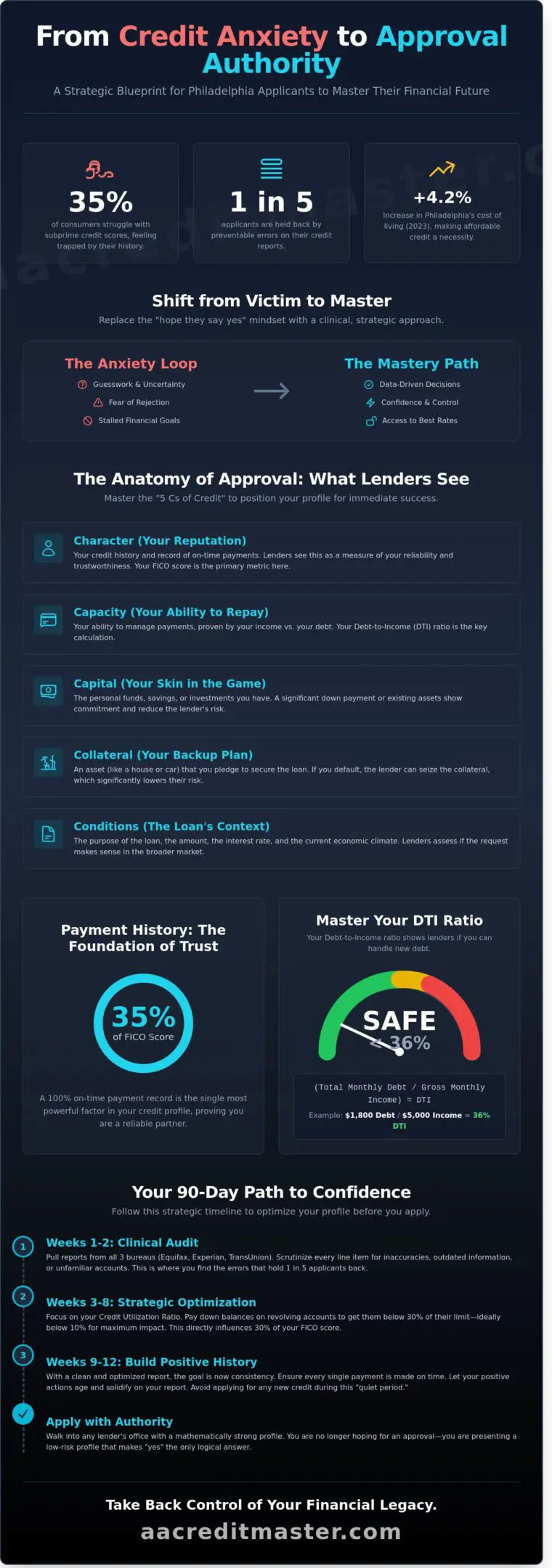
Clicking the “Submit” button on a loan application often feels like a gamble. It isn’t. Lenders use a structured, predictable framework to evaluate your risk level long before a human ever looks at your file. Understanding what lenders look for through the “5 Cs of Credit” changes the game. This framework includes Character, Capacity, Capital, Collateral, and Conditions. By viewing your finances through these five lenses, you can predict an approval before you even apply.
In Philadelphia, where the median household income is approximately $57,537, local lenders look closely at how your specific income aligns with regional living costs. While you might track a VantageScore on free apps, 90% of top lenders prioritize your FICO score. This algorithm scans for derogatory items from the last 7 years and weighs your credit mix heavily. Knowing the math behind the curtain is how to feel confident applying for credit because it removes the mystery from the process.
Capacity and Debt-to-Income (DTI) Ratios
Your Debt-to-Income (DTI) ratio is the ratio of monthly debt payments to gross monthly income. Most Philadelphia banks prefer a DTI below 36%, though certain mortgage programs allow up to 43%. If you earn $5,000 monthly, keep your total debt obligations under $1,800 to stay in the “safe” zone. Calculate your own capacity by dividing your total monthly minimum payments by your pre-tax income. Mastering this calculation allows you to take back control of your financial narrative before a loan officer even opens your file.
Payment History: The Foundation of Trust
Payment history accounts for 35% of your total FICO score. A 100% on-time record is the ultimate confidence booster because it proves you are a reliable partner. If a life event caused a 30-day late payment in the last 24 months, you can often provide a “Letter of Explanation” to local loan officers to provide context. Consistent reporting over a 12 to 24 month period builds a legacy of stability that outweighs past mistakes. This proven track record is how to feel confident applying for credit even if your journey started with a few hurdles.
Auditing Your Credit Report: The Secret to Pre-Application Certainty
You cannot fix what you do not see. A landmark study by the Federal Trade Commission found that 20% of consumers had a significant error on at least one of their three credit reports. This means 1 in 5 people are being unfairly penalized by data entry mistakes or outdated information. If you want to know how to feel confident applying for credit, you must start by verifying the accuracy of your own records. You can learn how to get your free credit report from each of the three major bureaus; TransUnion, Equifax, and Experian; to begin your audit.
A “deep dive” audit involves more than just checking your FICO score. You need to scrutinize every line item for “zombie debt.” These are old, expired accounts that have passed the seven-year reporting limit but continue to haunt your profile because debt collectors have illegally re-aged them. If you find these outdated derogatory items, you have the right to demand their immediate removal. Wiping away a single 60-day late payment that shouldn’t be there can result in an immediate score increase, often by 20 points or more. This preparation ensures that when a lender pulls your file, they see a reflection of your true financial responsibility, not a collection of clerical errors.
Spotting Inaccuracies in Philadelphia Records
Philadelphia is a high-density urban environment where name mix-ups are surprisingly common. If you share a common surname with a neighbor in a large apartment complex or a row home block, their financial mistakes could end up on your report. Look for addresses you have never lived at or accounts you didn’t open. These are often the first signals of identity theft. If you spot these red flags, you must act quickly to learn how to remove inaccuracies from credit report entries. Taking back control of your identity is the first step toward financial mastery.
The Dispute Process as a Confidence Tool
The Credit Repair Organizations Act (CROA) provides the legal framework for you to challenge any item that is inaccurate, incomplete, or unverifiable. Understanding your rights transforms the credit bureaus from intimidating gatekeepers into entities that are legally accountable to you. While generic dispute software often uses “cookie-cutter” templates that bureaus quickly flag and ignore, professional consulting offers a personalized strategy. If you use a human-led approach, then your disputes are backed by specific legal citations that demand attention. The typical restoration timeline takes 30 to 45 days per round of disputes. Aligning this process with your 6-month or 12-month application goals is the most effective way how to feel confident applying for credit. You aren’t guessing your chances; you are engineering your success.
Strategic Preparation: A 5-Step Checklist for Philly Applicants
Mastering your financial profile changes the power dynamic between you and the lender. When you follow a proven framework, you move from a position of uncertainty to one of total command. If you prepare correctly, then the approval becomes a mathematical certainty rather than a gamble. Follow this 5-step checklist to ensure your application stands out to Philadelphia lenders.
- Step 1: Pull and review all three credit reports 90 days before applying. Access your data from Equifax, Experian, and TransUnion. This 90-day window provides the necessary time to dispute errors or remove derogatory items before a lender sees them.
- Step 2: Optimize credit utilization to under 10%. While 30% is the standard ceiling, a 10% ratio signals elite financial management to local banks. Pay down your balances at least 30 days before your application date to ensure the bureaus report the lower balance.
- Step 3: Use pre-qualification tools to “soft-test” the market. Use digital tools that offer a soft-pull look at your eligibility. This helps you gauge your standing without the risk of a hard inquiry damaging your score.
- Step 4: Organize local residency and income documentation. Gather two years of W2s and your most recent 30 days of pay stubs. Lenders in the city prioritize stable local residency and consistent income.
- Step 5: Consult a Philadelphia credit score specialist for a final review. A professional eye can spot hidden traps in your file that automated software misses.
Timing the Philadelphia Market
Timing determines your interest rate. If you’re seeking a mortgage, the Philadelphia spring market often sees lenders offer competitive incentives to capture the seasonal surge. For personal lines of credit, end-of-quarter cycles in March and September are ideal as banks aim to meet specific lending quotas. Always observe a six-month “Credit Cooling” period between major applications. If you applied for an auto loan in January, wait until July for a credit card. This patience is how to feel confident applying for credit because it proves you aren’t desperate for liquidity.
Leveraging Local Resources
Philadelphia offers unique advantages for those who know where to look. Local credit unions often provide more flexible approval criteria than national institutions because they value your history as a community member. For those building a company, utilizing Philadelphia small business resources can bridge the gap between personal scores and commercial credit. A personalized strategy beats a generic algorithm every time. Understanding these nuances is how to feel confident applying for credit regardless of your past financial hurdles. You deserve a plan that accounts for your specific goals, whether that’s a rowhome in Fishtown or a storefront in Center City.
Take back control of your financial future today by scheduling your personalized credit strategy session with our expert team.
Master Your Financial Future: Why Expert Guidance Changes the Game
Credit repair is a temporary fix, but credit mastery is a permanent lifestyle. Most people view credit as a mysterious gatekeeper that randomly decides their fate. This perspective creates anxiety. At AA Credit Master, we shift that dynamic by replacing guesswork with precision. We don’t just dispute errors; we provide the expert reassurance you need to understand exactly how to feel confident applying for credit. Mastery means knowing your approval is a mathematical certainty before you even walk into a bank.
Philadelphia residents face a unique lending environment. Local credit unions and regional banks have specific risk appetites that differ from national giants. If you have a tailored roadmap, you can navigate these local nuances with ease. We move you from a state of fear, where you worry about rejection, to a state of freedom, where you choose the lender with the lowest rates. You deserve to be the one in control of the conversation.
Taking Back Control of Your Legacy
Your credit score is the most influential number in your financial life. It dictates your ability to build wealth and protect your family’s future. If you improve your score by 100 points, you can save more than $60,000 in interest over the life of a typical $300,000 mortgage. These aren’t just numbers on a screen; they represent college tuition, retirement security, and home equity. High-level credit education Philadelphia residents can trust ensures these savings stay in your pocket rather than going to a lender.
- Lower Insurance Premiums: A higher score often leads to lower monthly payments for auto and home insurance.
- Utility Deposits: Eliminate the need for hundreds of dollars in upfront deposits when starting new services.
- Employment Opportunities: Many employers in the financial and government sectors review credit reports as a sign of reliability.
Your Next Steps to Credit Mastery
The path to a 740+ score starts with a single, focused conversation. When you visit our Philadelphia office for a consultation, you are stepping into a judgment-free zone. We act as your financial guardian, standing between you and the credit bureaus. To make the most of your first session with a credit score specialist, please bring your most recent credit reports from all three bureaus and any correspondence you’ve received regarding derogatory items. This data allows us to build a factual, aggressive strategy for your recovery.
Mastering your finances is a skill, not a matter of luck. If you commit to the process, then the system must respond to your improvements. You have the power to rewrite your financial story starting today. Don’t let another year pass by paying high interest rates or fearing a “denied” notification. It’s time to take back control and secure the legacy you’ve worked so hard to build.
Claim Your Financial Authority in Philadelphia
Mastering your credit score is the most direct way to secure lower interest rates and build a lasting legacy. You now understand that lenders focus on specific data points within your FICO profile, and you know that a meticulous audit can catch the errors found in one in five credit reports as reported by the FTC. Knowledge is the foundation of power. Once you have a five step checklist in hand, you will finally know how to feel confident applying for credit for a home or a business loan.
The 2026 PA financial landscape is complex, but you don’t have to navigate it alone. Our team at 1515 Market Street provides the expert reassurance you need to move from worry to action. We prioritize your success with post-performance service fees; you only pay for the results we achieve together. If you choose to partner with a professional mentor, then the path to restoration becomes clear and manageable. You deserve a future defined by freedom rather than debt.
Take back control of your financial future and schedule your Philadelphia credit consultation today.
Your journey toward total financial mastery begins right now.
Frequently Asked Questions
Does checking my own credit score lower it before I apply?
No, checking your own credit score is a soft inquiry that never impacts your FICO score. You can monitor your report daily through services like AnnualCreditReport.com or your bank app without losing a single point. Knowing your standing is the first step toward understanding how to feel confident applying for credit. If you check your report and find errors, you can dispute them before a lender sees a hard inquiry.
How long should I wait between credit applications to stay confident?
You should wait at least 6 months between hard credit applications to maintain a strong profile. Each hard inquiry can drop your score by 5 to 10 points and stays on your report for 24 months. If you apply for multiple cards in a 30 day window, lenders see you as a high risk borrower. Spacing out your requests shows stability and gives your score time to recover from the initial dip.
Can I still get approved for credit in Philadelphia with a 600 score?
Yes, you can get approved with a 600 score, though you’ll likely face interest rates 10% to 15% higher than those with prime credit. Local Philadelphia credit unions often offer fresh start loans or secured cards for scores in the 580 to 620 range. If you choose a secured card, a $200 deposit usually serves as your initial limit. This path helps you rebuild your history while accessing the capital you need.
What is the most important factor Philadelphia lenders look for?
Payment history is the most critical factor, accounting for 35% of your total FICO score according to Fair Isaac Corporation. Philadelphia lenders prioritize seeing 12 to 24 months of on time payments because it proves you’re a reliable partner. If you have a single 30 day late payment, your score can drop by as much as 100 points. Consistent, timely behavior is the foundation of financial mastery and long term approval.
How do I remove a late payment that is actually an error?
You must file a formal dispute with the three major bureaus; Equifax, Experian, and TransUnion; to remove reporting errors. Under the Fair Credit Reporting Act, bureaus have 30 days to investigate and respond to your claim. Provide clear evidence, such as a bank statement showing the transaction date, to ensure the error is corrected. Removing a single false late payment can boost your score by 60 points or more almost overnight.
Is it better to apply for credit online or in a local Philly branch?
Applying online offers a decision in 60 seconds, but visiting a local Philly branch like TD Bank or PNC allows for human advocacy. If your score is borderline, a branch manager can review your total relationship rather than relying solely on an algorithm. This personal touch is a key strategy for how to feel confident applying for credit when your history isn’t perfect. Local branches often have more flexibility with manual underwriting for community members.
What should I do if my credit application is denied?
Review your Adverse Action Notice immediately to understand the specific reasons for the denial. Lenders are legally required by the Equal Credit Opportunity Act to provide this letter within 30 days of their decision. Use this data to target the exact issues, whether it’s high credit utilization or a recent derogatory item. Once you address the root cause, you can reapply with a much higher probability of success and take back control.
How much does professional credit consulting in Philadelphia cost?
Professional credit consulting costs vary, but industry averages show setup fees ranging from $100 to $200 followed by monthly service fees. Some firms charge per deleted item, which can range from $50 to $75 per bureau. It’s important to choose a consultant who offers a personalized strategy rather than a one size fits all software solution. Investing in expert guidance ensures you avoid the pitfalls of the complex credit reporting system.