
How to Build Credit Without a Credit Card in Philly: The 2026 Guide
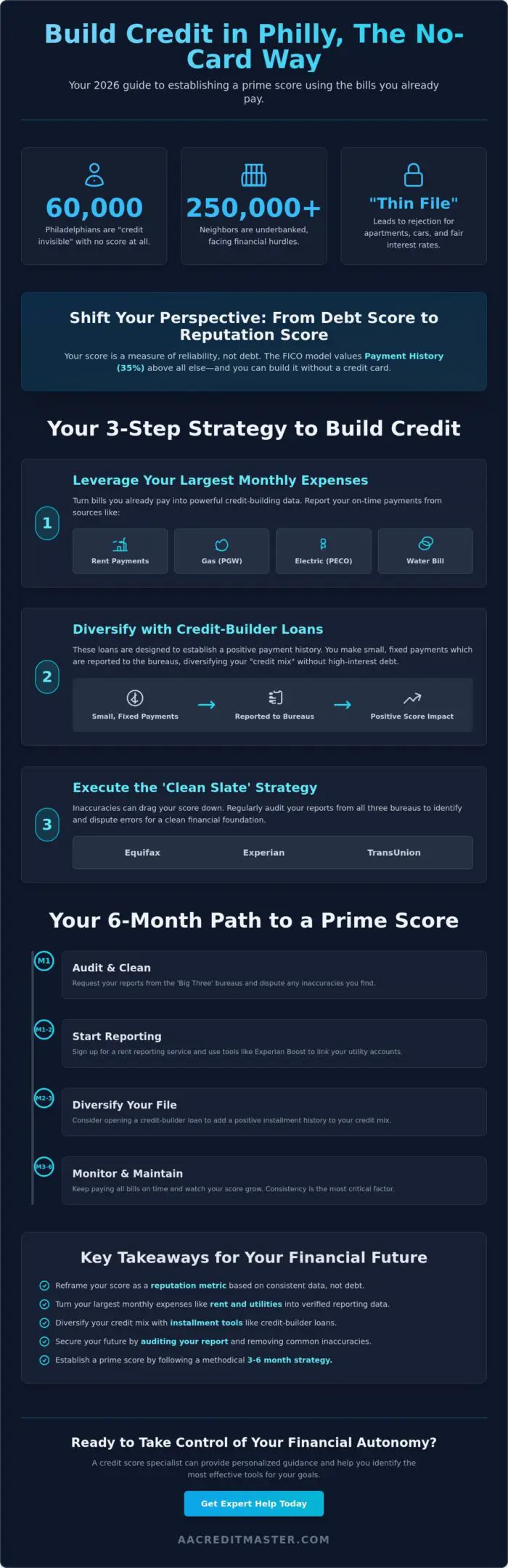
Nearly 60,000 Philadelphians currently have no credit score at all, effectively locking them out of the city’s financial future. It’s a frustrating catch-22 that leaves over 250,000 of our neighbors underbanked and struggling with high interest rates on local auto loans. You likely feel the weight of this system every time you apply for an apartment or a car, only to be told your “thin file” is a risk. It’s exhausting to be judged by what you don’t have rather than your actual reliability.
The good news is that your financial reputation doesn’t depend on a piece of plastic. You can learn how to build credit without a credit card in Philly by leveraging the bills you already pay every month. This 2026 guide provides a clear path to establish a prime score using local resources like the Philly Builds Credit initiative and modern rent reporting. We’ll walk you through auditing your current report for a clean slate and utilizing specific installment tools that favor your lifestyle over high-interest debt. You’re about to gain the foundational knowledge needed to take control of your fiscal autonomy and secure the terms you deserve.
Key Takeaways
- Build a powerful profile without a revolving card account by reframing your credit score as a reputation metric based on consistent data.
- Master how to build credit without a credit card Philly residents use to turn their largest monthly expenses into verified reporting data.
- Diversify your credit mix by utilizing installment tools like credit-builder loans that focus on growth rather than high-interest debt.
- Secure your financial future by identifying and removing common inaccuracies that often drag down local credit reports.
- Establish a clear path to prime status by following a methodical 3-6 month strategy tailored to your specific financial goals.
Can You Build a Credit Score Without a Credit Card?
Your credit score isn’t a badge of honor for how much debt you can carry. It’s a reputation score. Think of it as a financial resume that tells lenders, landlords, and even employers how reliably you handle your obligations. Many people believe a credit card is the only way to enter this system, but that’s a myth. Understanding What is a credit score? is the first step toward realizing that data, not plastic, drives your number. The FICO model puts the most weight on your “Payment History,” which accounts for 35% of your total score. This metric tracks whether you pay what you owe on time. It doesn’t care if that payment went to a bank or a utility provider, as long as the data reaches the bureaus. Avoiding revolving debt is a valid, healthy choice that shouldn’t stop you from hitting major life milestones. In Philadelphia, where over 250,000 residents are considered credit invisible or underbanked, a strong score is the key to local housing and career growth.
The Mechanics of Non-Card Credit Reporting
Banks aren’t the only ones who can talk to the “Big Three” bureaus: Equifax, Experian, and TransUnion. Data furnishers like large property management groups and utility companies can also report your consistency. This is how you master how to build credit without a credit card Philly style. You shift the focus from revolving credit, which includes cards with variable balances, to installment credit, which involves fixed payments over time. A “thin file” simply means the bureaus don’t have enough data to judge you. It is the primary hurdle for the 60,000 Philadelphians currently lacking a score. By reporting the bills you’re already paying, you fill that file with positive evidence of your reliability.
Why Philly Residents Are Skipping the Plastic
The 2026 economic climate has shifted toward personal autonomy and debt-free living. Many Philadelphians are choosing to skip the high-interest traps of retail and bank cards that often lead to a cycle of instability. You don’t need a 24% APR balance to prove you’re responsible. Instead, residents are leveraging community resources and rent reporting to build a foundation of trust. This approach prioritizes long-term stability over temporary fixes. It allows you to compete for the best local mortgage rates and employment opportunities without the stress of monthly interest charges. Learning these skills now creates a permanent solution for your financial health.
Reporting Your Philadelphia Rent and Utilities
Transforming your largest monthly expense into a credit building asset is one of the most effective ways to establish a financial reputation. For most residents, rent is that expense. Historically, this data stayed between you and your landlord; however, the 2026 landscape has changed that. You can now use third party services to ensure your on-time payments reach the major bureaus. This directly impacts your Payment History, which is the single most important factor in your score. Every payment you make to a property manager in Center City or a private owner in South Philly can now work in your favor. It turns a silent transaction into a loud statement of your reliability.
Mastering how to build credit without a credit card Philly starts with the bills you already pay. Beyond rent, your consistency with the Philadelphia Gas Works (PGW), PECO, and the Water Revenue Bureau provides a wealth of data. By reporting these existing obligations, you prove your fiscal discipline without the need for high interest revolving debt. This approach prioritizes your current lifestyle and rewards the habits you’ve already formed. It is a proactive way to take control of your file and prepare for future milestones like homeownership or better employment terms.
How to Get Your Philly Landlord on Board
Many large property management companies in neighborhoods like University City already use reporting systems. If your landlord doesn’t, you can still take the lead. Request that they verify your payments through a tenant-led reporting app. Some platforms allow you to bypass landlord cooperation entirely by linking your bank account to verify rent transfers. If you’re looking for professional guidance on which platforms best fit your situation, a credit score specialist can help you identify the most effective tools for your specific goals. Identifying credit friendly managers before you sign a lease is also a smart strategy for long term growth.
Maximizing Utility and Phone Bill Data
Your history with PECO and PGW is a goldmine for your credit file. By linking your bank account to tools like Experian Boost, you can capture historical payments for gas, electricity, and even your phone bill. This is a quick win for younger residents or those with a thin file. It adds immediate depth to your report by documenting months or years of on-time behavior. Be aware that these methods primarily influence newer scoring versions like FICO 8 or 9. While they are powerful for many lenders, they might not yet affect older mortgage scoring models. Using these tools is a foundational step toward permanent financial autonomy.
Building Through Installment Loans and Credit Builders
A credit builder loan functions as the reverse of a traditional loan, designed specifically to help you grow your score without the risk of overspending. Unlike a standard loan where you receive cash upfront, these tools hold the funds in a locked savings account while you make monthly payments. Once you complete the term, the money is released to you, and your history is reported to the bureaus. This method is a cornerstone of how to build credit without a credit card Philly residents use to create a solid foundation. It transforms the act of saving into an active reporting event. Your consistency proves to future lenders that you can handle a fixed schedule, which is exactly what they look for in a reliable borrower.
Installment accounts like these, along with auto loans and student loans, satisfy the “Credit Mix” requirement of your FICO score. This category accounts for 10% of your total number. Lenders prefer to see that you can manage different types of debt, not just monthly service bills. While you should never take on debt you don’t need, using a small installment loan can provide the variety your file requires. Be cautious of high-interest predatory lenders who target individuals with thin files in our city. These loans often carry hidden fees that can set you back further than where you started. Focus on transparent, local options that prioritize your growth over their profit.
Local Philly Credit Unions vs. National Apps
Philadelphia Federal Credit Union (PFCU) and other local institutions often provide more personalized support than national digital apps. For example, PFCU offers personal loans with rates as low as 9.99% APR as of May 2026, which can be a strong indicator of their credit-building terms. While national apps offer convenience, local credit unions keep your money in the community and offer a human element to your financial strategy. A $500 credit builder loan can outperform a $5,000 credit card in specific scoring models because it proves you can maintain a fixed schedule without the temptation of revolving debt. Choosing a local branch allows you to build a relationship with a lender who understands the Philadelphia market.
The Power of the Authorized User Strategy
Authorized user status, often called “piggybacking,” allows you to benefit from a trusted family member’s long-standing financial history. By being added to their account, their positive payment history and account age are reflected on your report. This is a strategic move for Philly residents preparing for a mortgage, as it can quickly add years of perceived reliability to a thin file. However, this strategy carries risks. If the primary owner misses a payment or carries a high balance, your score could suffer alongside theirs. Clear communication and trust are essential before using this method to bolster your autonomy.
The ‘Clean Slate’ Strategy: Auditing Your Current Report
Building a high score on top of a report filled with errors is like trying to fill a bucket with a hole in the bottom. You can implement every strategy for how to build credit without a credit card Philly offers, but if inaccuracies are dragging you down, your progress will stall. Many residents assume their file is accurate, yet identity mix-ups or outdated collections from local agencies are common. Under the Fair Credit Reporting Act (FCRA), you have the legal right to challenge any information that is not 100% accurate, timely, and verifiable. Establishing a “clean slate” through credit education Philadelphia residents can trust is the essential foundation for any long-term building strategy. It’s about ensuring the system reflects your actual behavior, not someone else’s mistakes.
A proactive audit protects you from the clinical reality of industry reporting errors. When you take the time to verify every line item, you’re exercising personal agency over your financial future. This isn’t just about a number. It’s about restoration and long-term stability. You deserve a report that accurately represents your reliability to lenders and landlords alike. By mastering the skill of report auditing, you turn a confusing landscape into a manageable process.
Identifying Inaccuracies in Your Philly History
Before adding new data, you must review credit report Philadelphia data for “ghost” accounts or incorrect balances. These often appear as medical debt from local health systems or balances from utility companies that should have been closed years ago. These errors act as a weight on your score. Removing a single negative inaccuracy can often improve your profile faster than months of building new history. It is about restoring your true financial identity rather than just adding to a flawed one. Focus on the details to ensure no outdated collection from a local agency remains on your file.
The Role of a Credit Score Specialist
A credit score specialist Philadelphia understands that your situation is unique. Generic, automated dispute tools often fail because they don’t address the specific nuances of your history. A personalized consulting approach identifies high-impact areas where intervention can yield the most significant results. It’s also vital to understand the Credit Repair Organizations Act (CROA), which protects you from deceptive practices and ensures transparency. By working with a mentor who knows the system, you move from a state of worry to a state of progress. If you’re ready to stop guessing and start growing, consult with a specialist today to secure your financial future.
Your Action Plan: Establishing Credit in Philadelphia
Seeing results from non-card strategies typically takes a window of 3 to 6 months. This timeline allows enough reporting cycles for the bureaus to acknowledge your new data points and update your file. Don’t obsess over daily fluctuations in your score. Instead, focus on a monthly review to ensure your reported information remains accurate and consistent. Acquiring these financial skills is far more valuable than chasing temporary hacks. It builds a permanent foundation for your autonomy and ensures you’re prepared for major life milestones. You are learning a capability that will serve you for decades, standing between you and the high interest rates of the past.
Consistency is your most powerful tool. By following a methodical checklist, you move from a state of uncertainty to one of measurable progress. This shift in pace helps to build trust in your own financial management while providing the clinical data lenders require. It’s about taking proactive intervention in your fiscal health rather than waiting for the system to change on its own.
- Review your report every 30 days to catch errors or “ghost” accounts early.
- Verify that your rent reporting service is actively transmitting data to at least two major bureaus.
- Confirm on-time payments for all utility accounts including PGW and PECO to maximize your history.
- Check for any new, unauthorized inquiries that might suggest identity theft or clerical errors.
- Monitor your “Credit Mix” to ensure you have at least one active installment account alongside your reported bills.
Phase 1: The Audit and Clean-Up
Pulling your reports is the first step in identifying the “anchor” inaccuracies that hold your score back. You must initiate disputes for credit report inaccuracies Philadelphia residents often find before adding any new accounts. This ensures you aren’t building on top of a flawed or unstable foundation. Set a baseline score goal for the next 90 days to keep your momentum high. If you find multiple errors, prioritize the ones with the highest impact, such as incorrect collection dates or accounts that don’t belong to you. Removing these weights is often the fastest way to see a significant shift in your standing.
Phase 2: Layering Positive Data
Activating rent and utility reporting for your Philadelphia residence turns your existing lifestyle into a credit-building machine. This is the core of how to build credit without a credit card Philly experts recommend for long-term stability. Once your foundation is clean, opening a targeted installment account through a local credit union adds the necessary variety to your credit mix. This layered approach proves your reliability across different financial products without the need for revolving debt. Lenders want to see that you can handle a variety of obligations over a sustained period. You don’t have to navigate this complex landscape alone. A personalized roadmap ensures you avoid common pitfalls and reach your milestones faster. Take control of your financial future with AA Credit Master and start your journey toward restoration today.
Secure Your Financial Autonomy in Philadelphia
Your credit score is a reflection of your consistency, not your credit card balance. By auditing your report for errors and reporting the rent and utility payments you already make, you can establish a powerful reputation without entering a cycle of revolving debt. You now have the roadmap for how to build credit without a credit card Philly residents use to bypass traditional barriers. This path requires a methodical approach and a commitment to acquiring long-term financial skills rather than relying on temporary fixes.
Mastering the industry reporting system is easier with a seasoned mentor by your side. We provide expert knowledge of the Credit Repair Organizations Act (CROA) to ensure your rights remain protected. Our post-performance service fees mean we only get paid after you see results, which aligns our success directly with yours. You deserve a future defined by restoration and access to the best fiscal terms in the city. Start building your credit today with a professional Philadelphia consultant and take the first step toward your new financial identity. Your progress starts now.
Frequently Asked Questions
Can I really get a 700+ credit score without a credit card?
Yes, achieving a score above 700 is entirely possible without ever opening a revolving credit card account. Your FICO score relies heavily on payment history and credit mix, both of which you can satisfy through installment loans and rent reporting. By consistently documenting your reliability with these alternative data points, you prove your fiscal discipline to the bureaus. This approach builds a robust reputation based on your actual lifestyle rather than high-interest debt.
How long does it take to build credit from scratch in Philadelphia?
You can typically expect a credit score to generate within 3 to 6 months of active reporting. This timeframe allows the major bureaus to collect enough data to calculate your initial FICO score. Starting from scratch requires a methodical approach to ensure every payment is captured accurately from the very first month. Once this baseline is established, your focus shifts to long-term growth and maintaining a clean slate.
Does paying my PGW or PECO bill on time actually help my credit?
Paying your PGW or PECO bills on time will help your score if you use a reporting tool to link your bank account to your credit file. These utility companies don’t automatically report positive data to the bureaus on their own. By capturing this history, you add immediate depth to your file. It’s a quick win for anyone learning how to build credit without a credit card Philly residents can use to leverage their existing monthly overhead.
What is the fastest way to build credit without a card?
The fastest way to see results is a dual approach of reporting your past rent history and opening a credit builder loan simultaneously. Rent reporting services can often look back up to 24 months to provide an immediate boost to your payment history. When you pair this with the credit mix benefits of an installment loan, you create a powerful and diverse data stream. This proactive intervention moves you quickly from a state of worry to a state of measurable progress.
Will my student loans help me build credit even if I’m in deferment?
Student loans contribute to your credit profile even during deferment because they are recorded as active installment accounts on your report. As long as the account is in good standing, it adds to your length of credit history and improves your credit mix. This helps build your score without requiring immediate out-of-pocket payments. It’s a foundational element for many younger Philadelphians looking to establish their financial autonomy early in their careers.
Are credit builder loans worth the interest costs?
Credit builder loans are worth the cost when viewed as a strategic investment in your future borrowing power. The small amount of interest you pay is a trade-off for the significantly improved terms you’ll receive on future auto loans or mortgages. Think of it as a fee for a permanent capability rather than a static expense. You’re essentially buying a better financial reputation that will save you thousands of dollars in interest charges over your lifetime.
Can a credit score specialist help me if I have no credit history at all?
A credit score specialist is a powerful ally when you’re starting with a completely blank slate. They help you navigate the confusing landscape of reporting tools and identify the most efficient path for your specific financial goals. Instead of relying on generic automated tools, you receive a personalized strategy that focuses on building foundational knowledge. This mentorship ensures you don’t fall into common pitfalls or predatory traps while establishing your file.
What happens if my Philadelphia landlord refuses to report my rent?
You don’t need your landlord’s permission to report your rent if you use a tenant-led reporting app. These services verify your payments by linking directly to your bank account or using your digital payment records to confirm the transfers. This allows you to take control of your own data without waiting for a property manager to take action. It’s a vital tool for personal agency in the Philadelphia rental market, ensuring your largest expense finally counts.