
Monitoring Your Credit After Repair in Philadelphia: The 2026 Strategy for Permanent Results
Your credit score isn’t a trophy you win once; it’s a living asset that requires a dedicated bodyguard in 2026. While you might be focused on what to expect during the credit repair process Philadelphia experts provide, the real victory lies in what happens after the disputes are settled. It’s completely natural to feel a sense of dread that a deleted error might suddenly reappear or that a new algorithm change will strip away your hard-earned progress.
We recognize that the path to financial restoration is often intimidating and complex. This guide gives you the tools to lock in your success and protect your newly restored score against the rising threat of identity theft. You’ll learn the exact 2026 monitoring strategies needed to stay ready for a Philly home or business loan. We’ll show you how to move from a state of worry to a state of permanent action. This ensures your financial health becomes a capability you’ve conquered for good rather than a temporary fix. You deserve the confidence that comes from knowing your financial foundation is secure.
Key Takeaways
- Understand what to expect during the credit repair process Philadelphia residents use to defend their financial rights and prevent deleted errors from resurfacing.
- Distinguish between the algorithms lenders prioritize and the scores apps show to ensure you’re always prepared for a major loan application.
- Implement a proactive three-bureau monitoring strategy that acts as a 24/7 guardian for your newly restored credit score.
- Develop the essential skill of quarterly report audits to maintain permanent stability in the evolving 2026 financial landscape.
- Leverage your personal credit success as a foundation to build business credit and access exclusive local Philadelphia resources for long-term growth.
What to Expect During the Credit Repair Process in Philadelphia
Think of credit repair as a proactive defense of your financial rights. You aren’t just “fixing” numbers; you’re leveraging the Fair Credit Reporting Act (FCRA) to force massive institutions to report accurately. When you understand what to expect during the credit repair process Philadelphia professionals navigate, you realize it’s about holding bureaus accountable for every line of data. This is especially critical because of the ‘reinsertion’ risk. Sometimes, a deleted error resurfaces months later because a creditor’s automated system reported it again. Constant monitoring is your only shield against these recurring errors.
For residents eyeing real estate in neighborhoods like Fishtown or Graduate Hospital, the stakes are incredibly high. In the 2026 market, a few points can be the difference between a competitive mortgage and a flat rejection. We frame monitoring as a vital skill you must acquire, not just a service you pay for. It’s a personal capability that empowers you to protect your future from impersonal institutions. Understanding how credit scores work allows you to maintain permanent restoration rather than a temporary boost. You’re building a foundation that lasts a lifetime.
The Fragility of a Newly Restored Score
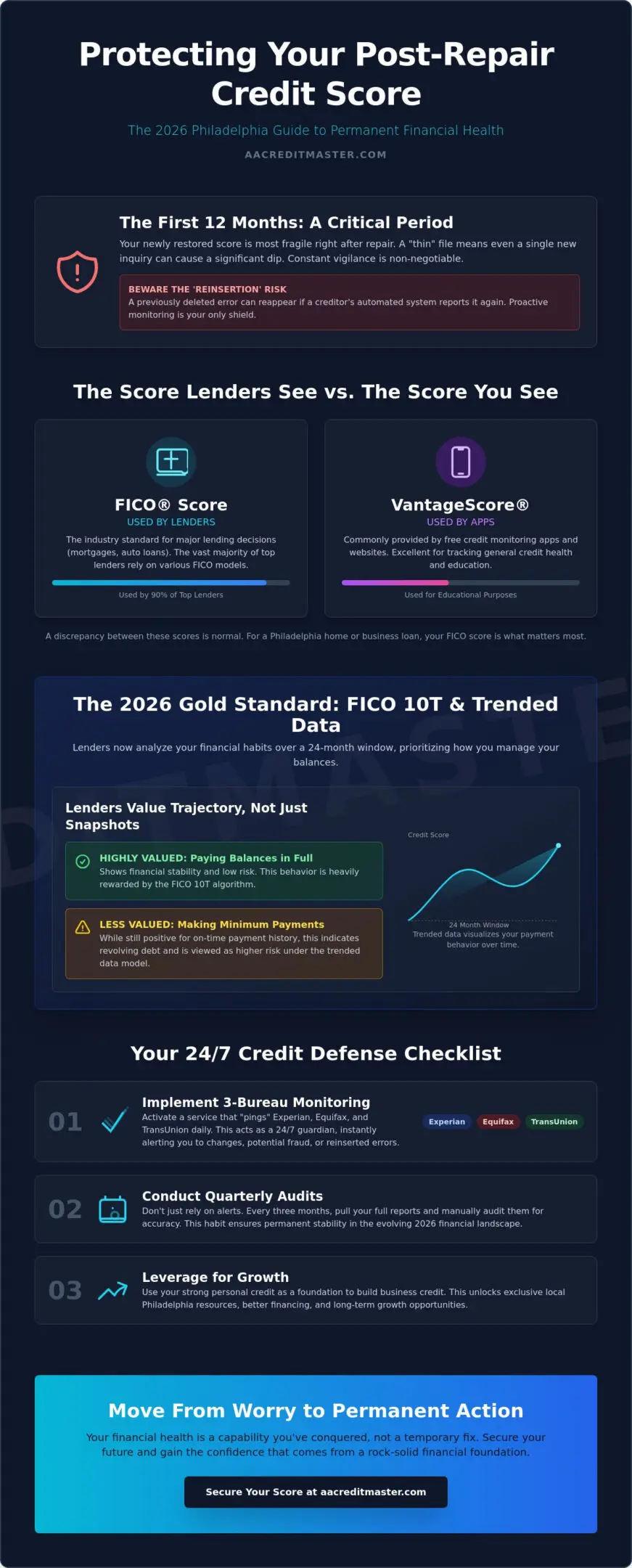
Your credit report is most sensitive during the first 12 months after restoration. While your file is now clean, it might still be “thin” regarding recent active history. This means a single new credit inquiry can cause a more pronounced dip than it would for someone with decades of established accounts. You must treat your report with extreme care during this transitional period. Credit stability is the consistent alignment of reporting and reality. If you don’t manage your new accounts with precision, the gains from the repair process can fluctuate unexpectedly.
Philadelphia Financial Dynamics in 2026
Philadelphia’s financial landscape has shifted, and a high credit score is now a primary survival tool. With local cost-of-living trends rising, your score dictates your monthly cash flow through interest rate savings. Local lenders across the city have become more cautious. They often look past the raw number to see how recently your report was restored. It’s also a known trend that many regional banks in the Delaware Valley lean heavily on TransUnion data for their lending decisions. Knowing what to expect during the credit repair process Philadelphia involves preparing for these specific local preferences so you can walk into any bank on Broad Street with total confidence.
The Mechanics of Credit Tracking: Bureaus and Algorithms in 2026
Understanding the machinery behind your score is the first step toward total control. Experian, Equifax, and TransUnion aren’t government agencies; they’re private companies that sell your data. In the post-repair phase, they act as the gatekeepers of your financial restoration. When learning what to expect during the credit repair process Philadelphia residents often discover that these bureaus hold conflicting information. Monitoring services ‘ping’ these databases daily, alerting you the moment a change occurs so you can act before a lender sees a mistake.
Confusion often arises when your free tracking app shows one score while a Philadelphia mortgage lender sees another. Most apps use the VantageScore model, whereas the vast majority of top lenders still rely on FICO scores. Knowing your rights during credit repair ensures you can demand accuracy across both systems. If you find the discrepancy between these numbers overwhelming, a credit score specialist can provide the clarity needed to navigate these technical waters. You aren’t just watching a number; you’re managing a complex data profile.
Understanding Trended Data and FICO 10T
By 2026, FICO 10T has become the benchmark for major loan approvals in Pennsylvania. This algorithm focuses on “trended data,” which tracks your payment trajectory over a rolling 24-month window. Lenders now place a higher value on clients who pay their balances in full rather than those who simply pay the minimum on time. Monitoring tools help you visualize this trajectory, allowing you to adjust your habits before applying for a loan. This shift transforms credit management from a monthly chore into a strategic long-term capability.
The Bureau Notification Cycle
Most Philadelphia-based creditors operate on a 30 to 45-day reporting cycle. This lag creates a window where “zombie debt”-old, settled, or previously deleted accounts-can suddenly reappear without warning. Vigilance during this cycle allows you to spot these errors before they cause permanent damage to your score. It’s a critical part of what to expect during the credit repair process Philadelphia experts manage. Under federal law, credit bureaus must notify you in writing within five business days if they reinsert a previously deleted item into your report.
Comparing Credit Monitoring Tools: From Free Apps to Professional Services
Choosing the right monitoring tool is a strategic decision that impacts your financial privacy. Many free apps appear helpful, but they often trade your personal data for convenience. These platforms typically sell your information to third-party marketers to generate revenue. If you want to know what to expect during the credit repair process Philadelphia lenders demand, you’ll need more than a basic consumer app. You require a comprehensive view of all three credit bureaus to prevent unexpected rejections during a high-stakes mortgage application. High-quality monitoring acts as a 24/7 guardian against identity theft, which remains a significant concern for residents navigating the Philly financial landscape.
Free vs. Paid: Which Philadelphia Residents Need What?
Your credit profile determines which level of monitoring is appropriate for your goals. Students or individuals with very simple credit files often find the “Free Tier” sufficient for basic tracking. This provides a general pulse on activity without a monthly cost. However, entrepreneurs and prospective homebuyers belong in the “Premium Tier.” These users require real-time alerts from Experian, Equifax, and TransUnion simultaneously. Relying on a single-bureau app is a dangerous gamble when a Fishtown townhome is on the line. Cheap monitoring software frequently triggers “false positives” or misses critical updates entirely. Understanding the Credit Repair Organizations Act helps you identify which professional services operate with the required integrity and transparency.
The Human Element: Strategy over Automation
Data is essentially useless without a clear plan for action. An automated alert might tell you your score dropped twenty points, but it won’t explain the underlying cause or provide a solution. This is where the value of a credit score specialist Philadelphia residents trust becomes clear. We act as a sophisticated human filter for the noise of automated reporting. We interpret the complex algorithms and provide a personalized strategy that no software can replicate. Allen & Allen, Inc. bridges the gap between raw data and actionable achievement. We transform confusing reports into a clear roadmap for your personal autonomy. This level of expert insight is a core part of what to expect during the credit repair process Philadelphia clients use to secure their long-term stability and financial health.
Your Philadelphia Credit Maintenance Checklist: 5 Steps to Permanent Health
Protecting your newly restored credit requires a permanent shift in your financial habits. If you’ve been wondering what to expect during the credit repair process Philadelphia professionals lead, it’s the transition from cleaning up the past to bulletproofing your future. You’ve worked hard to remove errors; now you must ensure they stay gone. This checklist serves as your tactical roadmap for long-term stability. You can’t just hope the bureaus stay accurate. You must force them to through disciplined habits.
- Set up real-time alerts: Activate notifications for all three major bureaus to catch reinsertions instantly.
- Schedule quarterly deep-dives: Go beyond the score and audit every line of your full reports every 90 days.
- Maintain utilization below 10%: Keep your reported balances low to provide a safety ‘pad’ for your score.
- Limit new applications: Practice strict credit hygiene by waiting at least six months between any new credit inquiries.
- Partner with a mentor: Use a consulting company to move from personal restoration to building business credit.
Quarterly Deep-Dives: What to Look For
Philly’s unique housing landscape, especially in multi-unit buildings in areas like West Philly or South Philly, often leads to address variations. Check your reports for incorrect apartment numbers or slight misspellings that could link your file to someone else’s. You also need to verify that ‘Resolved’ disputes haven’t defaulted back to ‘Active’ status due to automated system refreshes. Finally, ensure your employment data is updated to reflect your current status, as this can impact future manual underwriting reviews. These small details are often what lenders use to verify your identity and stability.
Mastering Utilization and Inquiries
Maximized scores often come from the ‘AZEO’ (All Zero Except One) method. This involves letting only one credit card report a small balance while all other accounts report zero. This strategy signals to lenders that you have access to credit but don’t depend on it. When shopping for Philly auto loans, group your inquiries within a 14-day window to minimize the impact on your score. If you need more ‘padding,’ request credit limit increases on your oldest accounts every six to twelve months. This allows you to grow your available credit without necessarily increasing your debt. If you’re unsure how to time these moves, a credit score specialist can provide a personalized schedule based on your specific goals.
Beyond Monitoring: Leveraging Your New Score for Philadelphia Opportunities
Securing a high credit score is your entry ticket to the true Philadelphia economy. While you now know what to expect during the credit repair process Philadelphia specialists facilitate, your journey shouldn’t end with a clean report. Your restored score is a powerful financial tool that lowers your cost of living across Pennsylvania. In 2026, residents with elite credit profiles benefit from significantly lower auto insurance premiums and waived security deposits for utilities. These immediate cash-flow improvements provide the capital you need to pivot from financial defense to aggressive growth. We don’t just fix credit; we build masters who understand how to use their data as a strategic asset.
Opportunities for homeownership in Philadelphia are more accessible when your score reflects your true reliability. Local resources like the Philadelphia Housing Development Corporation (PHDC) offer programs that become far more effective once your interest rates are minimized. The city’s recent S&P Global Ratings upgrade to ‘A+’ reflects a strengthening local economy. You deserve to participate in that growth with the confidence of a optimized credit profile. Your financial health is no longer a source of anxiety; it’s a capability you’ve conquered through disciplined monitoring and expert education.
Building Business Credit in the City of Brotherly Love
Your personal credit score is the essential key to unlocking corporate tradelines. Most lenders in the Delaware Valley require a strong personal guarantee before they’ll extend credit to a new entity. Learning how to build business credit allows you to separate your personal liabilities from your professional ventures. This transition is a core focus of our work as a consulting company. We guide you toward Philadelphia small business resources that help you scale without risking your personal assets. Once your business accounts are active, a regular business credit report check ensures your company’s reputation remains as spotless as your personal one.
The Emotional Reward of Financial Autonomy
Reflect on the distance you’ve traveled from the initial stress of financial instability to your current state of expert reassurance. You’ve moved past the fear of hidden errors and the confusion of 2026 algorithms. This journey has transformed credit management from an intimidating hurdle into a skill you now own. You are no longer at the mercy of impersonal institutions; you are a proactive participant in your own success. As a credit score specialist, our goal is to see you navigate the Philly landscape with total autonomy. Join the ranks of Philadelphia residents who have mastered their financial narrative. Take the final step toward permanent stability and start building the legacy your hard work has earned.
Secure Your Financial Legacy in the City of Brotherly Love
Your credit score is a dynamic asset that requires constant vigilance to remain an effective tool for growth. Permanent results depend on mastering the 2026 notification cycles and understanding how trended data influences modern lending. By moving beyond basic apps and adopting a rigorous three-bureau strategy, you position yourself to seize Philadelphia’s most competitive real estate and business opportunities. Knowing what to expect during the credit repair process Philadelphia residents navigate is only the first step. The real victory is the long-term stability you maintain through expert-level monitoring and a commitment to disciplined financial hygiene.
Our Philadelphia-based expert consultants operate in full compliance with the Credit Repair Organizations Act (CROA), providing the protective guardianship you need to thrive. We offer tailored resources designed to help you transition from personal restoration to building robust business credit. Protect your progress and master your score with Allen & Allen, Inc.. You have the power to rewrite your financial narrative. Take command of your future today and walk into every bank on Broad Street with the confidence you’ve earned. It’s a capability you’ve conquered for good.
Frequently Asked Questions
How often should I check my credit report after it has been repaired?
You should check your credit report at least once a month while keeping real-time alerts active on your smartphone. Consistent monitoring ensures that your newly restored score remains stable and that any unexpected changes are addressed immediately. This habit transforms credit management into a permanent capability rather than a one-time event. Frequent checks help you maintain the confidence needed to navigate the Philadelphia financial landscape.
Can a deleted item come back on my credit report after repair?
Yes, a previously deleted item can reappear if a creditor’s automated system reports the data again. This is known as reinsertion. Under federal law, credit bureaus must notify you within five business days if they put a deleted item back on your report. Knowing what to expect during the credit repair process Philadelphia experts manage helps you stay vigilant against these sudden and frustrating reporting errors.
Does checking my own credit score lower it?
Checking your own credit score never lowers it because it is considered a soft inquiry. These inquiries are visible only to you and do not impact the algorithms lenders use to determine your creditworthiness. You can monitor your progress as often as you like without worrying about damaging the hard-earned points you’ve gained during the restoration phase. It’s a safe way to track your financial health.
What is the best credit monitoring service for Philadelphia residents?
The best monitoring service for Philadelphia residents is one that provides comprehensive data from all three major bureaus: Experian, Equifax, and TransUnion. While many local banks offer single-bureau tracking, you need a three-bureau view to ensure accuracy before applying for a mortgage or business loan. A credit score specialist can help you select a professional-grade tool that offers the highest level of security and identity protection.
How long does it take for a credit repair to show up on my monitoring app?
Changes typically appear on your monitoring app within 30 to 45 days of a successful dispute. This timeline aligns with the standard reporting cycles used by most Philadelphia-based creditors and the credit bureaus’ investigation windows. Understanding what to expect during the credit repair process Philadelphia professionals lead ensures you don’t feel discouraged during this necessary waiting period. If updates don’t appear after 45 days, further investigation is required.
What should I do if I see a new error on my credit report after finishing repair?
You must dispute the new error immediately to prevent it from dragging down your score. Contact your consulting company to document the mistake and initiate a formal challenge under the Fair Credit Reporting Act. Rapid intervention is the key to maintaining your financial autonomy and ensuring that your report accurately reflects your current credit behavior. Don’t let a simple reporting mistake undo your hard work.
Is free credit monitoring enough for someone who just finished repair?
Free monitoring is often insufficient for individuals who have just completed the credit repair process and are planning major life milestones. Most free apps only track one or two bureaus and use consumer-grade scores that lenders rarely see. To protect your investment in your credit health, you need the advanced security and full-spectrum reporting found in premium monitoring services. These tools provide a more accurate picture for lenders.
How does monitoring help prevent identity theft in Philadelphia?
Monitoring acts as a protective guardian by alerting you the moment a new account or inquiry appears in your name. Early detection is your best defense against identity theft in the Philadelphia financial landscape. When you receive an instant alert about unauthorized activity, you can freeze your reports and stop a thief before they cause extensive damage to your restored credit profile. It provides immediate peace of mind.