
Getting a New Credit Card After Collections: Your 2026 Philadelphia Recovery Guide
What if a history of collections wasn’t a permanent barrier, but a puzzle you finally have the tools to solve? You’ve likely felt the sting of an automatic rejection or the exhausting stress of aggressive collection calls. It’s natural to feel confused about whether paying an old debt helps your score or if you’re stuck in a cycle of high interest rates. You aren’t alone in this frustration, and your past doesn’t have to dictate your financial future. Getting a new credit card after collections is a skill you can master with the right guidance.
This guide delivers the exact strategic steps for your recovery, turning a confusing process into a clear path toward financial autonomy. You’ll learn how to optimize your report and navigate Philadelphia’s new 2026 Diversion Program to pause legal proceedings. We’ll examine why a FICO score in the fair range of 580 to 669 still offers real opportunities and how you can transition from subprime 27.41% interest rates back to standard terms. It’s time to stop waiting for a clock to run out and start mastering the skills to rebuild your life. This is your roadmap to a fresh start and a stronger financial foundation.
Key Takeaways
- Protect your financial future by understanding how Pennsylvania law shields you from aggressive tactics while you navigate automated underwriting systems.
- Select specific “utility” cards designed for growth potential to ensure your first new account serves as a powerful rebuilding tool rather than a lifestyle card.
- Master the strategic roadmap for getting a new credit card after collections by auditing your report for “double reporting” and establishing a perfect payment history.
- Leverage the expertise of a credit score specialist to identify “unverifiable” data that automated fixes often miss, giving you a distinct advantage with lenders.
- Acquire the foundational skills needed to transform credit management from a source of stress into a capability you can control for life.
Understanding the Impact: How Collections Affect Your Card Applications
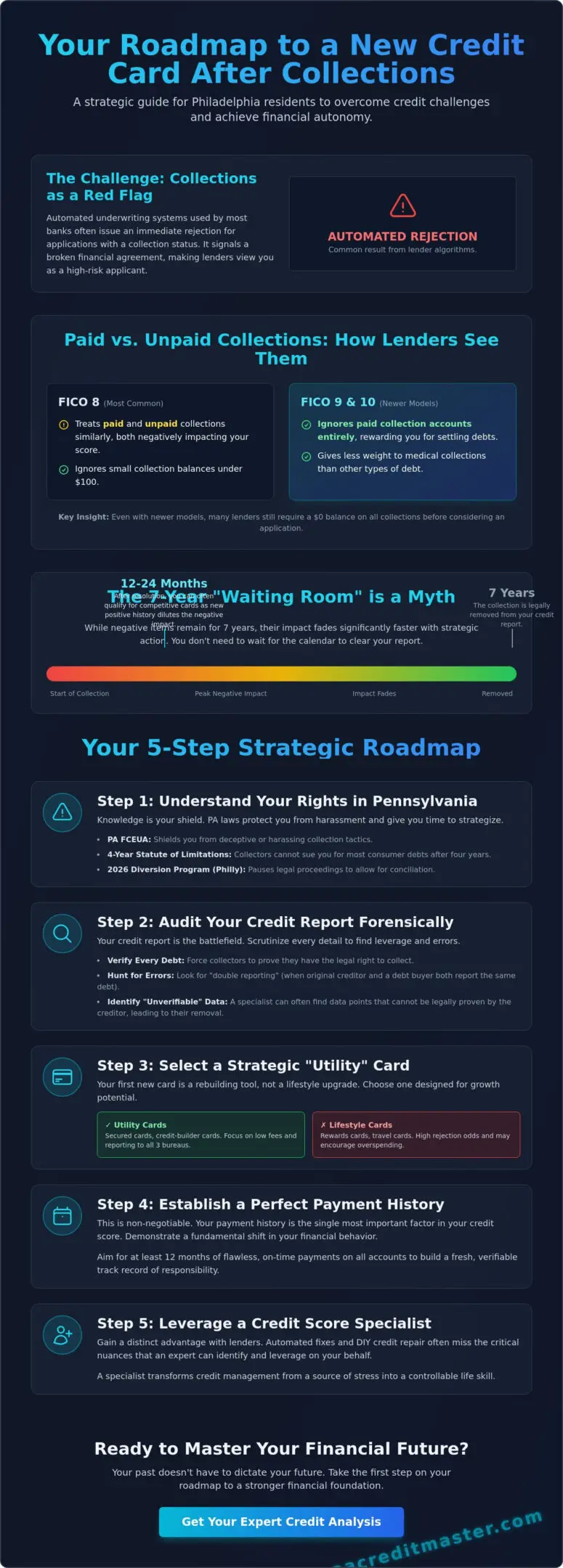
Lenders in 2026 view a collection entry as a signal of a broken financial agreement. When you’re getting a new credit card after collections, you’re essentially proving that this breakdown was a temporary event rather than a permanent habit. Most modern banks use automated underwriting systems that scan your report for specific red flags. A collection status often triggers an immediate rejection. The algorithm assumes the risk of default is too high to calculate accurately. You’re effectively sidelined until you can demonstrate a shift in your financial behavior.
Distinguish between internal collections and third-party debt buyers to understand your standing. Internal collections occur when the original store or bank tries to recover the funds themselves. Third-party agencies are different; they purchase your debt for pennies on the dollar. Gaining a foundational understanding of how debt collection works helps you see why lenders worry. If a third party is involved, the original creditor has officially given up on you. However, lenders now prioritize the “time since last activity” over the original debt date. A four-year-old collection that hasn’t been touched is often less damaging to your prospects than a small debt you just acknowledged or partially paid yesterday.
Paid vs. Unpaid Collections: Does it Matter to Lenders?
Accelerate your approval by understanding which scoring model the bank uses. FICO 8, which remains common in 2026, treats paid and unpaid collections similarly, though it ignores small balances under $100. Newer models like FICO 9 and FICO 10 are more forgiving. These systems often ignore paid collection accounts entirely, rewarding you for settling your debts. Many Philadelphia lenders still require a $0 balance on all collections before they’ll consider your application. Settling the debt provides a vital psychological clean slate during a manual review. It proves you take your obligations seriously even when things go wrong.
The “Waiting Room” Myth: Do You Really Need 7 Years?
Reclaim your financial autonomy without waiting a full decade. While the Fair Credit Reporting Act allows negative data to stay on your report for seven years, its practical impact fades much faster than most people realize. You can often qualify for competitive cards just 12 to 24 months after a collection is resolved. This period allows for credit seasoning, which is the strategic process of letting time and new positive history dilute the negative impact of old mistakes. Getting a new credit card after collections is a game of strategic timing. You don’t need to wait for the calendar to clear if you’re actively building a fresh, verifiable track record of responsibility.
The Philadelphia Borrower’s Rights: PA Laws and Credit Reporting
Knowledge is your first line of defense against financial stagnation. When you’re focused on getting a new credit card after collections, you must first understand the legal framework that protects your journey. The Pennsylvania Fair Credit Extension Uniformity Act (FCEUA) serves as a powerful shield for Philadelphia residents. It mirrors federal protections but adds layers that prevent creditors and third-party collectors from using deceptive or harassing tactics. Familiarizing yourself with Pennsylvania consumer protection laws ensures you aren’t bullied into making mistakes that could reset the clock on old debts.
Always verify a debt before taking any action. Collectors often rely on your fear to prompt a quick payment, but acknowledging a debt without verification can inadvertently restart the statute of limitations. This verification process is a vital skill. It forces the collector to prove they have the legal right to collect and that the amount is accurate. Philadelphia’s 2026 Consumer Credit Card Collection Diversion Pilot Program further supports this by pausing legal proceedings to allow for conciliation. Use this time to audit your report and ensure your path toward getting a new credit card after collections remains clear of illegal obstacles.
Pennsylvania Statute of Limitations on Debt
Protect your progress by knowing the numbers. In Pennsylvania, the statute of limitations for most consumer debts, including credit cards, is four years. Once this period passes, a debt is considered “time-barred.” A collector can no longer successfully sue you to recover the funds. However, there’s a critical difference between a debt being collectible and being reportable. A debt can remain on your credit report for seven years even if the legal window to sue has closed. Beware of “zombie debt” collectors who buy old accounts and attempt to trick you into making a small payment. Doing so can revive the entire four-year legal window, exposing you to new risks.
Disputing Inaccuracies in the Philadelphia Market
Errors are frequent when debt is sold between multiple agencies. You might find “double reporting,” where both the original creditor and a collection agency list the same balance as an open debt. This artificially inflates your credit utilization and destroys your score. Using professional credit repair services Philadelphia residents trust allows you to audit these files with precision. While the “Pay for Delete” strategy is still a reality in 2026, it requires a methodical approach and written confirmation. Lenders increasingly prefer seeing a settled status over an active dispute. Consulting with a credit score specialist can help you determine the best personalized strategy for your specific report.
Comparing Your Options: Best Card Types for Credit Rebuilders
Think of your first account as a utility tool, not a lifestyle accessory. When you’re getting a new credit card after collections, your primary objective is to establish a verifiable pattern of reliability. You need a card that acts as a bridge toward better fiscal terms, not one that traps you in a new cycle of debt. Focus on the long-term growth potential of the account rather than the immediate perks or rewards. A card that graduates to a higher limit or an unsecured status provides far more value than a one-time sign-up bonus.
Avoid “fee-harvesting” cards that target individuals with low scores. These predatory products often charge massive application fees and monthly maintenance costs that eat your available credit before you even swipe the card. In May 2026, the average interest rate for applicants with poor credit sits at 27.41%, but subprime cards can climb as high as 36%. Protect your progress by comparing the total cost of entry against the reporting benefits. Consult the Consumer Financial Protection Bureau guide to understand how these new accounts will interact with your existing report data. Philadelphia residents should also explore local credit unions, which often provide more personalized consideration than large, impersonal national banks.
Secured Credit Cards: The Gold Standard for Recovery
Secured cards serve as the most effective training wheels for your credit skill. You provide a refundable security deposit that typically dictates your credit limit, which minimizes the lender’s risk and maximizes your approval odds. As of May 19, 2026, the average APR for secured cards is 26.13%. Look for cards like the Discover it® Secured, which carries a 26.49% purchase APR but offers a clear path to graduation. Ensure your chosen card reports to all three major bureaus. This reporting is the only way your responsible use translates into a higher score.
Unsecured “Second Chance” Cards and Retail Options
Unsecured cards are accessible even with a history of collections, but they require careful management. These “second chance” products often come with higher APRs and lower limits. Retail cards can also serve as a strategic entry point if you have a thin credit file. Many of these issuers offer “pre-approval” tools. Use these tools to check your eligibility without triggering a hard inquiry on your report. Getting a new credit card after collections is a calculated move. Use these entry-level cards to prove your capability, then move toward premium products as your score stabilizes.
Your 5-Step Roadmap to Credit Card Approval
Proactive strategy beats passive waiting every time. Getting a new credit card after collections is a skill you acquire through a methodical approach rather than a lucky guess. You must transform your credit report from a list of past mistakes into a record of current capability. This roadmap ensures you present the strongest possible case to potential lenders in 2026.
- Step 1: Audit your report for “double reporting.” Ensure the same collection balance isn’t being reported by both the original creditor and a debt buyer, which artificially deflates your score.
- Step 2: Establish a 6-month history of 100% on-time payments. Consistency is your most persuasive argument. Ensure every utility, rent payment, and existing bill is paid exactly on time for at least half a year before applying.
- Step 3: Lower your overall utilization. If you have any open accounts, pay them down to nearly zero. This proves you don’t rely on credit to survive.
- Step 4: Use a Credit Score Specialist to optimize your profile. Expert eyes can spot technical errors or unverifiable data that automated systems miss. Speak with a credit score specialist to identify the specific hurdles in your unique report.
- Step 5: Apply for the right card, not the first card. Use the pre-approval tools mentioned earlier to target cards where your approval odds are highest.
Optimizing the “Human Element” of Your Application
Lenders sometimes look beyond the algorithm during a manual review. If a bank asks about your past, be prepared to explain the circumstances with professional detachment. Use your local Philadelphia residency and stable employment history as proof of your current stability. A clean 12-month window of perfect financial activity creates a powerful “recent history” that can often outweigh older, resolved collections. This period of perfection demonstrates that your previous instability was a temporary event, not a permanent character trait.
Mastering the Skill of Credit Utilization
Adhere to the “under 10%” rule to maximize your score growth. If your new card has a $300 limit, never let the reported balance exceed $30. Treat your new card like a debit card by paying off every purchase immediately. This discipline proves to the lender that you are a low-risk borrower who can handle higher limits in the future. You can deepen your understanding of these strategies by exploring credit education Philadelphia resources designed to build long-term financial mastery. Mastering utilization is the fastest way to signal that you are ready for a standard, unsecured credit line.
Why a Philadelphia Credit Score Specialist is Your Best Ally
Generic automated tools often fail because they cannot interpret the unique nuances of your financial story. When you are focused on getting a new credit card after collections, an algorithm only sees a red flag from a past mistake. A Philadelphia credit score specialist sees the specific path to your restoration. Allen & Allen, Inc. acts as a formidable ally, identifying technical errors and “unverifiable” data that automated systems frequently overlook. This personalized strategy ensures your report reflects the clinical reality of your current capability rather than a static metric from a difficult period. You gain an expert who knows exactly where the pitfalls lie in the complex reporting landscape.
Standing between you and large, impersonal institutions requires more than just a software subscription. It requires a seasoned mentor who understands the specific economic pressures of the Philadelphia market. By choosing a professional consulting company, you move from a state of worry to a state of strategic action. We help you conquer financial management as a capability rather than a source of stress. This transition is vital for anyone getting a new credit card after collections who wants a permanent solution instead of a temporary fix.
Tailored Solutions for Local Philly Residents
We provide a non-judgmental environment that acknowledges the stress of financial instability while offering a clear path forward. Our team navigates the complex reporting systems for you, ensuring every detail is accurate and verified according to current standards. You benefit from a post-performance fee structure where you pay for results rather than empty promises. This approach aligns our success with your progress, providing immediate confidence that your case is being handled with thorough, expert attention. We prioritize your personal autonomy and long-term stability throughout the entire consulting process.
Your Future Beyond the New Card
Restoration is only the first step toward your ultimate financial goals. Once you have mastered the skill of personal credit, you can begin building business credit to fund your entrepreneurial expansion. Whether you aim for home ownership in a historic Philadelphia neighborhood or starting a local venture, your score is the foundation of your success. We help you turn credit management into a permanent life skill that serves you for years to come. Take the first step toward your financial restoration and personal achievement. Schedule your Philadelphia credit consultation today and start your journey toward lasting stability.
Reclaim Your Financial Autonomy Today
You’ve discovered that recovery is a proactive skill to be mastered, not a passive waiting game for a clock to run out. By leveraging Pennsylvania’s consumer protections and following a methodical 5-step roadmap, you can clear the path to new approvals. Getting a new credit card after collections becomes a reality when you prioritize report accuracy and strategic utilization over generic automated fixes. Your journey involves moving from the stress of the past to the capability of the future.
AA Credit Master provides Philadelphia-based expert consulting with a personalized strategy that looks beyond the algorithm. Our CROA-compliant post-performance fees ensure you pay for tangible results as you restore your standing. Start your journey back to creditworthiness with a Philadelphia specialist and turn your financial management into a permanent capability. Your past doesn’t define your potential. With the right mentor by your side, you can build the foundation for home ownership, business expansion, and lasting stability in the city you call home.
Frequently Asked Questions
Can I get a credit card if I still have an unpaid collection on my report?
Yes, you can qualify for specific account types even with active collections on your record. Secured cards are the most accessible entry point because your security deposit mitigates the lender’s risk. While standard unsecured cards usually require a FICO score of 670 or higher, secured options in 2026 often accept scores as low as 300. Focus on accounts that report to all three bureaus to ensure your responsible use builds a new, positive foundation.
How much will my credit score increase after I pay off a collection?
Your score increase depends heavily on which scoring model the lender uses for your application. Newer systems like FICO 9 and FICO 10 ignore paid collections entirely, which can lead to a significant jump in your numbers. For those using credit-builder tools, data shows an average FICO score increase of 47 points after six months of consistent, on-time use. Getting a new credit card after collections is most effective when you leverage these modern reporting standards.
Does paying a collection restart the 7-year reporting clock in PA?
Paying a collection does not restart the seven-year reporting window defined by federal law. The Fair Credit Reporting Act dictates that negative items must fall off your report seven years after the original date of delinquency. However, making a partial payment can restart the four-year Pennsylvania statute of limitations for legal collection actions. You should always verify all debt details before taking action to avoid reviving a collector’s right to sue you in a Philadelphia court.
Which credit cards are easiest to get with a history of collections?
Secured cards and retail accounts that offer pre-approval tools are the easiest to obtain with a damaged history. The Discover it® Secured Credit Card is a top choice in 2026, offering a 26.49% purchase APR and a clear path to an unsecured upgrade. These products prioritize your current security deposit and recent payment history over old collection entries. They serve as essential utility tools for anyone getting a new credit card after collections who wants to prove their current reliability.
How long should I wait after a collection is removed to apply for a card?
You don’t need to wait for a collection to be removed before you begin applying for new credit. Many banks approve applications 12 to 24 months after a collection is resolved if you have established a perfect payment record during that time. This period of “credit seasoning” proves to lenders that your financial habits have fundamentally changed. Proactive intervention and building new history is always more effective than waiting for a seven-year reporting clock to expire.
What is the minimum credit score needed for a secured card in 2026?
Secured cards are accessible to applicants with FICO scores as low as 300. While a “fair” credit score is generally categorized between 580 and 669, the secured card market specifically targets the “poor” category of 300 to 579. Your security deposit acts as the primary collateral for the lender. This makes your specific score less critical than your ability to provide the upfront deposit and maintain a perfect record of on-time monthly payments.
Can a credit score specialist help me remove a legitimate collection?
A credit score specialist can assist by identifying technical errors or unverifiable data that shouldn’t be on your report. Even if a debt was originally yours, the way it is reported must comply with strict federal and state regulations. Specialists look for “double reporting” or incorrect dates that unfairly suppress your score. This professional audit ensures your credit report is an accurate and legal representation of your financial history according to current reporting standards.
Is it better to settle a collection or pay it in full for a new card application?
Settling for a lower amount is often just as beneficial as paying in full when using modern scoring models. FICO 9 and FICO 10 treat any $0 balance collection the same, regardless of whether it was settled or paid in its entirety. Some local Philadelphia lenders might prefer a “paid in full” status during a manual review for a mortgage or large business loan. For a standard credit card application, a settled status is usually sufficient to bypass automated rejection triggers.