
Checking a Philadelphia Company Credit History: The Strategic Guide for Business Owners
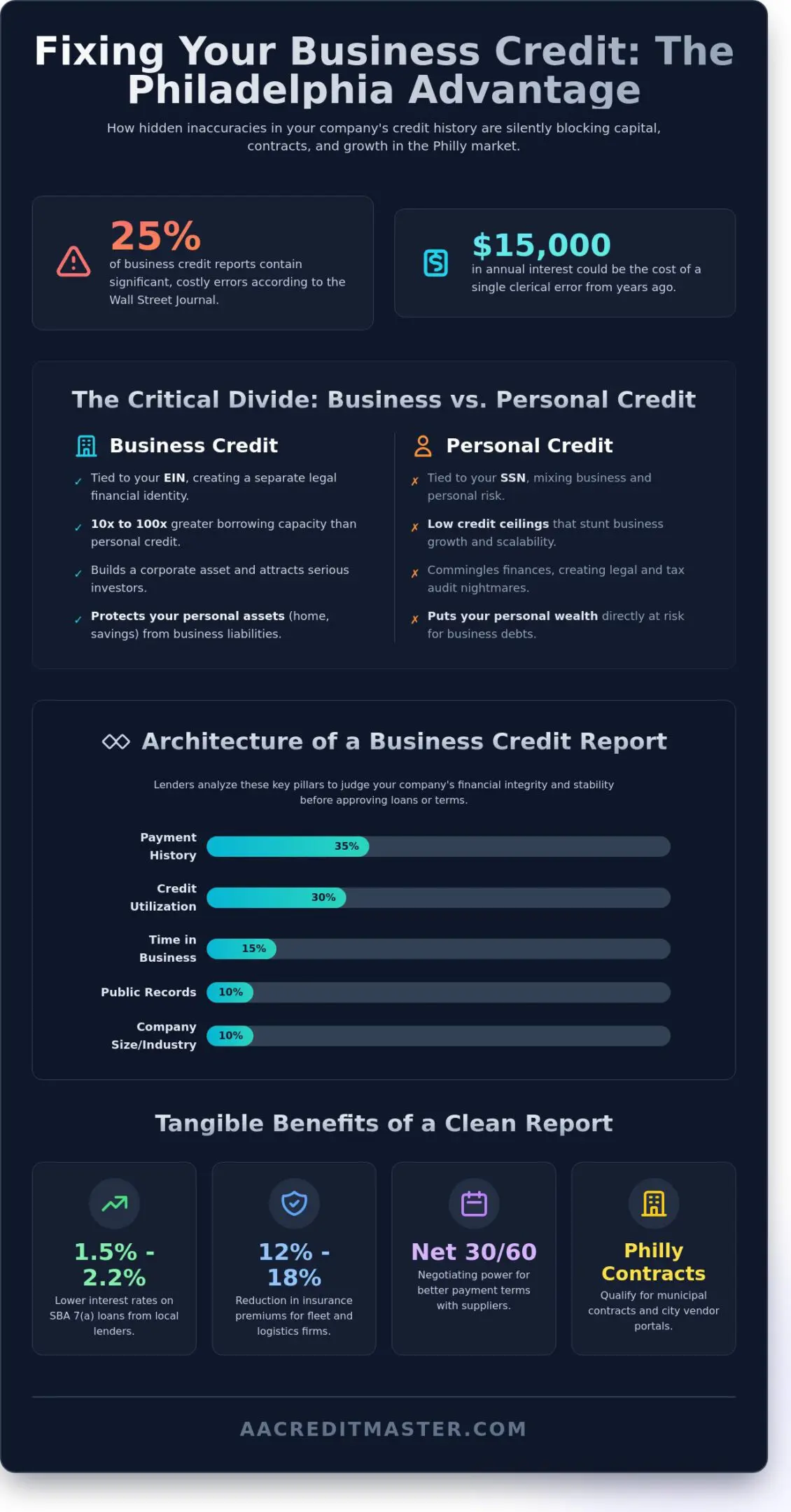
What if a clerical error from 2022 is currently costing your Philadelphia business $15,000 in annual interest? It’s a reality for many, as a study by the Wall Street Journal found that 25% of business credit reports contain significant errors. You might think your personal score is the only metric that matters, but lenders scrutinizing your company credit history see a completely different story. If your profile is cluttered with inaccuracies, then your path to a Philly SBA loan or better vendor terms is effectively blocked.
You’ve likely felt the frustration of dealing with opaque bureaus that offer zero transparency. It’s exhausting to feel like you’re flying blind while trying to build a lasting legacy. We’re here to change that. To secure the capital you deserve, you’ll learn exactly how to audit your profile, identify hidden red flags, and master the dispute process. This guide provides a 5 point checklist to clean your record and unlock the local Philadelphia resources that drive real growth. It’s time to take back control of your financial reputation.
Key Takeaways
- Unlock exclusive Philadelphia vendor accounts and city contracts by establishing a business financial track record separate from your personal identity.
- Understand the specific metrics lenders use to judge your stability, including how your time in business in Pennsylvania impacts your score.
- Protect your growth by learning to spot and eliminate frequent inaccuracies in your company credit history that often go unnoticed.
- Master the step-by-step process of auditing your D-U-N-S number and business listings to ensure data consistency across all major bureaus.
- Take back control of your financial legacy with a performance-based strategy that ensures your credit profile reflects your business’s true potential.
What is Company Credit History and Why Does it Matter in Philadelphia?
Your company credit history is the financial DNA of your business. It’s a permanent record tied to your Employer Identification Number (EIN) that exists entirely separate from your personal Social Security Number. When you understand what is a business credit report, you see that your company is its own legal entity with its own reputation. In the Delaware Valley, this reputation is your most valuable asset. It determines whether you can bid on 2024 City of Philadelphia municipal contracts or if you’ll be sidelined while competitors take the lead. If you build a strong EIN-based profile, then you unlock capital that others simply can’t access. This is the foundation of Credit Mastery. It’s a competitive advantage that turns a struggling startup into a regional powerhouse.
Philly-based logistics and distribution firms face unique overhead pressures. If you operate a fleet of delivery vans in Northeast Philly or a warehouse near the Port of Philadelphia, your credit health directly impacts your bottom line. Insurance providers frequently offer a 12% to 18% reduction in premiums to companies with high credit scores. These savings represent thousands of dollars in annual cash flow that you can reinvest into your operations. Taking back control of your history isn’t just about borrowing; it’s about reducing the cost of doing business in a high-stakes environment.
The Tangible Benefits for Philly Entrepreneurs
Growth requires leverage. A robust company credit history allows you to secure SBA 7(a) loans with interest rates 1.5% to 2.2% lower than the market average through local lenders like TD Bank or Citizens. You also gain the power to negotiate net-30 or net-60 payment terms with regional suppliers across the PA/NJ/DE tri-state area. This creates a “Financial Guardian” shield. It ensures your personal home and savings remain protected from business liabilities while you scale your legacy.
Business vs. Personal Credit: The Critical Divide
Relying on personal FICO scores is a trap that stunts growth in Philadelphia’s $450 billion regional economy. Personal credit has low ceilings. Business credit scales differently, often providing 10 to 100 times the borrowing capacity of an individual. If you continue commingling credit identities, then you risk a legal nightmare during a 2024 tax audit or lawsuit. Personal credit is for your life; business credit is for your empire. Mastering this divide is the only way to protect your future in the city’s expanding tech and service sectors.
Why Philadelphia businesses must prioritize credit health today:
- Access to Capital: Qualify for higher credit limits that don’t appear on your personal report.
- Contract Eligibility: Meet the stringent financial vetting requirements for City of Philadelphia vendor portals.
- Vendor Trust: Secure inventory without massive upfront deposits from regional wholesalers.
- Asset Protection: Maintain a clear legal separation between your family’s wealth and your company’s debts.
Financial literacy is a permanent solution to the stress of instability. When you master your company credit history, you stop reacting to problems and start dictating your own terms. It’s time to move from worry to action. Take back control of your business’s financial narrative and build the foundation your hard work deserves.
The Architecture of a Business Credit Report: What Lenders See
Your company credit history acts as a financial resume that lenders scrutinize before they ever shake your hand. It’s a transparent record of your fiscal integrity. Lenders focus on three critical pillars: payment history, credit utilization, and public records. Payment history typically accounts for 35% of your total score. If you pay 30 days late, your score drops immediately. If you pay 15 days early, your score climbs. Most Philly lenders also look for UCC-1 filings recorded with the Pennsylvania Department of State. These filings show which assets you’ve pledged as collateral. You must understand the components of a business credit report to protect your firm from predatory lending terms.
Stability is a major factor in the Philadelphia market. Data from the Bureau of Labor Statistics shows that 20% of new businesses fail within their first year. Once you cross the 24-month mark, your stability score improves. Lenders view a 5-year-old company as a safer bet than a 6-month-old startup. This longevity proves you can survive local market shifts. When you audit your business profile, you stop guessing and start growing your legacy with confidence.
Major Bureaus and Their Unique Scoring Models
Dun & Bradstreet focuses on the PAYDEX score, which ranges from 1 to 100. You need a D-U-N-S number to start this file; it’s the SSN for your business. An 80 score is the gold standard for Philadelphia contractors. Experian Business uses the Intelliscore Plus to predict risk. It analyzes 800 different data points to determine if your startup will default. Equifax Commercial relies heavily on the Small Business Financial Exchange (SBFE). This data pool includes information from big banks that other bureaus might miss.
The Importance of Industry-Specific Data
Your SIC and NAICS codes define your risk profile. In Philadelphia’s massive healthcare sector, an SIC code of 80 (Health Services) carries specific expectations. A “derogatory item” like a $500 late payment might be overlooked in a high-cash-flow retail business. However, that same $500 late payment can trigger a red flag for a specialized education startup. UCC filings in PA also play a role. These legal notices stay on your history for 5 years and tell lenders exactly who has first dibs on your equipment or inventory.
For many Philly small businesses, the line between personal and business credit is thin. Lenders often use a “Blended Score.” This model merges your personal FICO with your company credit history. If your personal credit is 750 but your business score is 40, you’ll likely face a rejection. You must master both sides of the coin to achieve true financial freedom. This isn’t just about a number; it’s about taking back control of your financial future. Mastery of these reports ensures you aren’t at the mercy of impersonal institutions. You become the captain of your own ship.
Myth vs. Reality: Addressing Inaccuracies in Company Credit History
Many Philadelphia entrepreneurs believe their business credit report is a set-in-stone document. This is a dangerous myth. A 2013 study by the Wall Street Journal found that 25% of business owners discovered errors that put them in a higher risk category. Your company credit history is often riddled with inaccuracies because reporting is voluntary and lacks the strict oversight seen in personal finance. You might see an old office on Market Street listed as your current headquarters or find ghost debts from vendors you haven’t used since 2018. These mistakes aren’t just typos. They’re roadblocks to your success.
When you’re understanding and building business credit, you must realize that data entry errors are common. An incorrect Standard Industrial Classification (SIC) code can flag your business as high-risk, even if you operate a safe, local consultancy. The biggest objection we hear is “I can’t change what the bureaus report.” This is false. You can challenge every piece of data through strategic disputes. Correcting your company credit history is not just a possibility; it’s a necessity for growth. If you allow a 5-year-old late payment to remain on your report, then you’re voluntarily limiting your Philly expansion. Outdated information shouldn’t haunt your future when you’ve already moved past those early-stage hurdles.
The High Cost of Credit Inaccuracies
A single error can trigger a “denied” status for a Philadelphia Small Business Reserve (SBR) loan. Lenders see a 5-year-old late payment and assume your cash flow is unstable. This leads to interest rates that are 2% to 4% higher than average. For a $100,000 loan, that mistake costs you $4,000 extra in overhead every year. We identify these red flags before the lender does. This proactive approach saves your capital and your reputation. Expert reassurance means knowing your data is clean before you sign a single application.
Why Business Credit Restoration is Different
Business credit lacks the Fair Credit Reporting Act (FCRA) protections that guard your personal score. You don’t have the same legal safety net. This is why you need a Master Mentor to navigate the Credit Repair Organizations Act (CROA). We look for unverifiable information. If a bureau cannot prove a debt is yours, they’re legally required to remove it. You can move from worry to action with a personalized strategy. Take back control of your legacy today. Mastery of your credit is a life skill that ensures you never overpay for capital again. We stand between you and the impersonal institutions that profit from your mistakes.
Practical Guidance: How to Check and Audit Your Philly Company History
You deserve total clarity regarding your financial standing. Auditing your company credit history is the only way to ensure your hard work is reflected accurately in the eyes of lenders. Start by securing your nine digit D-U-N-S number. Next, visit the PA Department of State website to verify your entity status. If your record shows as “inactive” or “delinquent” in Harrisburg, your credit score will plummet regardless of your actual payment habits. You must align your state filings with your credit files to build a foundation of trust.
Gather your data from every available source. You need reports from Dun & Bradstreet, Experian Business, and Equifax Business. Data inconsistencies between these three bureaus lead to 25% of commercial loan rejections in the Philadelphia metro area. If your Equifax report lists a different suite number than your Experian file, lenders flag it as a high risk indicator. Accessing all three reports allows you to spot these discrepancies before a loan officer does.
Execute a line by line audit of every payment tradeline. Look for “Closed” accounts that still show an active balance. If you settled a line of credit with a regional bank in 2022, but the report shows a $10,000 balance in 2024, your debt to credit ratio is being artificially inflated. This error can cost you thousands in higher interest rates. If you identify a reporting mistake, then your immediate priority is gathering the proof to strike it from your record.
Validate your seniority with absolute precision. Check your “Years in Business” against your actual Philadelphia incorporation date. A business with 10 years of verifiable history often qualifies for interest rates 1.5% to 3% lower than a three year old startup. If the bureau underestimates your company’s age, you’re essentially paying a “young business” tax that you don’t owe. Mastery of your profile means ensuring every year of your legacy is counted.
Document every inaccuracy with clinical precision before you file a dispute. Take screenshots of the errors. Collect cancelled checks or lien release documents from the Philadelphia Prothonotary’s Office. Mastery requires a paper trail that no bureau can ignore. When you present undeniable evidence, you force the bureaus to correct their mistakes. This proactive approach transforms your credit from a source of stress into a powerful tool for growth.
Where to Find Your Reports in Philadelphia
The Philadelphia Department of Commerce at 1515 Arch Street provides vital resources for small business owners to understand their legal filings. While basic monitoring is often free, paying $149 for a “Premier Profile” is a strategic investment when you’re preparing for a major expansion. These reports provide the deep analytics lenders use to judge your stability. Set up real time alerts to catch identity theft or reporting errors the moment they occur in the system.
The Audit Checklist for Philly Entrepreneurs
Accuracy is your greatest asset in a competitive market. Use this checklist to protect your profile:
- Verify your legal name (LLC vs. Inc.) matches your PA Department of State filing exactly.
- Ensure your 191xx zip code is current and matches your utility bills.
- Confirm that regional suppliers, such as local wholesalers or Philly based logistics firms, are reporting your on time payments.
- Identify accounts marked “Delinquent” that were actually resolved during the 2020 economic shifts.
Take Back Control: How AA Credit Master Empowers Philly Businesses
You work too hard to let a flawed report dictate your future. Allen & Allen, Inc. serves as the Financial Guardian for the Philadelphia business community. We understand that a credit score isn’t just a number; it’s the heartbeat of your operations. When errors or outdated information clutter your company credit history, your ability to scale stops. We step in to clear the path. Our team acts as a shield between you and the major bureaus, ensuring your financial narrative is accurate, fair, and powerful.
We operate on a strict post-performance fee structure. This means our goals align perfectly with yours. We don’t win until your credit profile reflects your true potential. You shouldn’t pay for promises; you should pay for results. This model eliminates the risk for the business owner. It forces us to be aggressive, meticulous, and effective. If we don’t remove the derogatory items that are holding you back, we haven’t done our job. It’s that simple.
Generic software solutions often fail because they lack the human element. They use “one-size-fits-all” templates that bureaus quickly flag and ignore. Our personalized consulting process is different. We analyze every line item. We look for the technicalities that automated systems miss. According to a 2021 FTC study, 25% of consumers identified errors that affected their scores. In the business world, these errors are often more complex and damaging. We provide the expert reassurance you need to stop worrying about the “why” and start focusing on the “what next.”
Our Philadelphia-First Consulting Approach
Our Market Street office sits at the heart of the city. We aren’t a faceless corporation in a different time zone. We understand the specific economic pressures of the Delaware Valley. Whether you’re a tech startup in West Philly or a multi-generational firm in Center City, your challenges are unique. We offer a Master Mentor advantage. We handle the bureaus, the disputes, and the paperwork. This allows you to stay focused on running your business. We tailor our strategies to your specific stage of growth, ensuring your credit supports your 2024 goals and beyond.
Your Path to Credit Mastery Starts Here
Mastery is about foresight. If you fix your company credit history today, then you secure your company’s legacy tomorrow. Consider the math. A business with a clean profile can often secure interest rates 3% to 5% lower than those with derogatory marks. On a $250,000 expansion loan, that difference saves you over $30,000 in interest costs. We don’t just fix scores; we build financial literacy. This knowledge becomes a permanent foundation for your business. It ensures you never feel powerless in front of a lender again.
The time for uncertainty is over. You deserve a partner who knows the system and isn’t afraid to challenge it. We invite you to a professional credit review with our Philadelphia-based specialists. We will walk through your report, identify the pain points, and map out a clear recovery plan. Don’t let a mistake from three years ago stop your growth in 2025. Take back control of your company credit history with a free consultation from Allen & Allen, Inc.. Your legacy is waiting for you to lead the way.
Secure Your Business Legacy in Philadelphia
Your company credit history isn’t just a collection of data points; it’s the heartbeat of your Philadelphia enterprise. We’ve explored how to audit your reports for errors and why understanding the architecture of lender-facing documents is vital for growth. You don’t have to let a single reporting error at a major bureau stall your expansion or increase your interest rates. You deserve a clear path to capital that reflects your hard work.
Our Philadelphia-based experts operate directly from 1515 Market Street to provide tailored restoration strategies for PA businesses. We prioritize your success by offering post-performance service fees that remain fully CROA compliant. This means you only pay for the tangible results we achieve together. Take back control of your financial narrative with a team that understands the local landscape and the clinical reality of credit reporting.
Start your journey to Credit Mastery with a Philadelphia specialist today. You’ve built your business with grit; let’s ensure your credit score matches that same level of excellence.
Frequently Asked Questions
How do I find my company’s credit history for the first time?
You can access your company credit history by requesting a formal report from Dun & Bradstreet, Experian Business, or Equifax Small Business. Start by searching for your 9-digit DUNS number on the D&B website to see if a file already exists. If your business isn’t listed, you’ll need to register your legal entity and obtain this identifier immediately. Once you have it, you can purchase a baseline report to see exactly what lenders see. Taking this first step puts you in the driver’s seat of your financial future.
Can a bad business credit history in Philadelphia be fixed?
You can absolutely restore a damaged business profile by identifying and disputing inaccurate derogatory items with the bureaus. It’s a structured process where you challenge errors using specific evidence. If you have 5 late payments on record that were actually paid, proving this can boost your score. You also rebuild by opening 3 new net-30 accounts with vendors who report your positive data. This proactive strategy lets you take back control and secure the lower interest rates your business deserves.
How long does it take for a company’s credit history to update after a dispute?
Expect to see changes within 30 to 45 days after a credit bureau receives your dispute documentation. Federal law requires these bureaus to investigate and respond within a 30-day window. Once they verify the error, they update your file and notify you of the correction. You’ll see the corrected data reflected in your next monthly reporting cycle. This timeframe ensures your path to financial freedom stays on a predictable and professional track toward mastery.
Does my personal credit score affect my company’s credit history in Pennsylvania?
Your personal FICO score directly impacts your business options if you’re one of the 90 percent of small business owners who use personal guarantees. Lenders often pull your personal report alongside your company credit history to assess total risk. If your personal score is below 680, you might face higher rates or outright denial. Mastering both scores is the only way to ensure your business has the legacy and power it deserves in a competitive market.
What is a ‘good’ score for a business credit report?
A Paydex score of 80 or higher is the gold standard for healthy business credit. This number tells 100 percent of potential creditors that you pay your bills on time or even early. While personal scores go up to 850, most business scales top out at 100. Achieving a score in the 80 to 100 range unlocks the best terms for equipment leases and lines of credit. It transforms your business into a formidable force that creditors respect.
Are there free ways to check my Philadelphia company’s credit history?
You can utilize services like Dun & Bradstreet’s CreditSignal, and other financial platforms often provide free tools to monitor your score changes. These services provide 24/7 alerts when your rating fluctuates, though they don’t always show the full 20-page breakdown. For a complete look at your credit standing, you’ll usually need to pay a fee to the specific bureau. Using these free alerts helps you maintain mastery over your financial reputation without incurring constant expenses while you grow.
What should I do if my business credit report has someone else’s information on it?
File a formal dispute with the credit bureau immediately if you find 1 or more accounts that don’t belong to you. This mixed file error occurs in roughly 25 percent of credit reports and can devastate your borrowing power. Submit your articles of incorporation and tax ID numbers as proof of your unique identity. We stand as your ally in this fight, ensuring these impersonal institutions correct their records and restore your business’s integrity and financial control.
How often should a Philly small business owner check their credit report?
Review your business credit profile at least 4 times a year to catch errors before they cost you money. Checking every 90 days ensures you stay ahead of potential identity theft or reporting mistakes. If you’re planning to apply for a major loan in the next 6 months, increase this to a monthly check. Consistent monitoring is a vital life skill that protects your company’s long-term financial freedom and ensures you’re always ready for the next opportunity.