
Financial Habits to Maintain Good Credit in Philadelphia: A 2026 Guide
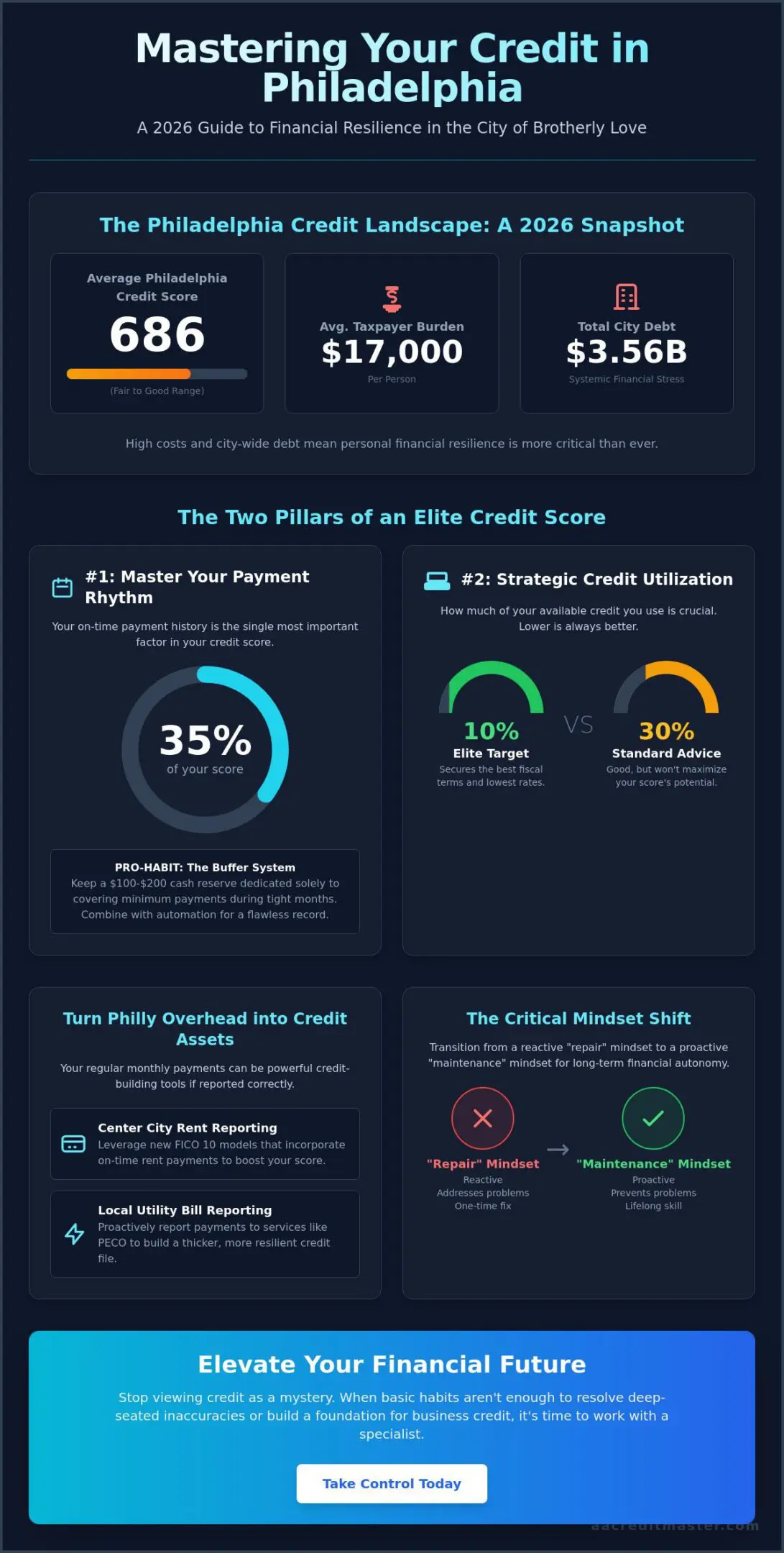
With the average Philadelphia credit score hovering at 686 in early 2026, many residents are realizing that a high income doesn’t automatically guarantee the best interest rates. You might feel the constant pressure of the city’s $17,000 taxpayer burden or worry that a single missed utility bill could tank your progress. Mastering the right financial habits to maintain good credit in Philadelphia is about more than just paying bills; it’s about understanding the specific local rhythms of the Philly market.
We understand that the high cost of living in neighborhoods from Fishtown to Center City makes debt management feel like a constant struggle. You deserve a clear path toward lower interest rates and the ability to secure better rental terms without the fear of predatory lenders. This guide provides the expert reassurance and technical knowledge you need to take control of your financial future.
You will learn how to leverage new rent reporting trends and the latest FICO 10 models to your advantage. We will explore how to build a foundation for business credit while maintaining a personal score that stands up to the toughest institutional scrutiny. It’s time to stop viewing credit as a mystery and start acquiring the skills that lead to permanent financial autonomy.
Key Takeaways
- Understand how your credit score acts as a vital tool for navigating the rising costs of living in Northern Liberties and other evolving Philadelphia neighborhoods.
- Master the specific financial habits to maintain good credit in Philadelphia by prioritizing a payment rhythm that accounts for 35% of your total score.
- Learn why elite credit achievers aim for a 10% credit utilization ratio rather than the standard advice of 30% to secure the best possible fiscal terms.
- Discover how reporting your local utility bills and Center City rent can proactively turn your monthly overhead into a powerful credit-building asset.
- Identify when to transition from basic habits to working with a Credit Score Specialist to resolve deep-seated report inaccuracies.
The Philadelphia Credit Landscape: Why Maintenance Matters in 2026
In Philadelphia, your credit score is the silent engine behind every major move you make. Whether you’re eyeing a rehabbed rowhome in Northern Liberties or planning a startup in Center City, credit is the currency of opportunity. By 2026, the economic environment in Pennsylvania has shifted significantly. With a taxpayer burden of approximately $17,000 per person and city debt reaching $3.56 billion, individual financial resilience is no longer optional. Adopting the right financial habits to maintain good credit in Philadelphia allows you to distance yourself from these systemic stresses and build a private sanctuary of stability.
Mastering your score provides a vital buffer against the rising costs of living. High-demand neighborhoods require more than just a proof of income; they demand a proven track record of fiscal responsibility. We view credit not as a static grade, but as a dynamic reflection of your daily choices. Transitioning from a “repair” mindset to a “maintenance” mindset is the first step toward lifelong autonomy. This proactive approach ensures you’re never caught off guard by economic shifts or predatory lending practices that often target those with fluctuating scores.
The Real Cost of a Mediocre Score in Philly
A mediocre score acts as an invisible tax on your lifestyle. On a standard Philadelphia rowhome mortgage, the difference between a 660 and a 740 score can cost you tens of thousands of dollars in interest over the life of the loan. These are funds that could otherwise go toward your retirement or your child’s education. Beyond the mortgage, local insurance providers and landlords in neighborhoods like South Philly use your score to determine security deposits and monthly premiums. Lowering these upfront costs through consistent financial habits to maintain good credit in Philadelphia puts cash back in your pocket immediately. You deserve the emotional freedom that comes with being “loan-ready” at any moment, knowing that your foundation is secure.
Credit as a Financial Skill, Not a Static Number
We believe understanding your credit score is a capability you can conquer through repetition and strategy. It’s about moving away from the idea of “fixing” credit as a one-time event. Instead, focus on building a financial legacy. This involves setting clear 2026 goals, whether that’s moving from a subprime 600 to an elite 800+ or simply stabilizing your current standing.
- Proactive Intervention: Address inaccuracies before they impact your borrowing power.
- Skill Acquisition: Learn the mechanics of reporting cycles to timing your payments perfectly.
- Personal Agency: Take ownership of your data rights under the new 2026 CFPB rules.
When you view credit management as a skill, you stop being a victim of the system. You become a savvy participant who knows exactly how to leverage every dollar for maximum impact. This shift in perspective turns a source of anxiety into a source of power.
Mastering the Payment Rhythm: The #1 Habit for Success
Establishing a flawless payment history is the most effective way to protect your financial standing. In the FICO scoring model, your track record of on-time payments accounts for a massive 35% of your total score. Given that credit card interest rates reached historic highs in early 2026, missing even one cycle can trigger a cascade of expensive penalties and downward score adjustments. Adopting proactive financial habits to maintain good credit in Philadelphia means moving beyond a “hope for the best” approach. You need a system that ensures your obligations are met before you even think about discretionary spending.
Automation is your first line of defense, but it isn’t a “set it and forget it” solution. While automated transfers prevent simple forgetfulness, they don’t account for the timing of your local income or unexpected bank fees. We recommend the “Buffer Habit.” This involves keeping a dedicated cash reserve, even just $100 to $200, specifically to cover minimum payments during tight months. Combining this safety net with Strategic Credit Utilization ensures that your accounts remain in good standing even when life in the city gets unpredictable. If you’re unsure how to balance these competing priorities, seeking professional Credit Education can provide the personalized roadmap you need.
The 5-Step Automation Framework
Consistency is a skill you can master. Follow this methodical framework to solidify your payment rhythm:
- Audit Billing Cycles: List every recurring Philadelphia-based bill, including PECO, PGW, and your local gym.
- Align Paychecks: Contact your creditors to move due dates so they fall within 48 hours of your primary Philly paycheck.
- Safety Net Alerts: Enable “Low Balance” and “Payment Posted” notifications with your local credit union or bank.
- Manual Verification: Schedule a ten-minute “Financial Audit” on the 15th of every month to verify that your automated systems performed as expected.
The “Grace Period” Myth
Don’t confuse a late fee with a reported late payment. Most creditors charge a late fee the moment you’re 24 hours past the deadline, but they typically don’t report the delinquency to the credit bureaus until you are a full 30 days late. If you realize you’ve missed a deadline by a day or two, call the institution immediately. Pay the balance and politely ask for a fee waiver. For those focused on financial habits to maintain good credit in Philadelphia, this immediate intervention prevents a minor hiccup from becoming a permanent mark on your record. If a late mark does appear, a well-crafted “Goodwill Letter” can sometimes restore your status, provided you’ve maintained a clean history otherwise. Personal agency is your greatest asset here; standing between yourself and impersonal institutions is how you win.
Strategic Credit Utilization for the Savvy Philadelphian
Maintaining a high credit score requires more than just paying on time; it demands precise control over your credit utilization. This ratio, which measures your outstanding balances against your total available limits, accounts for roughly 30% of your score. While many local institutions suggest keeping this number below 30%, elite scorers in the Philadelphia metro area know that the real target is 10% or less. High credit utilization suggests to lenders that you’re overextended, even if you plan to pay the balance in full by the due date. Mastering the financial habits to maintain good credit in Philadelphia involves understanding that the balance reported to the bureaus is often the one on your monthly statement, not the one after your payment clears.
You can effectively manipulate this reported balance by adopting the habit of “Micro-Payments.” Instead of waiting for a single monthly bill, make small payments every time you receive a paycheck or after a large purchase. This proactive intervention ensures your reported utilization remains low, protecting your score from the volatility of large monthly expenses. Following the guidelines for a strong credit score provided by the CFPB is a great starting point, but true mastery comes from these personalized timing strategies. By keeping your balances near zero throughout the month, you demonstrate a level of personal autonomy that traditional automated tools simply cannot replicate.
The Mid-Month Check-In Habit
Your statement closing date is the most important day of the month for your credit score. This is the date your lender “snapshots” your balance and sends it to the credit bureaus. To keep your score high, set a calendar alert for three days before this date. Paying your balance down before the statement closes ensures that the credit bureau sees a low utilization rate, even if you spend heavily during the rest of the month. This simple shift in timing provides an immediate boost to your borrowing power without requiring you to spend a penny more than usual. Seeing a zero balance every two weeks also provides a psychological win that reinforces your commitment to long-term stability.
Requesting Limit Increases Without Hard Inquiries
Increasing your total available credit is a powerful way to lower your utilization ratio instantly. Make it a habit to request a limit increase every six to twelve months on your most-used accounts. When you call, specifically ask if the increase can be processed using a “soft pull” rather than a hard inquiry. Most major lenders allow this if your account has been in good standing for a consistent period. These increased limits should be viewed as a tool for score stability, not an invitation for more spending. This strategy, combined with other financial habits to maintain good credit in Philadelphia, creates a robust foundation that can withstand the occasional large purchase without tanking your score.
Local Nuances: Utilities, Rent, and Philadelphia Reporting
Philadelphia residents often overlook the reporting power of their monthly overhead. While traditional credit cards are vital, your daily financial habits to maintain good credit in Philadelphia must extend to your municipal accounts. As of 2026, the trend of reporting utility and rent payments to major bureaus has accelerated. Payments to Philadelphia Gas Works (PGW) and the Philadelphia Water Department (PWD) can now actively influence your profile. By using tools like Experian Boost, you can link these local accounts and your streaming services to your credit report, providing an immediate lift to your score without taking on new debt. This proactive intervention turns your necessary city living expenses into a strategic advantage.
Establishing a rigorous habit for disputing local inaccuracies is equally important. Philadelphia-based collections, often stemming from old utility bills or municipal fees, can be notoriously difficult to resolve without a clear strategy. You must become a protective guardian of your own data. This means reviewing your reports specifically for errors related to Philly institutions. If you encounter resistance from local creditors or find deep-seated errors that habits alone cannot fix, consulting a Philadelphia Credit Score Specialist can provide the professional leverage needed to restore your standing.
Turning Your Philly Rent into a Credit Asset
Your largest monthly expense should be working for you. Whether you are renting a loft in Northern Liberties or a rowhome in South Philly, your on-time rent can now be reported to Equifax, Experian, and TransUnion. Several rent-reporting services are now available to Pennsylvania tenants, allowing you to build a “Clean Rental Record” that lenders view as a sign of high-level fiscal responsibility. Make it a habit to verify that your rental history appears correctly on your consumer reports at least twice a year. This verification ensures your housing stability translates directly into lower interest rates for future home purchases.
Navigating Philadelphia Utility Disputes
Billing errors from local utility companies can happen, and they often threaten your score if left unaddressed. Developing a “Paper Trail” habit is your best defense. Keep digital or physical records of every PGW and PWD payment, including confirmation numbers and dates. If a local utility reports an unfair delinquency, you can file a formal complaint with the Pennsylvania Public Utility Commission (PUC) to initiate a third-party review of the dispute. This methodical approach ensures that administrative mistakes don’t derail your long-term financial goals.
Elevating Your Financial Future with Allen & Allen, Inc.
Daily discipline serves as the bedrock of a strong score. However, even the most disciplined financial habits to maintain good credit in Philadelphia cannot always overcome deep-seated inaccuracies or systemic reporting errors. When you’ve automated your payments and optimized your utilization but still see a stagnant score, it’s time to shift from solo management to expert intervention. Allen & Allen, Inc. acts as your advocate, standing between you and the large, impersonal bureaus that often ignore individual disputes. This partnership provides the expert reassurance you need when the clinical reality of credit reporting feels overwhelming.
Our “Post-Performance” philosophy ensures our goals are perfectly aligned with yours. We win when you win. This means we focus on proactive restoration and skill acquisition rather than temporary fixes. Once your personal score is stabilized, you can begin building business credit in Philadelphia. This transition allows entrepreneurs to separate their personal liabilities from their professional ventures, creating a dual-layer of financial protection. By mastering these systems now, you prepare yourself for a future of personal autonomy and long-term stability.
Customized Consulting for Philly Entrepreneurs
Generic apps often fail to account for the unique economic pressures of our city, such as the high cost of living or the specific local utility reporting cycles we’ve discussed. We provide a human element that automated tools simply cannot match. By working with a seasoned mentor, you move beyond basic tips toward mastering your finances in Philadelphia. We tailor every restoration strategy to your specific life milestones, whether that is qualifying for a mortgage in a competitive neighborhood or securing a commercial lease. This personalized approach turns financial management into a capability you conquer for life, rather than a metric you fear.
Your Next Move: A Personalized Credit Roadmap
Taking the first step toward restoration shouldn’t be intimidating. During your initial consultation, our Philly team conducts a methodical review of your profile to identify the specific roadblocks holding you back. We leverage the latest 2026 consumer data rights, including the federal rules implemented by the CFPB in April, to ensure you have full control over your information. We work diligently to remove inaccuracies from your credit report, ensuring your data reflects your true fiscal responsibility.
You have the power to change your trajectory starting today. By combining your new financial habits to maintain good credit in Philadelphia with our expert consulting, you build a foundation that lasts. Secure your financial autonomy for 2026 and beyond. Take action now to ensure your credit score becomes a tool for your success rather than a barrier to your dreams.
Claim Your Place in Philadelphia’s Financial Future
Success in the 2026 Philly market depends on your ability to treat credit as a conquerable skill. You’ve learned how to navigate the specific local reporting rhythms and strategic utilization targets that define elite scores. These financial habits to maintain good credit in Philadelphia are more than just rules; they are the foundation for your future home, business, and peace of mind. By moving from a passive state of worry to a proactive state of mastery, you distance yourself from systemic economic pressures and reclaim your agency.
Allen & Allen, Inc. stands ready to help you navigate the complexities of the current landscape. We offer deeply localized expertise and tailored strategies that bridge the gap between your personal standing and your professional goals. Because we utilize a post-performance fee structure, you only pay for the tangible results we achieve on your behalf. Start your journey to credit mastery with a professional consultation at Allen & Allen, Inc. You deserve a financial future built on restoration and long-term stability.
Frequently Asked Questions
Do Philadelphia utility bills like PGW or PWD show up on my credit report?
Traditional utility bills from Philadelphia Gas Works (PGW) or the Philadelphia Water Department (PWD) don’t automatically appear on your credit report. These accounts typically only surface if they become severely delinquent and move to a collection agency. However, you can proactively add these positive payments to your profile using third-party reporting services or tools like Experian Boost. This turns your necessary monthly city overhead into a strategic asset for score improvement.
How long does it take for a new financial habit to change my credit score?
Expect to see initial changes in your credit score within 30 to 45 days of implementing a new habit. Most creditors report data to the bureaus once per month based on your specific statement closing date. Consistent financial habits to maintain good credit in Philadelphia produce cumulative results, meaning your score will continue to climb as your history of on-time payments and low utilization matures over several months.
Can I maintain good credit in Philadelphia if I have a low income?
Maintaining a top-tier credit score is entirely possible regardless of your income level. Credit scoring models prioritize your reliability and debt management skills over the size of your paycheck. By mastering the rhythm of your local obligations and keeping your credit utilization below 10%, you can achieve an elite score. This standing helps you offset the high cost of living in neighborhoods like Northern Liberties by qualifying for the lowest possible interest rates.
Is it better to pay off my credit card balance in full or leave a small amount?
Paying your balance in full every month is always the superior strategy for your financial health. Carrying a small balance does not improve your score; it only triggers unnecessary interest charges, which have reached historic highs in early 2026. Aiming for a zero balance before your statement closes ensures your reported utilization remains low. This habit proves to lenders that you can manage credit without becoming dependent on high-interest debt.
How does renting an apartment in Philadelphia affect my credit score?
Renting an apartment in Philadelphia only impacts your credit score if you or your landlord utilize a rent-reporting service. When these payments are reported to the major bureaus, they add a history of housing stability to your profile. This is particularly beneficial for residents in South Philly or Center City who want their largest monthly expense to help them qualify for future mortgage terms or business credit.
What is the fastest way to lower my credit utilization ratio?
Paying down your outstanding balances immediately is the fastest way to lower your utilization ratio. If you can’t pay the full balance, making multiple “micro-payments” throughout the month will keep the reported amount low. Another effective tactic is requesting a credit limit increase on your existing accounts, provided the lender performs a soft inquiry. These actions can result in a score increase as soon as your next statement cycle reports.
How often should I review my credit report for inaccuracies in Philadelphia?
Review your credit report for inaccuracies at least once a month to protect your financial standing. In a complex urban market, administrative errors with local municipal accounts or neighborhood creditors can occur. Catching these mistakes early allows you to perform a proactive intervention before the errors impact your borrowing power. Regular monitoring is a foundational skill that ensures your financial habits to maintain good credit in Philadelphia aren’t undermined by data errors.
Does checking my own credit score through an app hurt my credit?
Checking your own credit score through a monitoring app or your bank is considered a “soft inquiry” and will never hurt your credit. Only “hard inquiries” performed by lenders during a formal loan or credit application can cause a temporary dip in your score. Regularly monitoring your own data is an essential habit for personal autonomy, allowing you to track your progress and identify potential identity theft before it causes lasting damage.