
How Long Do Negative Items Stay on Your Credit Report in PA? (2026 Guide)
What if that “permanent” mark on your credit isn’t actually permanent? You’ve likely felt the sting of a loan denial or the crushing weight of a past mistake that seems to follow you through every financial decision. It’s exhausting to feel like your future is on hold because of a clock you can’t see. Understanding exactly how long do negative items stay on credit report PA is the first step toward taking back control of your life.
Mastering your credit score starts with knowing the rules of the game. This guide provides the clarity you need to stop guessing and start acting. We’ll explore the reporting timelines for bankruptcies and collections while showing you how a credit score specialist helps you acquire the skills for restoration. You’ll move from a state of worry to a state of progress as we break down the difference between Pennsylvania’s four year statute of limitations and the federal reporting windows. This is your path to personal autonomy and a restored financial standing.
Key Takeaways
- Distinguish between the federal 7-year reporting window and the Pennsylvania 4-year statute of limitations to protect your legal rights.
- Identify the exact removal dates for late payments and charge-offs to determine exactly how long do negative items stay on credit report PA.
- Avoid the “wait and see” trap that keeps you paying high interest rates while outdated marks linger on your file.
- Discover how a credit score specialist acts as your guardian against large reporting institutions to accelerate your recovery.
- Acquire the foundational skills needed to transform credit management from a source of stress into a capability you master.
The Federal Baseline: Understanding the 7-Year Credit Reporting Rule
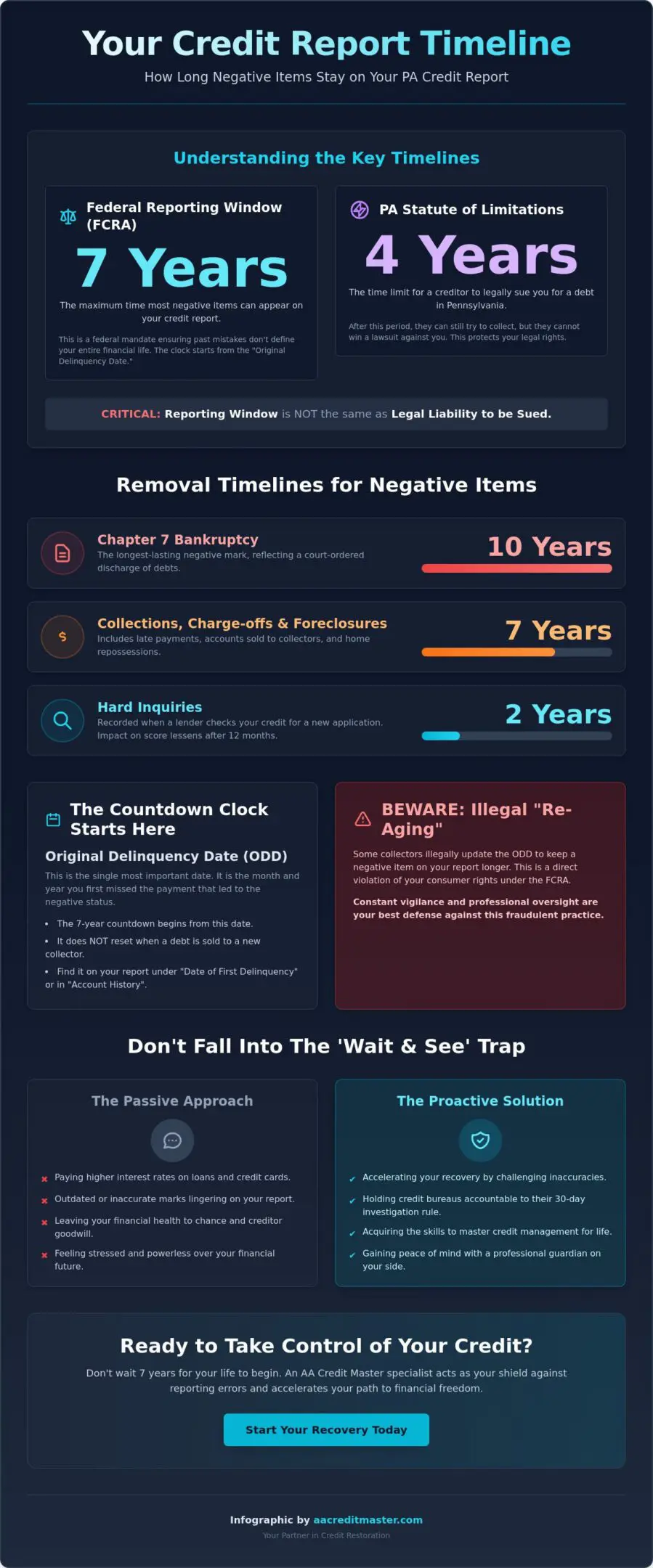
The Fair Credit Reporting Act (FCRA) is the shield that protects your financial reputation. While you may be searching for how long do negative items stay on credit report PA, it’s crucial to understand that these federal standards apply to every resident from Erie to Philadelphia. Most negative markers, like late payments or collections, are legally required to fall off your report seven years from the date they first occurred. This is a mandate, not a suggestion. These rules exist to ensure that a past mistake doesn’t define your entire financial life.
Reporting agencies often treat your data as an asset they own, but the law views it differently. Accuracy is the only metric that matters. If a bureau cannot verify a piece of information or if the timeline has expired, that data must be removed immediately. Your positive credit history can remain on your report indefinitely. This provides a permanent boost to your score as you build a track record of reliability and fiscal responsibility.
The burden of proof lies with the credit bureaus, not with you. When you challenge a piece of information, the bureau must investigate and confirm its validity within 30 days. If they can’t find the original documentation or the creditor fails to respond, the item must vanish. This is where a credit score specialist becomes your most powerful ally. We stand between you and these impersonal institutions to ensure your report reflects the truth, not just a collector’s record.
The ‘Original Delinquency Date’ Explained
Your seven year countdown doesn’t start when a debt is sold to a collector. It starts at the “Original Delinquency Date.” This is the specific month and year you first missed a payment that led to the account being charged off or sent to collections. It acts as the anchor for your entire recovery timeline. Some collectors attempt “re-aging,” which is the illegal act of updating this date to keep a negative item on your report longer. This is a direct violation of your consumer rights. You can find this date by looking at the “date of first delinquency” or “account history” section on your Experian, Equifax, or TransUnion reports.
Why Some Items Stay Longer Than Others
Not all financial setbacks are treated equally by the reporting system. While standard late payments vanish after seven years, Chapter 7 bankruptcies can linger for up to ten years. Understanding how long do negative items stay on credit report PA helps you map out a strategy, but simply waiting for the clock to run out is a passive approach that leaves your financial health to chance. Financial management is a capability you can conquer through proactive Mastering Your Finances: A Guide to Credit Education in Philadelphia. By treating credit as a skill to be acquired rather than a static number, you gain the agency to navigate these complex rules and move toward a stable future.
Timelines for Specific Negative Items on PA Credit Reports
Understanding the specifics of how long do negative items stay on credit report PA allows you to plan your financial recovery with precision. While the general rule is seven years, different types of derogatory marks carry unique reporting lifecycles. Knowing these dates prevents you from living in a state of perpetual worry about your past. It’s about moving from a state of worry to a state of action. You deserve to know when your record will finally reflect your current financial habits.
- Late Payments: These remain for seven years from the month the payment was originally due.
- Collections and Charge-offs: These stay for seven years plus 180 days from the original delinquency date, regardless of how many times the debt is sold to new collectors.
- Foreclosures and Short Sales: Expect these to impact your ability to secure a new PA mortgage for seven years.
- Hard Inquiries: These stay for two years, but they typically only lower your score for the first 12 months.
Following federal credit reporting timelines ensures that your report remains a fair representation of your current habits. If you’re feeling overwhelmed by these dates, consulting with a credit score specialist can help you identify exactly when these items should disappear. We act as your protective guardian, ensuring that impersonal institutions don’t overstep their legal boundaries.
The Bankruptcy Exception: 7 vs. 10 Years
Chapter 13 bankruptcy is usually removed seven years from the filing date because it involves a partial repayment plan. In contrast, a Chapter 7 bankruptcy remains for 10 years because it involves a total discharge of debt. While these timelines seem long, the negative impact of a bankruptcy fades significantly over time as you build new, positive credit history. You don’t have to wait for the item to drop off to start seeing score improvements.
Tax Liens and Civil Judgments
The reporting landscape changed significantly with the National Consumer Assistance Plan. Most paid tax liens and civil judgments no longer appear on standard consumer credit reports because they often lacked sufficient identifying data. However, these “invisible” items aren’t truly gone. Lenders may still find them during deep background checks or through specialized public record databases when you apply for major financing in Pennsylvania. This is why foundational knowledge is a permanent solution rather than a temporary fix.
Focusing on how long do negative items stay on credit report PA is only half the battle. You must also proactively monitor for inaccuracies. Outdated information often lingers past its legal limit unless you take action to remove it. Mastering the skill of credit management ensures these timelines work for you, not against you.
Pennsylvania Nuances: Local Laws and Statute of Limitations
Pennsylvania residents enjoy protections that go beyond federal standards. While you now know how long do negative items stay on credit report PA based on federal law, the state’s Fair Credit Extension Uniformity Act (FCEUA) adds an extra layer of security. This law governs how debt collectors can interact with you and what they can report. Understanding the interplay between state and federal law is a vital financial skill. It transforms you from a worried bystander into a knowledgeable consumer who commands their own financial future. You gain immediate confidence when you realize the law is designed to prevent lenders from holding your past over your head forever.
PA Statute of Limitations vs. Credit Reporting
Legal liability and credit reporting are two different beasts. In Pennsylvania, the statute of limitations for most debts is generally four years. This means a creditor loses the legal right to sue you for the balance once that window closes. However, that same debt can legally remain on your credit report for the full seven year federal limit. You must be careful with your actions during this period. Making even a small partial payment on an old debt can restart that four year legal clock. This gives collectors a fresh chance to take you to court and secure a judgment. Handling debt collectors in the Philadelphia area requires a firm grasp of these FCEUA protections. You should always verify that a collector has comprehensive documentation before acknowledging a debt, a standard that the proposed PA HB1731 aims to strengthen for all residents.
The Role of the PA Attorney General in Credit Disputes
Escalating a dispute to the Pennsylvania Attorney General is a powerful move when credit bureaus refuse to correct verified errors. Local expertise is the human element that automated apps simply cannot replicate. A consulting company with deep roots in the region understands these specific local channels and how to navigate them effectively. This is why expert credit repair services in Philadelphia are so effective. They know exactly how to leverage state level resources to hold reporting institutions accountable. You aren’t just hiring a service; you’re gaining a protective guardian who knows where the pitfalls lie in the PA system.
Philadelphia specific rental history reporting can also impact your local housing options. Landlords often use specialized databases that track evictions or missed payments even if they don’t appear on a standard report. Mastering your credit profile is a permanent solution. It ensures these local nuances don’t block your path to a new home or a better interest rate. By treating financial management as a capability to be conquered, you ensure that you stay ahead of the reporting clock. Knowing how long do negative items stay on credit report PA is the foundation of this mastery, allowing you to time your applications for maximum success.
The ‘Wait and See’ Trap: Why Passive Credit Management Fails
Waiting seven years is a financial sentence you don’t have to serve. Many people ask how long do negative items stay on credit report PA because they want to know when the pain of a past mistake finally ends. But a passive approach is a trap. It keeps you locked into high interest rates that drain your savings every single month. You pay for your silence in the form of thousands of extra dollars on car loans, credit cards, and mortgages. Taking proactive steps today can save you a fortune tomorrow.
The law doesn’t just say negative items can stay for seven years. It mandates that every piece of data must be reported with “maximum possible accuracy.” If a record is unverifiable, incomplete, or outdated, it has no legal right to remain on your file. Active credit restoration is about demanding this standard. You take agency over your report. You stop fearing the data and start auditing it. This shift in mindset transforms your credit from a source of anxiety into a tool for personal autonomy.
Common Reporting Errors That Don’t Go Away on Their Own
Inaccurate information often sticks to your file like glue unless you intervene. Duplicate collections are a prime example. This happens when a debt is sold multiple times and each new buyer reports it as a separate negative entry. This artificially deflates your score and makes your history look worse than reality. Mixed files are another common hazard. This is where a stranger’s negative data appears on your PA report simply because you share a similar name or social security digits. Entrepreneurs face these same hurdles, which is why a Philadelphia Business Credit Report Check is essential for protecting your professional reputation and securing capital.
Acquiring the Skill of Credit Mastery
Think of your credit report as a financial resume. It needs periodic updates to reflect who you are today, not who you were years ago. In 2026, reporting standards are more rigorous than ever before. Verification now requires actual proof, not just a line in a digital database. Acquiring the skill of credit management turns a static metric into a capability you master. It’s a permanent solution that ensures you never feel helpless in the face of big banks again. You deserve a report that reflects your true potential.
You don’t have to navigate this complex landscape alone. Working with a credit score specialist provides you with a protective guardian who knows how to spot these errors and demand the accuracy you deserve. By taking action now, you ensure that the question of how long do negative items stay on credit report PA becomes a footnote in your success story rather than a barrier to your future.
How an AA Credit Master Specialist Can Accelerate Your Recovery
Regaining your financial freedom shouldn’t be a solo journey through a thicket of federal regulations and local laws. We function as your protective guardian against large, impersonal reporting institutions that often prioritize their data sets over your personal well-being. While you now understand how long do negative items stay on credit report PA, simply knowing the dates isn’t enough to force a change. You need a dedicated ally who knows how to hold these companies accountable to the highest standards of accuracy.
Confidence comes from knowing your interests are perfectly aligned with your consultant’s goals. Our post-performance fee structure ensures we only succeed when you see tangible results on your report. This eliminates the risk of paying for empty promises or automated processes that fail to deliver. Philadelphia residents deserve a customized strategy rather than the generic software solutions offered by national competitors. The human element is what allows us to navigate the complexities of your specific history with the care and precision you deserve.
Our Tailored Philadelphia Credit Restoration Process
Restoring your score requires a methodical, step-by-step auditing of every negative line item on your file. We don’t just look at the dates; we scrutinize the data for inconsistencies and missing documentation. Unverifiable or outdated information often sticks to reports long after the legal seven year clock should have expired. Our role is to identify these discrepancies and demand their removal. Throughout this process, you receive mentor-led guidance that replaces overwhelm with a clear sense of momentum. You’re not just fixing a number; you’re acquiring a lifelong capability.
Beyond Personal Credit: Building Your Philly Business
Transitioning from fixing your past to building your future is the ultimate goal of credit mastery. Restoring your personal credit profile is the key that opens doors for building business credit in Philadelphia. For local entrepreneurs, this synergy between personal autonomy and business growth is transformative. It allows you to secure the capital needed to expand your reach without relying solely on your personal assets. We invite you to a consultation to craft your personalized credit roadmap. Let’s move beyond the question of how long do negative items stay on credit report PA and start focusing on the milestones you’re ready to achieve.
Secure the Financial Freedom You Deserve
You now possess the clarity to distinguish between federal reporting windows and Pennsylvania’s specific legal protections. While understanding how long do negative items stay on credit report PA is foundational, your true power lies in proactive intervention. Waiting for a seven year clock to expire is a choice that costs you thousands in lost opportunities and inflated interest rates. You don’t have to accept a report that reflects your past rather than your potential. Taking agency over your data is the first step toward personal autonomy.
Our tailored Philadelphia based consulting focuses on identifying the unverifiable reporting errors that automated tools often miss. We stand as your protective guardian, using a CROA compliant post-performance fee structure to ensure our success is tied directly to your results. This is about more than just a score; it’s about acquiring the permanent capability to manage your financial life with confidence. Take control of your financial future today with AA Credit Master’s expert consulting. Your journey toward restoration starts the moment you decide to stop waiting and start acting.
Frequently Asked Questions
Can negative items be removed before the 7-year mark in PA?
Yes, you can remove negative items early if they fail the legal test of “maximum possible accuracy.” Federal law mandates that every line item must be verifiable, timely, and complete. If a bureau cannot confirm the details of a specific debt within 30 days of a dispute, that item must be deleted. This is a primary reason to consult a credit score specialist rather than just waiting for the clock to run out.
Does paying a collection account remove it from my credit report?
Paying a collection account usually changes the status to “Paid” rather than removing the entry entirely. While the mark remains, many modern scoring models ignore paid collection accounts when calculating your score. You can also attempt to negotiate a “pay for delete” agreement with the creditor before sending funds. This strategy requires written confirmation to ensure the collector actually follows through with the removal from your file.
What happens if a negative item stays on my report longer than 7 years?
You must dispute any negative item that lingers past the legal reporting limit immediately to protect your score. Credit bureaus are legally obligated to purge data once it hits the seven year mark, or ten years for certain bankruptcies. If you notice expired data, it means the bureau’s automated system has failed. Filing a formal dispute forces a manual review and ensures your report reflects your current financial standing accurately.
Is there a different reporting limit for private vs. federal student loans in PA?
No, the reporting limit for both private and federal student loans is typically seven years under the FCRA. The main difference lies in how you recover from a default. Federal loans offer a one time rehabilitation program that can remove the default status from your history entirely. Private lenders in Pennsylvania rarely offer such paths, making it even more important to understand exactly how long do negative items stay on credit report PA for these specific accounts.
How do I dispute an inaccurate late payment on my Philadelphia credit report?
Start by gathering your bank statements or canceled checks that prove you paid on time. You should then send a formal dispute letter to each credit bureau reporting the error. Be specific about why the entry is wrong and include your evidence. Local expertise helps here because a specialist can help you leverage both federal and state protections to ensure the bureau takes your claim seriously and acts quickly.
Can a PA debt collector ‘re-age’ my debt to keep it on my report longer?
Re-aging debt is an illegal practice that you should never tolerate. A collector cannot restart the seven year reporting clock simply by selling the debt or receiving a partial payment. The timeline is strictly anchored to the original delinquency date with the initial creditor. If a collector attempts to move this date forward to extend the reporting window, they are violating your rights and the item becomes eligible for immediate deletion.
Will a bankruptcy in PA affect my ability to get a job or an apartment?
It might impact some applications, but the effect isn’t permanent or total. Many Philadelphia landlords look at your most recent 24 months of history more closely than a past bankruptcy. You can overcome these hurdles by acquiring the skills to build new, positive credit lines. Showing a consistent track record of on time payments after a filing proves your financial capability and helps you secure housing and employment regardless of your past.