
Pay for Delete Letter Philadelphia: Negotiating Debt Removal in 2026
What if a single one-page document could save you $45,000 in interest over the life of your next home loan? In 2026, a high credit score is the only thing standing between you and the keys to a new property in Fairmount or Chestnut Hill. You likely feel the crushing weight of every collection call and the confusion of seeing a city tax lien mixed in with private debt. It’s a heavy burden that keeps your FICO score trapped in the low 600s, but you don’t have to accept a permanent mark on your record. By utilizing a strategic pay for delete letter Philadelphia, you can negotiate directly with creditors to wipe the slate clean. If you master this negotiation, then you unlock the door to the lowest available mortgage rates and true financial freedom.
We understand that the credit system often feels like it’s designed to keep you down. This guide changes that reality by offering expert reassurance and a proven roadmap for debt removal. You’ll learn how to identify which marks are eligible for deletion, how to communicate with aggressive agencies, and how to ensure the bureaus reflect your new, clean status. We’re going to break down the exact steps to transform your credit report from a source of anxiety into a powerful financial asset. It’s time to take back control and start rebuilding your legacy today.
Key Takeaways
- Secure your future in the Philadelphia housing market by mastering the negotiation tactics needed to remove derogatory items.
- Protect your rights by understanding how the FCRA and Pennsylvania consumer laws support your debt removal strategy.
- Determine if sending a pay for delete letter Philadelphia is the right move for your debt by analyzing the Pennsylvania statute of limitations.
- Draft a professional, non-judgmental offer letter that encourages collection agencies to settle on your terms.
- Take back control of your financial legacy by building a permanent foundation of credit mastery after negative items are removed.
What is a Pay for Delete Letter and Why Does it Matter in Philadelphia?
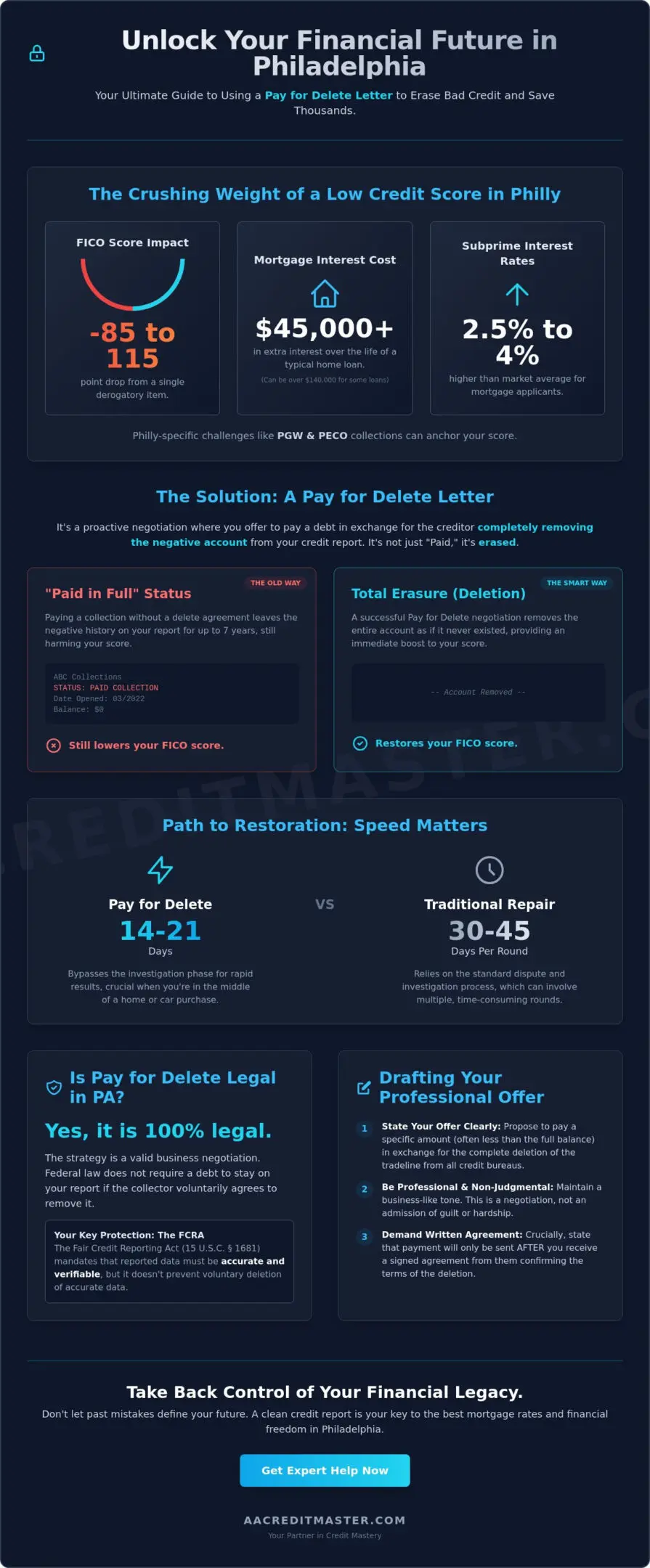
A pay for delete letter Philadelphia is your most powerful tool for immediate credit restoration. It functions as a proactive negotiation offer where you agree to pay a debt in exchange for the creditor removing the entire account from your credit report. This is not a request for a “Paid in Full” status. It is a request for total erasure. By 2026, lenders have moved toward highly sensitive trended data models. These models penalize any history of delinquency, even if the balance is zero. If you want to qualify for the best financial products, you need a clean slate, not just a satisfied debt.
While the Fair Credit Reporting Act governs the accuracy and privacy of your data, it doesn’t prevent a collection agency from voluntarily deleting a trade line. This distinction is vital for Philadelphia residents aiming to secure a mortgage or a premium rental in neighborhoods like Fishtown or Center City. A “Paid” collection still lowers your score; a deleted collection restores it. Taking back control of your financial narrative starts with understanding that your credit report is a living document, not a permanent sentence.
The Impact of Derogatory Items on Philly Credit Scores
In the 2026 Philadelphia housing market, a single derogatory item can drop a FICO score by 85 to 115 points. This massive decline often pushes local mortgage applicants into subprime territory, where interest rates currently sit 2.5% to 4% higher than the market average. Over a 30 year loan, that 2.5% difference can cost a Philadelphia homeowner over $140,000 in additional interest. Philadelphia residents face unique challenges with utility-related collections from providers like PGW and PECO, which often appear on reports due to administrative errors or residency changes. These specific collections act as anchors, dragging down your score and signaling high risk to local landlords and lenders.
Pay for Delete vs. Traditional Credit Repair
Traditional credit repair focuses on the dispute process, which typically takes 30 to 45 days per round of investigation. A pay for delete letter Philadelphia is often the faster path to restoration because it bypasses the investigation phase entirely. If the creditor agrees to your terms, the removal can reflect on your report within 14 to 21 days. This speed is essential when you’re in the middle of a home search or a car purchase. Using professional credit repair services Philadelphia ensures your negotiation is handled with expert precision. These professionals act as your financial guardian, ensuring the agreement is documented in writing so the creditor cannot take your money and leave the negative mark on your record.
Is Pay for Delete Legal? Understanding Pennsylvania Protections
You can legally wipe away the shadow of past financial mistakes. Using a pay for delete letter Philadelphia is a valid strategy because the law focuses on accuracy rather than mandatory reporting. While credit bureaus like Experian and TransUnion discourage this practice in their service agreements with collectors, no federal statute requires a debt to stay on your report if the collector chooses to remove it. It’s a business negotiation. You’re offering a trade: immediate payment in exchange for the removal of a derogatory item that hinders your financial growth.
Credit bureaus want a complete history to sell to lenders, but they don’t have the final word. When you send a pay for delete letter Philadelphia, you’re initiating a negotiation that is fully compliant with federal standards. Collectors often prefer a guaranteed settlement over the long-term cost of managing a stagnant account. This creates a window of opportunity for you to take back control of your FICO score and secure better interest rates for future home or auto loans.
Fair Credit Reporting Act (FCRA) and Your Rights
The FCRA, specifically 15 U.S.C. § 1681, protects your financial reputation by ensuring all reported data is 100% accurate and verifiable. Understanding your rights in debt collection is the first step toward mastery of your credit profile. The law mandates that if a collector reports information, it must be correct, but it doesn’t force them to report in the first place. A collector might legally choose to stop reporting a debt because the administrative burden of verifying a settled account outweighs the financial incentive of maintaining the entry on your credit report. This flexibility is the foundation of the pay for delete process.
Pennsylvania-Specific Debt Collection Rules
Pennsylvania’s Fair Credit Extension Uniformity Act (FCEUA), found at 73 P.S. § 2270.1, adds a powerful layer of protection for Philly residents. This state law mirrors many federal protections but applies them to both original creditors and third-party collectors. It’s designed to shield you from aggressive tactics that local agencies might use to pressure you into a bad deal. You can spot red flags if a collector uses profane language, calls you before 8:00 AM, or falsely claims that paying a debt will automatically fix your credit without a written deletion agreement.
Before you send a single cent, you must have the agreement in writing on the collector’s official letterhead. A verbal promise over the phone is impossible to enforce and often leads to the “paid collection” trap, which still hurts your score. If you want to ensure your negotiation is handled with professional precision, a personalized credit strategy can help you navigate these legal waters with confidence. Having a paper trail transforms a risky gamble into a documented victory for your financial legacy.
The Decision Framework: Should You Send a Letter?
Sending a pay for delete letter Philadelphia is a strategic strike, not a random guess. You need a map before you start the engine. Mastery of your credit report begins with a cold, hard look at the facts. You must determine if the debt is legally enforceable and if the collector has the right to report it. Every action you take should move you closer to financial freedom, so don’t rush this process.
Analyze the age of the debt immediately. In Pennsylvania, the statute of limitations for most consumer debts, including credit cards and oral contracts, is 4 years under Title 42, § 5525. If your debt is older than 4 years, the collector cannot successfully sue you to collect. This gives you massive leverage. You should also identify the holder of the debt. Original creditors like big banks rarely agree to deletions because they prioritize reporting accuracy. However, third-party collection agencies often prioritize cash flow over reporting. They bought your debt for pennies on the dollar, and they’re usually willing to negotiate to secure a profit. Use the Fair Debt Collection Practices Act (FDCPA) to verify that these agencies are following federal law during your negotiations.
When Pay for Delete is the Right Move
This tactic works best for small, verifiable debts that are clearly yours. If you owe a $150 medical bill or a $200 old utility balance, a pay for delete letter Philadelphia is often the fastest way to see a score increase. These “nuisance” collections carry a heavy weight on your FICO score. Clearing them is a foundational step in any credit education Philadelphia strategy. When the debt is small, the agency is more likely to accept a quick payment in exchange for the administrative task of deleting the tradeline. You gain a clean record, and they gain a quick settlement.
When to Avoid the Pay for Delete Tactic
Never use this tactic for a debt you plan to dispute as inaccurate. If the balance is wrong or the account isn’t yours, paying it validates the error. You also face the risk of “re-aging.” In Pennsylvania, making a partial payment on a debt that is 3 years old can restart the 4-year statute of limitations clock. This resets your legal liability. Additionally, paying a collection without a signed deletion agreement is a mistake. A “paid collection” still counts as a derogatory item. It can stay on your report for 7 years and may not improve your score at all. Always secure the agreement in writing before you send a single cent.
How to Write and Send Your Pay for Delete Letter in Philadelphia
Mastering the credit restoration process requires a tactical approach. Sending a pay for delete letter Philadelphia is your primary tool for removing derogatory items that weigh down your FICO score. Follow these five steps to execute this strategy with precision.
- Step 1: Verify the debt. Before offering a cent, demand a debt validation under the Pennsylvania Fair Credit Extension Uniformity Act. Ensure the agency has the legal right to collect in PA.
- Step 2: Draft your offer. Keep the tone professional. You aren’t begging; you’re proposing a business transaction. Offer a specific settlement amount in exchange for a full deletion of the account from all three bureaus.
- Step 3: Use Certified Mail. Visit a local branch, like the William Penn Annex or the 30th Street Post Office. Send your letter via Certified Mail with a Return Receipt. This creates a legal paper trail that creditors can’t ignore.
- Step 4: Secure a written agreement. Never pay based on a verbal promise over the phone. Wait for a signed letter from the agency that explicitly agrees to your terms.
- Step 5: Execute and verify. Once you have the agreement, pay via a cashier’s check. Monitor your credit report for 30 to 45 days. If the item remains, your written agreement is the evidence needed to file a dispute.
Negotiating with City of Philadelphia Agencies
Dealing with the Philadelphia Department of Revenue or the Water Department (PWD) requires a specialized touch. City agencies often prioritize collection over credit reporting, but delinquent taxes or PGW bills can still end up with third-party collectors like Linebarger Goggan Blair & Sampson. When dealing with city-related debts, emphasize your desire to resolve the municipal obligation to avoid liens. The tone should be civic-minded rather than adversarial. Resolving these items quickly prevents the city from filing a judgment, which is far harder to remove than a standard collection.
Crucial Components of a Successful Letter
Your letter must be legally airtight to protect your rights. Always include a statement that the payment is “not an admission of liability.” This ensures that if the negotiation fails, you haven’t accidentally restarted the statute of limitations on an old debt. Set a firm deadline, typically 15 to 20 days, for the agency to respond and for the deletion to reflect on your report.
Sample Terms Sentence: “Upon receipt of the agreed settlement of $XXX.XX, [Agency Name] agrees to completely remove all references to account #XXXXXX from Equifax, Experian, and TransUnion within 15 business days.”
You have the power to rewrite your financial story. If you’re ready to stop the stress of debt and start building a legacy, it’s time to take back control of your financial legacy with a personalized strategy.
Beyond the Letter: Achieving Long-Term Credit Mastery
Successfully negotiating a pay for delete letter Philadelphia is a significant victory. It clears the wreckage from your financial past. However, a clean slate is not the same as a high credit score. Deleting a collection account removes a negative, but it doesn’t automatically add the positive history lenders require for a mortgage or a low-interest auto loan. Mastery means looking past the immediate fix toward a future of total financial sovereignty.
Your FICO score relies on five distinct factors. Payment history is the most influential, accounting for 35% of your total score. When a derogatory item disappears, you must fill that void with consistent, on-time data. If you don’t have active accounts, your score may stagnate despite the deletion. Open a secured credit line or a credit-builder loan immediately after your report clears. Keep your credit utilization below 10% to show lenders you’re a master of your resources, not a slave to them.
For many Philadelphia residents, personal credit restoration is simply the first step toward a larger goal. Once your personal profile is healthy, you can pivot toward building business credit to fund your entrepreneurial dreams. This transition protects your personal assets while giving your company the leverage it needs to scale. AA Credit Master serves as your Financial Guardian throughout this evolution, ensuring you never backslide into the stress of high-interest debt.
Monitoring Your Progress in 2026
In 2026, credit reporting moves faster than ever. Use real-time tracking tools like MyFICO or Experian to watch your score recover post-deletion. You should also check your Philadelphia business credit report every 30 days if you’re running a company. Stay alert for “zombie debts.” These are old accounts sold to new collection agencies that attempt to re-report the same debt under a different name. It’s a common tactic, but with a vigilant eye, you can stop them before they damage your progress.
Take Back Control of Your Legacy
The shift from being “in debt” to becoming a “master of credit” is psychological as much as it is financial. It’s the moment you realize that you dictate the terms to the banks, not the other way around. While generic software might catch a few errors, it can’t craft a personalized strategy that accounts for your specific life goals. Human expertise is the difference between a temporary boost and a permanent legacy of wealth.
Don’t let your financial future happen by accident. Take back control of your narrative today. Schedule a consultation with an AA Credit Master specialist to build a roadmap that lasts long after the final collection is gone.
Master Your Path to Financial Restoration
Your credit score dictates your access to competitive 3.5 percent down payment mortgages and low interest auto loans. Sending a pay for delete letter Philadelphia is a tactical first step toward erasing derogatory items that suppress your FICO score. You’ve learned that Pennsylvania law provides specific protections for debtors, but the real power lies in your ability to negotiate written agreements before making any payments. If you secure a deletion, your credit report reflects your future potential instead of your past mistakes.
Don’t let a single collection account stop you from building a legacy. Our expert Financial Guardians live and work in Philadelphia, providing the local insight you need to navigate complex bureaus. We focus on a post-performance model; you only pay after we perform. Whether you’re seeking personal restoration or business credit mastery, we provide the tailored strategy you deserve. Take back control of your financial future; consult with a Philadelphia Credit Score Specialist today. You have the power to redefine your financial story starting right now.
Frequently Asked Questions
Is a pay for delete letter Philadelphia residents use legally binding in Pennsylvania?
A pay for delete letter Philadelphia residents use functions as a legally binding contract in Pennsylvania once both parties sign the agreement. If you settle a debt based on the promise of removal, the Pennsylvania Office of Attorney General enforces consumer protection laws that hold collectors to their written word. You’ll gain legal leverage by securing this document before sending a single cent to the agency.
Can I use a pay for delete letter for Philadelphia city tax liens?
You cannot use a standard pay for delete letter for Philadelphia city tax liens because these are public records governed by the Department of Revenue. While private collectors might delete a trade line, the city requires a formal Satisfaction of Lien filed with the Prothonotary’s Office. If you pay your 2025 property taxes in full, the city typically updates the status to satisfied within 30 days.
How much should I offer in a pay for delete negotiation?
Start your negotiation by offering 40% of the total balance to settle the account in exchange for a full deletion. Most collection agencies purchase debt for pennies on the dollar, often as low as $0.04 per $1.00 of debt. If you offer a lump sum payment of 50%, you provide the agency with a 1,150% profit margin, making them much more likely to accept your terms.
What happens if the collection agency refuses my pay for delete offer?
You should wait 30 days and resubmit your offer if the collection agency initially refuses your pay for delete letter Philadelphia request. Persistence pays off because collection floor managers often have monthly quotas to meet by the 30th of each month. If your offer’s rejected, you can also pivot to a formal dispute process via the Fair Credit Reporting Act to challenge the accuracy of the derogatory item.
Will my credit score go up immediately after a deletion?
Your credit score won’t increase the second you pay; instead, you’ll see a change once the bureau processes the deletion, which usually takes 30 to 45 days. If a $500 collection is removed from your report, you could see a FICO score jump of 25 to 40 points. This timeline depends on the reporting cycle of the three major bureaus, Equifax, Experian, and TransUnion.
Should I pay the collector before I get the deletion agreement in writing?
You must never send payment until you have a signed agreement on the collection agency’s official letterhead. Verbal promises don’t hold up in court or during a credit bureau dispute. If you pay without a written contract, the collector can simply mark the account as a paid collection, which still damages your score for seven years. Secure your paper trail first to protect your financial future.
Can AA Credit Master help me write and negotiate these letters?
AA Credit Master provides the personalized strategy you need to draft and negotiate effective pay for delete letters. We act as your Financial Guardian, using our industry expertise to handle the aggressive tactics of debt buyers. If you’re feeling overwhelmed by the process, our team helps you take back control by managing the communication and ensuring every agreement is legally sound.
How does pay for delete affect my ability to get a Philly SBA loan?
Successfully deleting a collection account improves your chances of securing a Philadelphia SBA 7(a) loan, which typically requires a minimum FICO SBSS score of 155. If your report shows active collections, lenders view you as a high-risk borrower. By removing these derogatory items, you’ll demonstrate financial mastery and clear the path to the capital you need for your business expansion.