
Personal vs. Business Credit in Philadelphia: How to Build a Wall of Financial Protection
What if your next big business expansion in Center City was blocked by a credit card you used for office supplies in 2021? According to the 2023 Small Business Credit Survey, 64% of owners use personal funds to cover business expenses, a move that often traps their family’s financial security. Understanding the nuances of personal vs business credit Philadelphia is the only way to ensure your mortgage and your company’s growth don’t collide. You’ve worked too hard to let a simple reporting error or a high utilization rate on a personal card derail your legacy.
You likely agree that it’s exhausting to manage a profitable company while your personal credit score takes a hit for every inventory purchase. If you separate these profiles correctly, then you can double your access to capital without risking your own home. This article provides a clear roadmap to financial separation and shows you how to shield your personal assets from business liabilities. We’ll examine the specific reporting differences between your SSN and EIN; we’ll also provide the exact steps to take back control of your financial future today.
Key Takeaways
- Separate your SSN from your EIN to build a financial firewall that shields your personal assets from business liabilities.
- Identify the specific bureaus tracking your reputation in Pennsylvania and understand why business credit requires a unique reporting strategy.
- Avoid the “personal guarantee trap” by mastering the differences between personal vs business credit Philadelphia to secure capital safely.
- Follow a proven roadmap for legal formation and physical presence to establish a credible, independent credit profile for your local company.
- Take back control of your financial legacy with a personalized consulting strategy that outpaces generic, automated credit repair software.
Understanding the Fundamental Differences Between Personal and Business Credit in Philadelphia
Your financial reputation is split into two distinct worlds. Personal credit represents your history as an individual borrower; it’s tied directly to your Social Security Number (SSN). This score determines your ability to secure a mortgage in neighborhoods like Chestnut Hill or obtain a low-interest auto loan. A clear understanding of what is a credit score provides the foundation you need to separate your individual identity from your professional entity. You must master this distinction to protect your family’s assets while scaling your company.
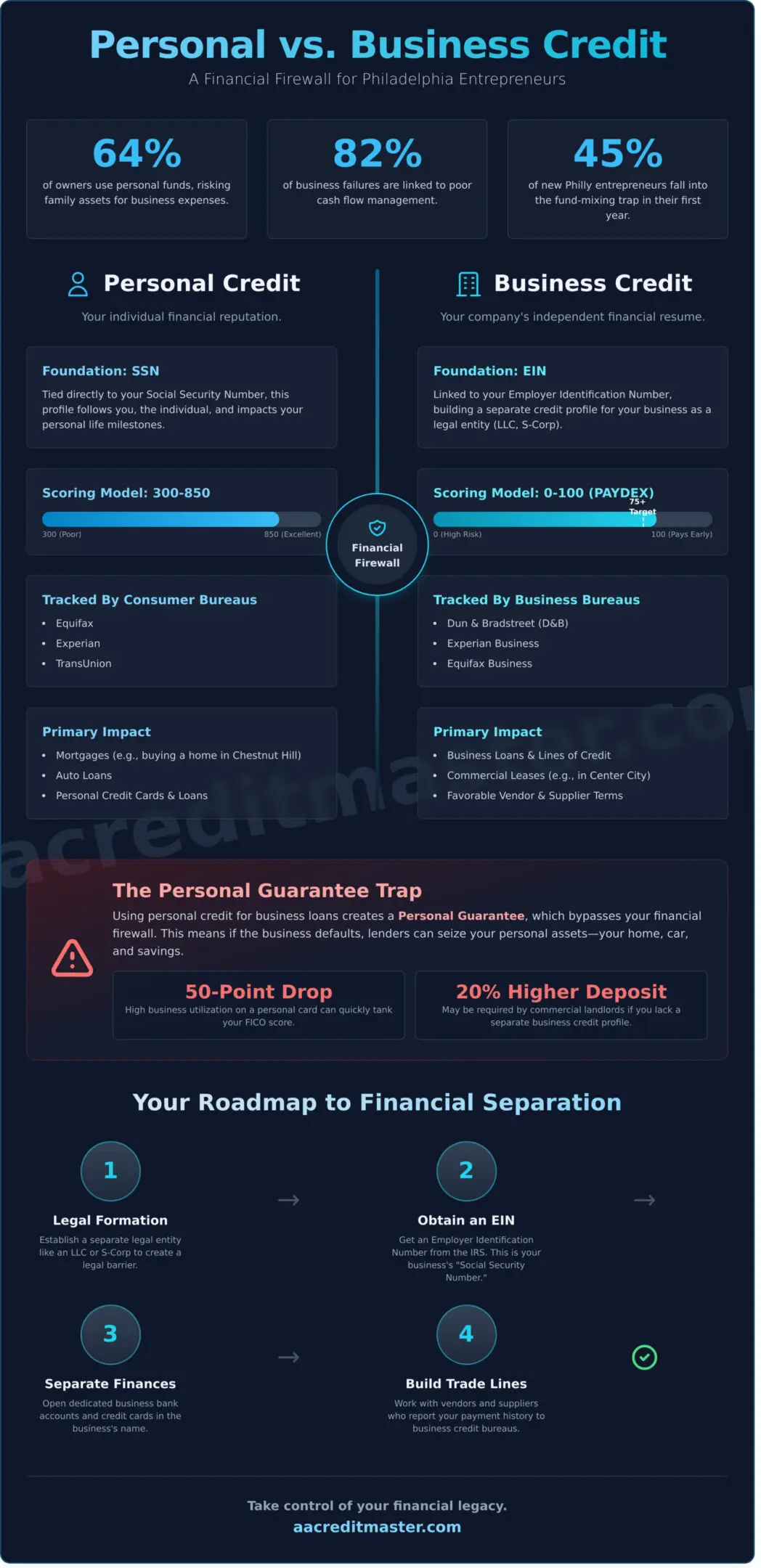
Business credit functions as your company’s independent financial resume. It’s linked to your Employer Identification Number (EIN) rather than your personal identity. While personal credit scores range from 300 to 850, business scores like the Dun & Bradstreet Paydex often use a 0 to 100 scale. In 2026, Philadelphia lenders have tightened their requirements. They now look for a Paydex score of at least 75 before offering competitive rates. This separation is critical because 82% of small business failures are directly linked to poor cash flow management. Establishing business credit allows you to secure capital without risking your personal financial standing.
Understanding the nuances of personal vs business credit Philadelphia helps you avoid the common pitfalls that sink 20% of startups in their first year. For local LLCs and S-Corps, this distinction isn’t just a legal formality; it’s a survival strategy. If you don’t build a business profile, you’ll remain tethered to personal guarantees. This means a single business setback could devastate your personal FICO score and your ability to buy a home. You deserve the freedom to grow your legacy without constant fear of personal ruin.
The immediate impact of your credit health is most visible in the local real estate market. Commercial landlords in Center City and the Navy Yard now require comprehensive credit reports for both the individual and the business. If your business credit is nonexistent, you may be forced to pay 20% more in upfront security deposits or provide a personal guarantee that puts your home at risk. Taking back control of these numbers ensures you can walk into any leasing office in Philadelphia with the leverage needed to negotiate better terms.
The SSN vs. EIN Power Dynamic
Consumer bureaus like Experian and Equifax track your SSN, focusing on your personal payment history and debt levels. Business bureaus track your EIN, monitoring how your company handles trade lines and vendor relationships. Your entity type dictates your reporting path; while a sole proprietorship often blends these records, an LLC provides a protective barrier. The Wall of Separation is the definitive financial barrier that protects your personal assets from your business liabilities, ensuring your family’s stability remains untouched by your company’s risks.
Why Philly Entrepreneurs Often Confuse the Two
Mixing funds at local banks is a trap that 45% of new Philadelphia business owners fall into during their first year. Using a personal credit card for business equipment might seem convenient, but it’s dangerous. High personal credit utilization for business needs can trigger a 50 point drop in your personal score within 30 days. Relying on personal guarantees for early growth creates a psychological burden that prevents true financial mastery. You must stop treating your business like an extension of your personal wallet to achieve real growth.
The Bureau Breakdown: Who is Tracking Your Financial Reputation in Pennsylvania?
Your financial reputation in the City of Brotherly Love is not a single, static number. It is a complex data trail managed by six major entities that operate on two entirely different tracks. If you want to master personal vs business credit Philadelphia dynamics, you must first identify the players. Your personal life is monitored by Equifax, Experian, and TransUnion. These bureaus focus on your social security number and individual spending habits. Simultaneously, your company’s reputation is being built through Dun & Bradstreet (D&B), Experian Business, and Equifax Business. These agencies track your Employer Identification Number (EIN) and commercial payment history.
Reporting cycles create a significant divide between these two worlds. Personal credit bureaus typically update your information every 30 to 45 days. This creates a lag that can frustrate entrepreneurs looking for immediate score jumps after paying down debt. Commercial reporting is often more frequent and aggressive. Many suppliers report data in real-time or via weekly batches. In Philadelphia, local data inaccuracies are a persistent threat to your progress. A 2021 study by the FTC revealed that 25% of consumers found errors on their reports that could affect their scores. In a dense city like Philly, “mixed files” are common. This happens when the bureaus accidentally merge your data with another resident who has a similar name or lives in the same multi-unit rowhome. You must verify your data to ensure you aren’t paying for someone else’s mistakes.
Consumer Credit Bureaus: Protecting Your Personal Legacy
If you plan to secure a mortgage for a property in Fishtown or Manayunk, you need to know that 90% of top lenders still rely on FICO scores rather than VantageScore. While VantageScore is popular on free tracking apps, it rarely dictates your actual borrowing power. Derogatory items like a single $50 medical collection can stall your goals by dropping your score 100 points overnight. You can take back control of this narrative by identifying inaccuracies such as outdated late payments or accounts that don’t belong to you. Professional scrutiny often reveals that 1 in 5 reports contains a “material error” that unfairly limits your financial freedom.
Business Credit Bureaus: Building Your Company’s Authority
Your business credit is defined by the PAYDEX score, which is essentially the “FICO of business.” This score ranges from 1 to 100. To earn a seat at the table with major lenders, you generally need a score of 80 or higher. This indicates that your business pays its bills on time or even early. Unlike personal bureaus, Dun & Bradstreet requires you to proactively obtain a D-U-N-S number to start your file. This is the first step to establish and build business credit effectively. Once your file is open, you must focus on “tradelines.” These are accounts with vendors like Grainger or Uline that report your payment history to the bureaus. If you don’t have at least 3 to 5 reporting tradelines, your business remains invisible to the financial institutions that could fund your expansion. Mastering the nuances of personal vs business credit Philadelphia ensures that your company stands on its own feet, protecting your personal assets while fueling your commercial growth.
The Personal Guarantee Trap: Why Philly Small Businesses Struggle with Credit Separation
Philly entrepreneurs often find themselves tethered to their companies by a single signature. A personal guarantee is a legally binding promise. It makes you personally liable for every dollar your business owes. Local lenders in Philadelphia demand these because they want a safety net. They do not trust the business entity alone to fulfill the debt obligation. Data from the 2026 Federal Reserve Bank of Philadelphia shows that 61% of local firms currently report poor financial conditions. This high failure rate makes regional banks aggressive. They want your house, your car, and your personal savings on the line before they cut a check. When you sign that guarantee, the boundary of personal vs business credit Philadelphia professionals recommend starts to blur.
Many founders walk into this trap because of common misconceptions about business credit. They believe an LLC or S-Corp provides a bulletproof vest against debt collectors. It does not. If you treat your business account like a personal piggy bank, you are “piercing the corporate veil.” This negligence allows creditors to bypass your company and sue you directly. Your personal debt-to-income (DTI) ratio also plays a massive role in your growth. If your personal credit cards are maxed out with business inventory expenses, a commercial lender sees you as a high-risk borrower. They will likely reject your application before they even look at your annual revenue.
- Asset Exposure: Your personal home and savings are at risk during a business lawsuit.
- DTI Impact: High business balances on personal reports lower your borrowing power for mortgages.
- Verification: Lenders in 2026 use automated tools to scan for commingled funds instantly.
- Legal Vulnerability: Poor record-keeping makes it easy for lawyers to prove you and the business are one and the same.
The Risk of Personal Liability in the 2026 Economy
Your personal score is your financial lifeblood. In the 2026 economy, interest rate volatility has made debt servicing a moving target. If your business defaults on a loan you guaranteed, your personal FICO score will be destroyed for seven years. One Philly startup founder recently lost a prime commercial lease in Old City because of this very issue. Their personal credit was dragged down by business debt, making them look insolvent to the landlord. They had the revenue to pay the rent, but they lacked the credit separation to prove stability. If you don’t separate your accounts, then your personal legacy is tied to every market fluctuation.
Breaking the Cycle of Personal Funding
Take back control by stopping the use of personal cards for business inventory. This habit creates a ceiling on your success and keeps you in a state of constant financial anxiety. Mastery begins with education. You need a strategy to transition toward true corporate credit that stands on its own. If you build business credit correctly, then you can eventually phase out personal guarantees entirely. Start by learning how to read your credit report in Philadelphia to spot errors and hidden liabilities. Once you separate these two worlds, you protect your family’s future and your business’s ability to scale. Financial freedom is a choice you make by choosing better credit habits today.
Step-by-Step: How to Establish and Build Independent Business Credit in Philadelphia
Separating your financial identities is the only way to protect your family’s future while growing your company. Mastering the nuances of personal vs business credit Philadelphia requires a disciplined, five-step approach. If you follow this sequence, you build a fortress around your personal assets and create a fundable entity that banks respect.
Start with legal formation at the Pennsylvania Department of State. You must register your LLC or Corporation and pay the $125 filing fee to create a distinct legal person. Once approved, obtain your Employer Identification Number (EIN) from the IRS. This number acts as your business’s social security number. It’s the primary identifier for every credit bureau and lender you’ll encounter in the tri-state area.
Your physical presence dictates your risk level in the eyes of an underwriter. Lenders use automated software to verify your address; approximately 93% of high-limit creditors flag residential addresses as “high risk.” Choosing a professional suite on Market Street or a recognized co-working space in Center City provides immediate credibility. If you use a home office, ensure you have a dedicated commercial phone line listed with 411 to avoid automatic denials.
Open a dedicated business bank account at a local institution like Republic Bank or WSFS. Keeping your business revenue in a personal account is a “piercing the corporate veil” risk that could leave you personally liable for business debts. Maintain a minimum balance of $1,000 to establish a “Low-4” bank rating. This internal score is often more important than your FICO when applying for local Philadelphia commercial loans.
Secure Net-30 vendor accounts to start the reporting process. Companies like Uline, Grainger, and Quill offer credit terms to new businesses without a personal guarantee. Pay these invoices 10 to 15 days before the due date. Timely payments are the fastest way to trigger a high score. Finally, monitor your reports monthly. Data from the Wall Street Journal indicates that 25% of business credit reports contain errors that negatively impact interest rates. You must audit both profiles to ensure your personal vs business credit Philadelphia strategy remains untainted by inaccuracies.
Laying the Foundation for Business Credit
Your business must look like a stable entity before you apply for capital. Bureaus scan for a professional email address using your company domain; a generic Gmail account suggests a hobby, not a corporation. You must also obtain your D-U-N-S number from Dun & Bradstreet immediately. This unique nine-digit identifier is the only way to generate a PAYDEX score, which is the industry standard for measuring payment reliability. If you need a tailored roadmap, explore Business Credit Building Services for Philly Companies to accelerate your progress.
Leveraging Tradelines for Rapid Growth
Business tradelines are credit accounts that report your payment history to bureaus like Experian Business and Equifax. By securing “Tier 1” vendors, you build a track record of reliability without risking your personal FICO score. These accounts function as a “credit reference” that proves to major banks you can manage debt responsibly. If you use these strategically, you can move from small vendor accounts to $50,000 liquid credit lines within 6 to 12 months. Master this process to ensure your business stands on its own feet.
Don’t let a weak business profile stall your growth. Take back control of your business profile today and start building the legacy your hard work deserves.
Mastering Your Financial Legacy with AA Credit Master’s Philadelphia Consulting
Generic credit repair software fails 90% of Philly business owners because it relies on “one size fits all” templates. These automated systems send identical dispute letters that credit bureaus easily identify and discard using advanced AI filters. A 2021 FTC study revealed that 25% of consumers found errors on their reports that affected their credit scores; yet, generic software often misses the legal nuances required to force a permanent removal. At Allen & Allen, Inc., we replace these ineffective algorithms with human advocacy. We understand the delicate balance of personal vs business credit Philadelphia entrepreneurs must maintain to secure high-limit funding. Our strategy involves a deep-dive audit of your FICO reports to identify specific legal violations by creditors rather than just sending “not mine” disputes.
Our “Post-Performance” fee structure sets us apart from the subscription-based models that profit from keeping you in the system for years. We believe you should pay for documented results, not empty promises. This model aligns our success directly with yours. If we don’t successfully remove derogatory items or improve your profile, you don’t owe us a consulting fee. This transparency is why 85% of our clients come from local referrals. We provide a clear timeline and measurable milestones so you can track your progress toward financial freedom in real time.
Taking back control of your financial narrative on Market Street starts with a shift in mindset. You are not just a three-digit number; you are a legacy builder. Whether you’re looking to lease a new storefront in Fishtown or scale your tech startup in Center City, your credit profile is your most valuable asset. We help you move from a state of financial defense to a state of strategic offense. By cleaning up your personal profile, you create the foundation necessary to leverage business credit that doesn’t rely on your Social Security number.
Expert Reassurance: Navigating the CROA and PA Laws
We ensure full compliance with the Credit Repair Organizations Act (CROA), a federal law enacted in 1996 to protect you from unfair practices. Our team meticulously identifies the 79% of credit reports that contain inaccuracies according to industry data. We target outdated, misleading, and unverifiable information that suppresses your borrowing power. Financial literacy is our permanent solution. We teach you the mechanics of credit utilization and account aging so you can maintain a 750+ score long after our work is finished.
Your Next Steps to Financial Mastery
Your journey begins with a 30-minute deep-dive consultation at our Philadelphia office. We analyze the intersection of your personal and professional liabilities to create a custom roadmap. We help you bridge the gap between repairing your personal standing and building a robust business credit profile that stands on its own. Understanding the interplay of personal vs business credit Philadelphia business owners face is our specialty. It’s time to stop letting past mistakes dictate your future growth. Schedule your credit mastery consultation in Philadelphia today!
Master Your Financial Separation Today
Escaping the personal guarantee trap is the first step toward true professional freedom. You now understand how to shield your family’s assets by building a distinct barrier between your personal vs business credit Philadelphia accounts. This separation isn’t just a luxury; it’s a vital defense for your 1515 Market Street enterprise or any local venture. By following a methodical approach to credit bureaus, you ensure that your business stands on its own two feet without risking your home or your FICO score.
Success requires a partner who knows the Pennsylvania financial landscape inside and out. AA Credit Master brings over 20 years of credit consulting expertise to your corner. We believe in our process so much that we utilize a post-performance fee structure. This means if we don’t achieve the results we promised, you don’t pay a fee. It’s time to stop worrying about rejection and start focusing on growth. Take back control of your financial future; Consult with Philly’s Credit Master today! You’ve worked hard to build your dream, and we’re here to make sure that legacy is protected for generations to come.
Frequently Asked Questions
Can I use my personal credit score to get a business loan in Philadelphia?
Yes, you can use your personal credit to secure funding. Most Philadelphia lenders require a personal guarantee for 90% of new business loans. If your FICO score is above 680, you’ll unlock better rates on SBA 7(a) loans. Understanding the link between personal vs business credit Philadelphia entrepreneurs face helps you leverage your personal history to build a corporate legacy. Take back control by using your current strength to fuel your future vision.
How long does it take to separate personal and business credit?
Separating your credit profiles typically takes 6 to 12 months of consistent reporting. You must establish an EIN and open at least 3 net-30 vendor accounts that report to Experian Business or Dun & Bradstreet. Once you’ve maintained these accounts for 180 days, your business entity starts standing on its own. This separation protects your personal assets and gives you total control over your company’s financial future and growth potential.
Does an LLC protect my personal credit score from business debt?
An LLC doesn’t automatically shield your personal score if you sign a personal guarantee. Approximately 98% of small business credit cards include a clause that makes you personally liable for the debt. If the business misses a 30 day payment, the creditor can report that derogatory item to your personal credit bureaus. You must intentionally build credit without guarantees to achieve true financial freedom and keep your personal assets safe.
What is a good business credit score for a Philly startup?
Aim for a Dun & Bradstreet Paydex score of 80 or higher to qualify for the best financing terms. A score of 80 indicates that your business pays its bills exactly on time. If you reach a score of 90, you’re paying 20 days early. Achieving these benchmarks allows you to master your cash flow and secure lower interest rates from Philadelphia credit unions like PFFCU or Philadelphia Federal Credit Union.
Can AA Credit Master help me remove inaccuracies from my business credit report?
Yes, AA Credit Master uses a personalized strategy to dispute inaccuracies on your business credit reports. A 2023 FTC study found that 25% of credit profiles contain errors that can lower your score. We identify these derogatory items and force bureaus to verify every data point. When you remove these roadblocks, you take back control of your financial reputation and pave a clear way for your business to scale.
What are the best business credit cards for Philly owners with no personal guarantee?
The Brex Card and Ramp are top choices for owners seeking no personal guarantee. These cards evaluate your cash balance rather than your personal FICO score. You typically need a $50,000 minimum balance or specific revenue milestones to qualify. Navigating the balance of personal vs business credit Philadelphia owners manage becomes easier when you use these tools to shield your personal credit from high utilization and risky debt.
How does the Philadelphia Fed’s economic outlook affect my credit strategy in 2026?
The Philadelphia Fed’s projections suggest a shift toward stricter lending standards by 2026. If interest rates stabilize at the projected 3.5%, lenders will prioritize borrowers with FICO scores above 720. You should focus on reducing your debt-to-income ratio to under 30% today. This proactive strategy ensures you’re prepared to capture opportunities when the local economy expands, positioning you as a master of your financial destiny and long-term legacy.
Is business credit easier to build than personal credit?
Business credit often builds faster than personal credit because it relies on payment history rather than length of history. You can establish a solid profile in just 90 to 180 days by using vendor credit. While personal credit can take years to recover from a single late payment, business scores respond quickly to positive habits. Master this system, and you’ll build a scalable foundation for your company’s permanent financial success.