
Understanding Your Dun & Bradstreet Business Credit Score in Philadelphia
Did you know that 47% of small business owners in the United States have no idea they even have a business credit profile? If you’re running a new LLC in Philadelphia and feel frustrated by a lack of credit history, you aren’t alone. It’s exhausting to watch local lenders offer high interest rates just because your dun & bradstreet business credit score is a blank slate or stuck at a mediocre number. You deserve to be treated like a professional, not a high-risk gamble. We understand the stress of financial instability and offer a clear path forward.
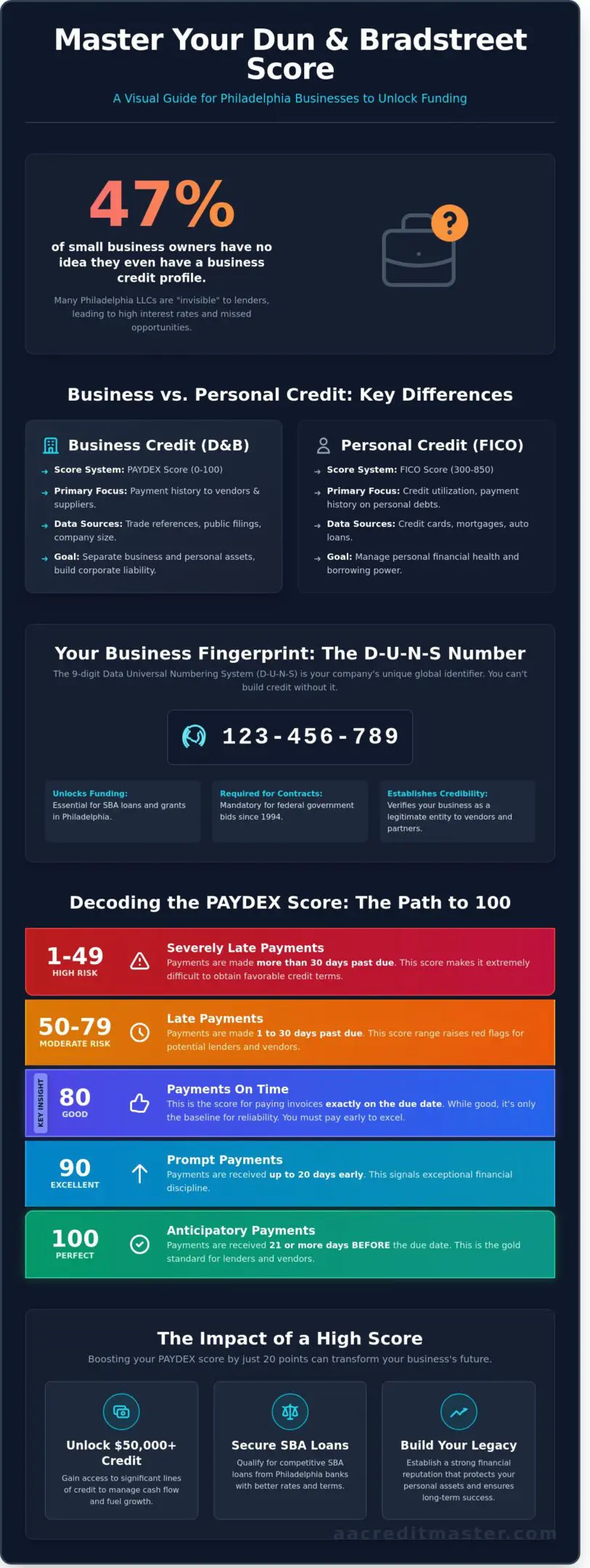
You can take back control of your financial reputation starting right now. This guide will demystify the 0 to 100 PAYDEX scale so you can move from confusion to mastery. You’ll learn the exact steps to boost your score by 20 points or more, allowing you to secure a $50,000 line of credit or a competitive SBA loan from a Philadelphia bank. We’ll break down how to establish trade lines, manage your credit profile, and leverage your business health for legacy-building growth.
Key Takeaways
- Master the hidden logic of the dun & bradstreet business credit score to move beyond average ratings and achieve true financial reliability.
- Identify exactly how Philadelphia banks and the local SBA District Office evaluate your business’s creditworthiness before approving commercial funding.
- Follow a proven, step-by-step process to properly establish your Pennsylvania legal entity and secure your D-U-N-S Number from the start.
- Learn why paying invoices exactly on time only earns you a score of 80 and how to strategically push your rating toward a perfect 100.
- Discover the “Financial Guardian” approach to disputing credit bureau errors and why personalized Philly-based consulting beats automated software.
The Foundation of Business Credit: What is a Dun & Bradstreet Score?
Founded in 1841, Dun & Bradstreet manages a massive database of over 500 million business records. It’s the world’s oldest and most respected credit bureau for companies. You need to understand that this institution doesn’t care about your personal shopping habits or your home mortgage. It focuses entirely on your company’s reliability and payment history. Your dun & bradstreet business credit score serves as a clinical measure of your professional health. It’s the primary tool lenders use to decide if your business deserves capital or if you’re a high-risk gamble.
Establishing a professional profile is how you take back control of your company’s future. There’s a core difference between your personal FICO score and the D&B system. FICO scores range from 300 to 850 and track your individual behavior. The D&B system is business-centric; it looks at trade references, industry benchmarks, and public filings. If you want to move beyond personal guarantees, you must master the D&B reporting structure. This shift allows you to protect your personal assets while building a lasting business legacy in Pennsylvania.
The Role of the D-U-N-S Number in Philadelphia
Your journey to credit mastery starts with the Data Universal Numbering System. This 9-digit identifier is the D-U-N-S Number. For a Philadelphia LLC, this number is just as vital as your EIN. It’s a unique fingerprint that tracks your business activities across the globe. You can’t even begin to establish a dun & bradstreet business credit score without one. If you’re unsure if you have one, you can search the D&B database for your specific Philly address. Many businesses are assigned a number automatically when they register with the Pennsylvania Department of State, but you must verify it to ensure accuracy.
This number is especially critical if you’re targeting federal contracts in the Greater Philadelphia area. Since 1994, the federal government has required a D-U-N-S Number for all grant and contract applications. Whether you’re bidding on a project at the Philadelphia International Airport or seeking an SBA loan, your D-U-N-S Number is the key that unlocks those doors. It provides the transparency that government agencies and large corporations demand before they’ll cut a check. Without it, your bid is dead on arrival.
Why Your Philly Startup is “Invisible” Without a D&B Profile
Operating as a “cash-only” business or relying on personal credit cards is a dangerous trap. In Pennsylvania, 82% of small businesses that fail cite cash flow issues as the primary cause. When you stay “invisible” to D&B, you’re cutting yourself off from 90% of vendor credit opportunities. Your D&B profile acts as a global resume. It tells potential partners in London or Tokyo that your local Philly shop is a legitimate enterprise. It transforms your business from a risky startup into a verified entity with a track record of success.
Lenders don’t want to hear your story; they want to see your data. If you don’t have a profile, you’re a ghost in the financial world. You’ll find yourself stuck with high interest rates and predatory terms because you haven’t proven your reliability. The D&B score is a 0-100 metric that measures how promptly your business pays its bills compared to agreed terms. By building this profile, you’re not just getting a number; you’re gaining financial freedom and the power to grow on your own terms.
Decoding the D&B PAYDEX Score and Rating System
Mastering your dun & bradstreet business credit score starts with understanding the PAYDEX. This 0 to 100 dollar-weighted indicator is the primary metric lenders use to judge your reliability. Unlike personal credit, which focuses on credit utilization, the PAYDEX focuses almost entirely on your payment history. If you manage a $50,000 invoice poorly, it will hurt your score more than a $500 utility bill. You gain the power to dictate your financial terms when you understand that 90% of major vendors use this data to decide your credit limits.
You can Understanding Business Credit Bureaus to see how D&B operates differently than Experian or Equifax. While those bureaus look at a broad range of factors, D&B prioritizes the speed of your payments. If you want to secure the best rates for a commercial lease in Center City or a fleet of vehicles, your PAYDEX must reflect a history of discipline. This score isn’t just a number; it’s a reflection of your reputation in the marketplace.
The PAYDEX Range: What the Numbers Actually Mean
- 80-100: Low Risk. This is the “Green Zone” for Philly business owners. If you sit in this range, you’ll likely qualify for the lowest interest rates and highest credit lines. It signals to the world that your business is stable and trustworthy.
- 50-79: Medium Risk. Falling into this bracket might stall your expansion in Philadelphia. Lenders see this as a sign that you’re occasionally struggling with cash flow. You might still get approved, but you’ll pay a “risk premium” in the form of higher interest.
- 1-49: High Risk. This range requires immediate steps for credit restoration. A score below 50 often leads to automatic denials for traditional bank loans. You must act quickly to dispute errors or settle outstanding “Days Past Due” (DPD) items to save your local reputation.
How Payment Timing Dictates Your Mastery
The mathematical reality of the PAYDEX often surprises seasoned entrepreneurs. Most people assume that paying bills on the due date earns a perfect 100. That’s a misconception. A score of 80 indicates a business pays its bills exactly on time. To reach the elusive 100, you must adopt a “Pay Early” strategy. Paying your invoices 30 days before the deadline is the only way to hit the top of the scale. This proactive behavior shows creditors that your cash reserves are robust.
Trade references from Philly-based suppliers can significantly boost your PAYDEX. If you have a long-standing relationship with a local wholesaler who doesn’t automatically report to D&B, you can manually add them as a reference. In a 2023 study, businesses that added three positive trade references saw an average score increase of 12 points within 60 days. This simple move helps you take back control of your financial narrative.
Beyond the PAYDEX, you must monitor secondary ratings like the Delinquency Predictor and Failure Score. The Failure Score uses a 1 to 5 scale, where a 1 means your business is in the bottom 10% of risk for closing. These scores look ahead at the next 12 months of your business life. If you find these metrics confusing, you can explore a personalized strategy to ensure every part of your D&B profile is optimized for growth. Mastery isn’t just about one number; it’s about the entire picture of your corporate health.
Why Your D&B Score is Critical for Philadelphia Funding
Your business identity in the 215 area code depends on more than your local reputation. It lives in your data. Major local institutions like TD Bank and Citizens Bank rely on your dun & bradstreet business credit score to determine your risk level before they ever look at your tax returns. If your score sits below an 80 PAYDEX, you face immediate rejection for commercial lines of credit. Banks view a strong D&B profile as concrete proof that you’ll honor your debts on time. When your score is optimized, you gain the leverage to demand lower interest rates, potentially saving 2% to 3% on a $100,000 commercial loan.
The SBA Philadelphia District Office processed over $700 million in loans during the 2023 fiscal year. Most of these approvals depend on the FICO SBSS score, which pulls significant data directly from your D&B file. A weak score stops your expansion plans before they start. Even securing a physical footprint in the city requires a solid profile. Landlords in Center City or the Navy Yard check your business credit to ensure you won’t default on a five year lease. If your credit is thin, they may demand a personal guarantee or a security deposit equal to six months of rent.
Philadelphia business owners often overlook the “hidden” cost of a poor rating. If you manage a fleet of 12 delivery vans in Port Richmond, a high D&B score can reduce your commercial insurance premiums by 15% annually. Insurance carriers use your credit data to predict future claims and financial stability. You gain the power to negotiate these overhead costs when you actively Build Business Credit by reporting your positive payment history. This proactive mastery of your data transforms a “risk surcharge” into thousands of dollars in annual savings.
Securing Vendor Credit in the Greater Philadelphia Area
Local wholesalers and construction suppliers in Grays Ferry or Northeast Philly use your D&B data to set your purchasing power. A strong score moves your account from “Pre-pay” or “Cash on Delivery” to “Net-30” or “Net-60” terms. This shift is vital for your cash flow. Consider a South Philly HVAC contractor who boosted his score from 45 to 82 in six months. This improvement allowed him to secure $50,000 in materials on credit without upfront payments. He saved $4,200 in high interest credit card fees during a single summer season by using vendor credit instead of personal debt.
Bidding on City of Philadelphia Government Contracts
Growth often means working with the city. If you’re seeking M/W/DSBE certification, your financial stability is under a microscope. A low dun & bradstreet business credit score can disqualify you from 2024 municipal projects because the city needs to know you can finish the job. Philadelphia city contracts often require proof of business financial health via D&B. Mastery of your credit profile ensures you stay competitive for these lucrative opportunities. When you take back control of your score, you position your business as a reliable partner for the city’s future infrastructure and service needs.
How to Build and Master Your D&B Score Step-by-Step
Mastering your dun & bradstreet business credit score starts with a solid legal foundation. If you register your company as an LLC or Corporation in Pennsylvania, then you create the necessary separation between personal and professional liability. This legal wall is the first requirement for a D-U-N-S Number. You can obtain this nine-digit identifier for free through the official D&B portal. As of January 2024, the application process typically takes 30 days for standard processing. Without this number, your business essentially doesn’t exist in the eyes of major creditors. Take back control of your identity early.
You need tradelines that actually report your activity. If you open accounts with vendors who share data with D&B, then your payment history becomes a visible asset. Don’t just pay on time. Aim for “Early-Bird” status. A PAYDEX score of 80 represents perfect “on-time” behavior. To push that number to 90 or 100, you must pay invoices 10 to 20 days before the due date. This proactive approach signals to lenders that your cash flow is robust. Follow these five essential steps to achieve mastery:
- Step 1: Register your business as a legal entity in Pennsylvania to establish a professional identity.
- Step 2: Secure your D-U-N-S Number via the official D&B website to begin your data profile.
- Step 3: Open at least five net-30 tradelines with vendors who report specifically to Dun & Bradstreet.
- Step 4: Pay every invoice 15 days early to maximize your PAYDEX score beyond the standard 80.
- Step 5: Audit your credit report every 90 days to catch errors before they impact your funding.
Choosing the Right Tradelines for a Philly Business
Start with “easy-approval” vendors. Companies like Uline and Grainger are famous for reporting to D&B even for new entities. If you spend $50 on office supplies and pay immediately, then you’ve started your credit journey. Philadelphia business owners should also contact local utility providers like PECO. While they don’t always report automatically, you can often request manual reporting to bolster your profile. Business credit cards from issuers like Chase or American Express also provide a critical secondary layer of data for your dun & bradstreet business credit score.
Disputing Inaccuracies on Your D&B Report
Inaccuracies act as anchors on your growth. Data from 2023 suggests that 25% of business credit reports contain errors that could lead to higher interest rates. Common issues include wrong SIC codes or outdated Broad Street addresses. If you find a misreported late payment, then use the D&B iUpdate portal to file a formal dispute. Research indicates that 33% of Philadelphia small businesses fail to monitor their credit profiles annually. Review your report every quarter. This habit ensures your data reflects your true performance and protects your financial legacy.
Navigating D&B Challenges with Philadelphia Credit Specialists
Automated software is a blunt instrument. It can’t see the context of your operations or the hard work you put into your Philadelphia storefront. Many online tools offer generic fixes that ignore the specific nuances of your dun & bradstreet business credit score. Allen & Allen, Inc. wins because we prioritize personalized, Philly-based consulting. We don’t rely on algorithms; we rely on decades of combined financial expertise to analyze your report. If your score is low, we don’t just tell you it’s low. We show you why and how to fix it.
Bureau errors are more common than most owners realize. A 2023 study showed that nearly 33% of business profiles contain inaccuracies that hurt creditworthiness. We act as your Financial Guardian. We identify these derogatory items and fight to have them corrected. This protection ensures that large, impersonal institutions don’t dictate your future. If an error exists, we find it. Then we fix it. We stand between you and the bureaus to ensure your data is 100% accurate. This is how you take back control of your reputation.
Our “Post-Performance” fee model reflects our commitment to Philadelphia businesses. You don’t pay for promises. You pay for results. This alignment of interests creates a partnership built on trust. Most national firms trap you in a subscription cycle where you pay monthly fees regardless of progress. We reject that model. We focus on your financial legacy. We provide expert education so you can master your credit profile forever. If we don’t deliver the results we promised, you don’t pay the performance fee. It’s that simple.
The Allen & Allen, Inc. Difference in Philadelphia
Our Market Street office serves as a beacon for local business owners. We understand the Philadelphia market better than any national software company. Our strategies go beyond generic online tips. We provide tailored plans that address your specific industry needs. We also ensure total compliance with the Credit Repair Organizations Act (CROA). This protects you from the predatory practices often found in the credit repair industry. We keep your dun & bradstreet business credit score accurate and secure while maintaining the highest ethical standards in the city.
Your Path to Financial Mastery Starts Here
Mastery provides emotional freedom. You deserve the peace of mind that comes from knowing your business is “bankable.” Whether you need a loan for expansion in 2025 or want to secure your family’s future through 2035, a strong score is the key. We prepare your Philly business for the next decade of growth by instilling permanent financial literacy. Stop worrying about your numbers. Start mastering them. Your financial legacy depends on the actions you take today. Let us be the guide that leads you to the top.
Ready to transform your business profile? Schedule your business credit consultation at our Philadelphia office today!
Secure Your Philadelphia Business Legacy Today
Your dun & bradstreet business credit score acts as the heartbeat of your company’s financial reputation. We’ve detailed how a solid PAYDEX rating serves as the primary bridge to securing competitive funding and how proactive reporting prevents costly credit denials. Mastering these metrics transforms your business from a risk into a reliable asset for lenders. You don’t have to navigate these bureaucratic hurdles alone or guess which moves will impact your rating.
Expert guidance is available right here in the city. Our team at 1515 Market Street provides mastery-focused consulting that prioritizes your long-term financial literacy over quick fixes. Because we follow a CROA compliant, post-performance fee structure, our success is directly tied to your progress. We stand as your financial guardian against impersonal credit bureaus to ensure your business gets the respect it deserves.
Take back control of your business future; consult with a Philadelphia Credit Specialist today.
You’ve built something incredible in Philadelphia, and now it’s time to give it the financial foundation it needs to thrive for years to come.
Frequently Asked Questions
How do I get a Dun & Bradstreet score for my new Philadelphia business?
You obtain a D-U-N-S Number by applying through the official Dun & Bradstreet website to establish your business identity. This 9-digit identifier is free and typically takes 30 days to process for new Philadelphia entities. If you need it faster, the D&B CreditBuilder Plus service costs $229 and reduces the wait to 5 business days. Once you have this number, you can start reporting trade lines to build your dun & bradstreet business credit score.
What is a “good” Dun & Bradstreet score for a small business loan?
A PAYDEX score of 80 or higher is the benchmark for securing favorable small business loan rates. This score ranges from 0 to 100, where 80 indicates your business pays its bills exactly on time. Lenders like the SBA often require this threshold to approve competitive 7(a) loans. If you achieve a score of 100, it shows you pay invoices 30 days before the due date, giving you maximum leverage during negotiations.
How long does it take to build a PAYDEX score from scratch?
You can establish a PAYDEX score in 60 to 90 days once your trade references begin reporting payment data. Dun & Bradstreet requires at least 3 separate trade references to generate a score. If you open accounts with vendors like Uline or Grainger, they typically report monthly. Consistent, early payments during this 3-month window will quickly move your score into the low risk category, allowing you to take back control of your financing options.
Can I use my personal credit score instead of a D&B score in PA?
You can use your personal credit score, but 46% of lenders will also check your dun & bradstreet business credit score to assess total risk. Most Pennsylvania banks use the FICO SBSS model, which aggregates your personal FICO data with business credit reports. This score ranges from 0 to 300; a minimum of 155 is usually required for SBA loan consideration. Relying solely on personal credit limits your borrowing capacity and keeps assets at risk.
Why did my Dun & Bradstreet score drop suddenly?
Your score likely dropped because a vendor reported a payment that was 1 to 30 days past due. A single late payment can plummet a PAYDEX score from an 80 to a 50 instantly. D&B also tracks your Dollar-Weighted average, so a late payment on a large $10,000 invoice hurts more than a small $100 bill. Monitor your report for inaccuracies, as 25% of business credit reports contain errors that negatively impact scores.
Is the D&B PAYDEX score the same as a FICO SBSS score?
No, the PAYDEX score and FICO SBSS score serve different purposes for lenders. The PAYDEX score focuses exclusively on your payment history with suppliers on a 100-point scale. The FICO SBSS score is a more complex 300-point calculation that includes personal credit, business financials, and years in operation. Mastering both scores is essential for true financial freedom, as they provide a complete picture of your company’s reliability to institutional creditors.
How much does it cost to check my business credit score with D&B?
You can monitor your score for free using the D&B CreditSignal tool, which provides alerts when your score changes. However, viewing your full, detailed Business Information Report costs $121.99 for a one-time look. For ongoing access and the ability to dispute derogatory items, monthly subscriptions like CreditBuilder Plus start at $159. Investing in this transparency is a vital step to ensure you aren’t blindsided by hidden data when applying for capital.