
Understanding Your TransUnion Score: A Philadelphia Resident’s Guide for 2026
Did you know that in Philadelphia, a landlord cannot legally deny your rental application based solely on a credit score number? It’s exhausting to feel like a three-digit figure defines your entire future, especially when that number shifts every time you check your phone. You’ve likely felt the sting of confusion while understanding my TransUnion score Philly style, wondering why it differs from other reports or if a simple inaccuracy will block you from your next home. We understand the stress of financial uncertainty, but knowledge is your most powerful tool for restoration.
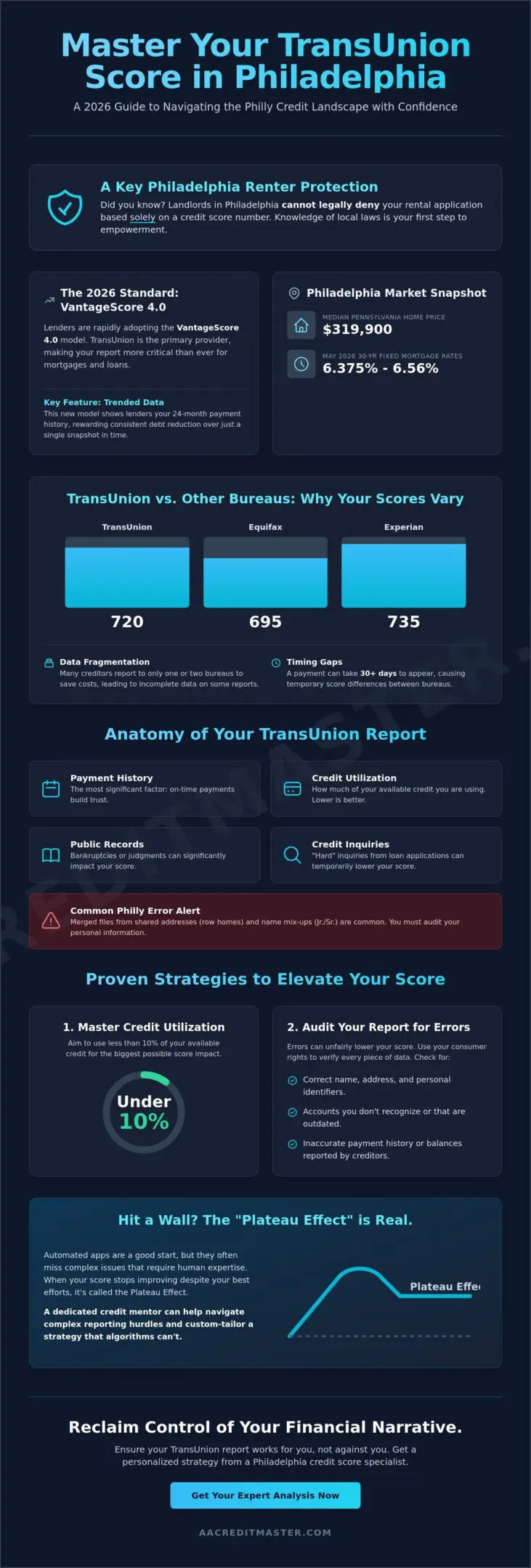
You can reclaim control over your financial narrative by mastering the specific factors TransUnion prioritizes in the 2026 market. If you learn how lenders use the new VantageScore 4.0 model, you’ll position yourself for the best rates on a median $319,900 Pennsylvania home. This guide provides a clear path to leverage local protections and technical reporting nuances so you can apply for financing with absolute confidence. We will examine the latest Philadelphia debt collection diversion programs and provide an actionable strategy to ensure your credit report works for you, not against you.
Key Takeaways
- Identify why your TransUnion data often varies from other bureaus and learn to spot common errors in your account history that impact your reliability rating.
- Gain a competitive edge in the Rittenhouse or Manayunk rental markets by understanding my TransUnion score Philly and how it influences local leasing decisions.
- Implement the under 10% credit utilization rule and audit your report for outdated information to see tangible improvements in your financial standing.
- Recognize the signs of the “Plateau Effect” and understand how a dedicated credit mentor can help you navigate complex reporting hurdles that automated apps often miss.
Decoding Your TransUnion Score in the Philadelphia Market
Your TransUnion score is a dynamic metric of your financial reliability. It acts as a digital handshake between you and every lender in the Delaware Valley. Understanding my TransUnion score Philly involves more than just glancing at a dashboard; it requires recognizing how your specific habits translate into risk for local institutions. At its core, what is a credit score? It is a mathematical model designed to predict the likelihood that you’ll repay a debt. In 2026, the industry has shifted toward the VantageScore 4.0 model as a primary standard. TransUnion now offers this version to mortgage lenders for as little as 99 cents per score, making it the dominant lens through which many East Coast property managers and banks view your application.
Lenders prioritize TransUnion data because it provides a comprehensive view of your fiscal behavior. If you’re seeking a competitive edge, you must treat this score as a skill to be mastered rather than a static grade. We believe in empowering you with the foundational knowledge needed to turn this report into a tool for personal autonomy. When you control the narrative of your credit file, you open doors to better terms and long-term stability.
TransUnion vs. The Big Three: Why the Difference Matters
You might notice your TransUnion numbers don’t match your Experian or Equifax reports. This often happens because of data fragmentation. Many creditors in the Philadelphia area only report to one or two bureaus to save on administrative costs. If a local credit union only updates TransUnion, your other scores stay stagnant. There’s also a timing gap to consider. A payment made at a bank on Broad Street might take thirty days or more to reflect on your TransUnion file. Even one minor error on this specific report can halt a local loan application. You must ensure this specific record is spotless to avoid unnecessary stress.
The 2026 Credit Landscape for Pennsylvanians
The financial environment in the Philadelphia metro area is currently defined by 30-year fixed mortgage rates sitting between 6.375% and 6.56% as of May 2026. Modern “fintech” lending apps now dominate the market, and they lean heavily on TransUnion’s “trended data” updates. This means lenders no longer just see your current balance; they see if you’re actively paying down debt or just treading water over the last 24 months. Mastering this data allows you to prove your financial growth even if your past wasn’t perfect. We focus on personalized strategy to help you navigate these complex systems with ease.
The Anatomy of a TransUnion Credit Report: What Philly Lenders See
Your credit report is a detailed narrative of your financial life that local lenders scrutinize before they approve a mortgage or a car loan. Understanding my TransUnion score Philly involves looking past the three-digit number to the raw data that builds it. When you apply for credit in the Delaware Valley, institutions look for patterns of reliability. They want to see that you respect your financial obligations and manage your available resources with care. You have specific consumer rights for credit reports that allow you to verify every piece of data TransUnion shares with these lenders.
In dense Philadelphia neighborhoods, personal information errors are surprisingly common. If you live in a multi-unit row home in South Philly or West Philly, TransUnion might accidentally “merge” your file with a neighbor who has a similar name. This creates a distorted view of your creditworthiness. Beyond your name and address, lenders focus on your account history, which includes your payment records and credit utilization. They also look for public records, such as bankruptcies or judgments, and the “footprint” left by inquiries from local car dealerships or mortgage brokers. If you’re seeing unexpected drops in your score, a credit score specialist can help you identify if these footprints are legitimate or errors.
Spotting Local Errors: Shared Addresses and Name Mix-ups
Merged files often occur when two people with similar names live in the same zip code. If you’re a “Junior” or “Senior,” a suffix error can cause your parent’s or child’s debt to appear on your TransUnion standing. You should also verify that local utility companies are reporting your on-time payments accurately. Use this checklist to audit your report:
- Confirm your name is spelled correctly with the proper suffix.
- Verify every address listed, especially if you’ve moved between Philly neighborhoods recently.
- Check that utility accounts don’t show duplicate entries for the same service period.
Understanding “Adverse Information” on Your Philly Report
Adverse information is any data point that suggests a breach of financial contract. This includes charge-offs and collections, which can stay on your TransUnion report for seven years. However, the Pennsylvania statute of limitations for most consumer debt is only four years. This means a creditor might lose the legal right to sue you, but the negative mark still damages your score. Late payments are weighted more heavily when they’re recent, but their impact fades as they age. Under the new Philadelphia Consumer Credit Card Collection Diversion Pilot Program effective June 1, 2026, residents now have more opportunities to resolve debt issues before they become permanent judgments on a credit file.
Why Your Score Matters More in the 215: From Rittenhouse to Mortgages
Your TransUnion score is your financial passport in the 215. Whether you’re eyeing a luxury condo in Rittenhouse or a starter home in Northeast Philly, this number dictates your accessibility to the local market. Understanding my TransUnion score Philly gives you the leverage to negotiate from a position of strength. While Philadelphia laws provide unique protections, a high score remains the most effective way to secure lower interest rates and better insurance premiums. In Pennsylvania, auto insurance companies often use your credit data to determine your premiums. A lower score can lead to higher monthly costs, even if your driving record is spotless. Mastering your report allows you to keep more money in your pocket for the things that matter most.
Employment opportunities in the city also hinge on your financial reputation. While a 2021 Philadelphia ordinance prohibits most employers from using credit info for hiring, exceptions exist for law enforcement and financial institutions. If you’re pursuing a career in Philly’s robust financial sector, a clean TransUnion report is essential. We believe in positioning you as a top-tier candidate by ensuring your financial history reflects your professional integrity. Restoration is possible when you have a clear plan and the right expertise by your side.
Winning the Philadelphia Rental Market
Landlords in competitive areas like Manayunk often use the TransUnion ResidentScore model to rank applicants. While Philadelphia regulations prevent landlords from automatically denying you based solely on a credit score, a high number acts as a powerful tie-breaker in a multi-bid scenario. A clean report proves your reliability when your income might be similar to other candidates. We suggest presenting your certificate of credit education Philadelphia alongside your application. This proactive step demonstrates personal agency and commitment to financial stability. It shows property managers that you’re a tenant who values foundational knowledge.
Securing a Mortgage in the City of Brotherly Love
Buying a home is a major milestone. With the median home sales price in Pennsylvania reaching $319,900 as of August 2025, your interest rate determines your long-term wealth. You generally need a minimum score of 620 for a conventional mortgage, though FHA loans may be accessible at 580.
- 30-year fixed rates currently range from 6.375% to 6.56% as of May 2026.
- 15-year fixed rates sit between 5.75% and 5.98%.
- A 20-point jump in your score can save you thousands in interest over the life of the loan.
Before you apply, consult a credit score specialist Philadelphia to ensure your report is optimized. We help you identify the specific adjustments needed to move from a fair rate to an excellent one. Personalized strategy always beats automated tools when your future home is on the line.
Proven Strategies to Elevate Your TransUnion Standing
Improving your financial standing requires proactive intervention and a commitment to skill acquisition. Understanding my TransUnion score Philly means realizing that every inaccuracy on your report is a hurdle to your personal autonomy. You must audit your file for every minor error or outdated entry immediately. While generic advice suggests keeping utilization under 30%, you should aim for under 10% for maximum impact on your score. This aggressive optimization signals to lenders that you’re in total control of your resources and ready for the best terms available in the 2026 market.
You can also build a “thick” file by strategically adding positive tradelines or secured accounts. This foundational strength helps your score withstand the temporary “footprints” left by hard inquiries. If you’re struggling with persistent negative marks, professional credit repair services Philadelphia can help you navigate the complexities of the bureau’s reporting systems. We position ourselves as your powerful ally, standing between you and the impersonal institutions that often ignore individual circumstances. Restoration is a process, but it begins with a single, decisive action.
The Power of the Dispute: Your Right to Accuracy
The Fair Credit Reporting Act (FCRA) is your strongest shield against reporting errors. This federal law mandates that all information on your TransUnion report must be 100% accurate, complete, and verifiable. Once you submit a dispute, the bureau has a 30-day window to investigate your claims. If the creditor cannot verify the data within that timeframe, TransUnion is legally obligated to remove it. It doesn’t matter if the debt was originally yours; if the bureau cannot prove it today, it cannot stay on your record. This legal leverage ensures that your financial history remains a fair reflection of your current reliability.
Strategic Debt Management for Philly Residents
Choose a repayment method that fits your specific financial goals. The “Snowball” method builds momentum by clearing small balances first, which provides immediate psychological wins. Conversely, the “Avalanche” method prioritizes debt with the highest interest rates, saving you the most money over time. If you’re an entrepreneur in the city, learning how to build business credit is essential to separate your personal and professional liabilities. You might also consider “paying for delete,” where a creditor agrees to remove a negative mark in exchange for payment. This process is often tricky to DIY and requires written confirmation to be effective. If you want to stop the “Plateau Effect” and see real movement, consult with a credit score specialist to build your personalized roadmap.
When to Call a Philadelphia Credit Score Specialist
You’ve audited your report. You’ve paid down your balances. Yet, your score remains stuck. This is the “Plateau Effect,” and it’s the moment where many residents stop understanding my TransUnion score Philly and start feeling defeated. Automated apps can only take you so far. These tools are designed to monitor problems, not solve them. A human mentor provides the personalized strategy you need to break through these barriers. We treat credit restoration as a vital investment in your future, especially if you’re planning to buy a Philadelphia home at the current $319,900 median price. Our “Post-Performance” fee structure ensures you pay for results, not just promises. We win when you win.
Relying on generic software often leads to missed opportunities. While an app might flag a late payment, it won’t understand the nuances of Pennsylvania’s statute of limitations or Philadelphia’s specific rental protections. A specialist looks at the human element of your story. We identify the specific reporting triggers that are holding you back and apply a methodical, step-by-step approach to resolve them. This proactive intervention transforms your credit from a source of stress into a tool for personal autonomy. You deserve a guide who knows exactly where the pitfalls lie in the 2026 financial landscape.
The AA Credit Master Difference
We bring deep Philadelphia expertise to every consultation. Our “Protective Guardian” approach means we stand between you and the large, impersonal bureaus to ensure your consumer rights are respected. We don’t just fix numbers; we help you conquer financial management as a lifelong skill. This focus on skill acquisition ensures that once you reach your target score, you have the foundational knowledge to keep it there. We position ourselves as your powerful ally, offering expert reassurance and a clear path toward restoration. You’re not just a file to us; you’re a neighbor working toward a better life in the City of Brotherly Love.
Your Next Steps Toward Financial Freedom
Don’t let a stagnant score dictate your life in the 215. A better future is possible when you move from a state of worry to a state of action. We invite you to a professional consultation to review your specific report and build a custom roadmap for your success. Whether you’re preparing for a mortgage or simply want the peace of mind that comes with financial stability, the time to act is now. Foundation knowledge is a permanent solution, and we’re here to help you build it. Take control of your TransUnion score with AA Credit Master today!
Secure Your Financial Future in Philadelphia
Mastering your credit data is the first step toward personal autonomy. You’ve learned how to spot local reporting errors and why understanding my TransUnion score Philly is vital for winning competitive rental bids or securing a mortgage. You don’t have to face impersonal institutions alone. Our Philadelphia-based office provides the expert guidance you need to navigate complex CROA and FCRA regulations with confidence. We prioritize your success by charging fees only after services are performed. This commitment ensures our goals are perfectly aligned with your financial restoration and long-term stability.
Your journey to a better financial future starts with a single, decisive action. Don’t let a plateau in your score hold you back from the home or career you deserve. We stand as your protective guardian and mentor, offering a clear path forward in a confusing landscape. Restore your creditworthiness with Philadelphia’s top specialists today and reclaim your seat at the table. You have the capability to conquer these metrics and build a legacy of stability. We’re ready to help you turn that potential into reality.
Frequently Asked Questions
Is a TransUnion score the same as my FICO score?
No, your TransUnion score is not the same as your FICO score. TransUnion is a credit bureau that collects your financial data, while FICO is a specific mathematical model used to calculate a score based on that data. Most lenders use FICO models, but TransUnion often promotes the VantageScore 4.0 model to mortgage providers. You actually have multiple scores depending on which model a lender pulls, so it’s essential to monitor the specific data on your TransUnion report.
How often does TransUnion update my credit score?
TransUnion typically updates your credit score every 30 to 45 days. This frequency depends on when your creditors, such as local Philly banks or credit card issuers, send their monthly data to the bureau. Because different lenders report on different schedules, your score can change several times throughout the month. Regular monitoring helps you stay ahead of these shifts and ensures your financial narrative remains accurate and up to date for any upcoming applications.
Can I get a free TransUnion credit report in Philadelphia?
Yes, you can access a free TransUnion credit report through AnnualCreditReport.com. In 2026, Philadelphia residents are still entitled to free weekly reports from each of the three major bureaus. Additionally, the TransUnion Credit Essentials service offers free daily reports and scores directly through their platform. Taking advantage of these free tools is a vital part of understanding my TransUnion score Philly and maintaining your long-term financial health without unnecessary costs.
How long do negative items stay on my TransUnion report in Pennsylvania?
Negative items generally stay on your TransUnion report for seven years from the date of the original delinquency. This includes late payments, collections, and charge-offs. Bankruptcies have a longer lifespan, with Chapter 7 filings remaining on your record for ten years. While these marks persist, their impact on your score lessens as they age. Proactive restoration efforts can help you mitigate the damage while you wait for these items to eventually fall off your record.
Why is my TransUnion score lower than my Experian score?
Your TransUnion score is likely lower because of data fragmentation among your creditors. Not every lender in the Philadelphia area reports to all three bureaus. If a local creditor only reports a high balance or a late payment to TransUnion, your Experian score won’t reflect that negative data. Timing also plays a role; one bureau might process an update faster than another, creating a temporary gap between your scores that usually resolves within a few weeks.
Can Philadelphia landlords see my full TransUnion report?
Yes, Philadelphia landlords can see your full TransUnion report if you provide written consent during the application process. Most property managers use specialized versions like the TransUnion ResidentScore, which focuses on factors specific to rental history. While they see your payment history and debt levels, local regulations prohibit them from denying your application based solely on a specific score number. This protection ensures a fairer evaluation of your reliability as a tenant in a competitive market.
How quickly can I raise my TransUnion score by 50 points?
You can potentially see a 50-point jump in as little as 30 to 45 days if you resolve major inaccuracies or significantly reduce your credit utilization. Removing an erroneous collection through a successful dispute often yields the fastest results. If your report is accurate, lowering your balances to under 10% of your limits is the most effective way to see a rapid increase. Every situation is unique, and a personalized strategy is key to achieving these specific milestones.
Does checking my own TransUnion score lower it?
No, checking your own TransUnion score does not lower it. This is considered a “soft inquiry,” which has zero impact on your credit standing. Only “hard inquiries,” which occur when a lender reviews your credit for a new loan or credit card, can cause a small, temporary dip in your score. You should check your report frequently to ensure accuracy and catch errors early. Regular self-monitoring is a fundamental skill for anyone committed to understanding my TransUnion score Philly.