
What is a Good Credit Score in PA? The 2026 Pennsylvania Financial Guide
The average FICO score in Pennsylvania climbed to 722 in 2025, yet many residents still feel sidelined by local lenders. You might feel trapped by a number that doesn’t seem to move or confused by the conflicting advice found online. It’s stressful to worry about a rejection letter when you’re ready to start the next chapter of your life. Understanding exactly what is a good credit score in PA is the essential first step to replacing that anxiety with a concrete plan for success.
You can unlock the 6.375% mortgage rates currently available in the Keystone State by targeting the right benchmarks. This 2026 guide reveals the specific scores you need for PHFA programs, including the 660 threshold required for Keystone Home Loans. We’ll explore how to bridge the gap between where you are and where you want to be. You’ll gain the foundational knowledge to navigate local financial applications with confidence and learn the skills to transform your credit into a tool for long term stability.
Key Takeaways
- Aim for a score of 700 or higher to meet the standards of top-tier Pennsylvania lenders and secure the most favorable fiscal terms.
- Understand how Pennsylvania’s credit health compares to neighboring states like New Jersey and Delaware to gauge your standing in the local market.
- Unlock specific financial milestones by identifying what is a good credit score in PA for suburban mortgages and business credit development.
- Transform your financial future by acquiring the skills to identify reporting errors and take command of your personal data.
- Gain a powerful ally in your corner by consulting with specialists who navigate complex reporting systems to protect your interests and restore your autonomy.
Defining a Good Credit Score in Pennsylvania for 2026
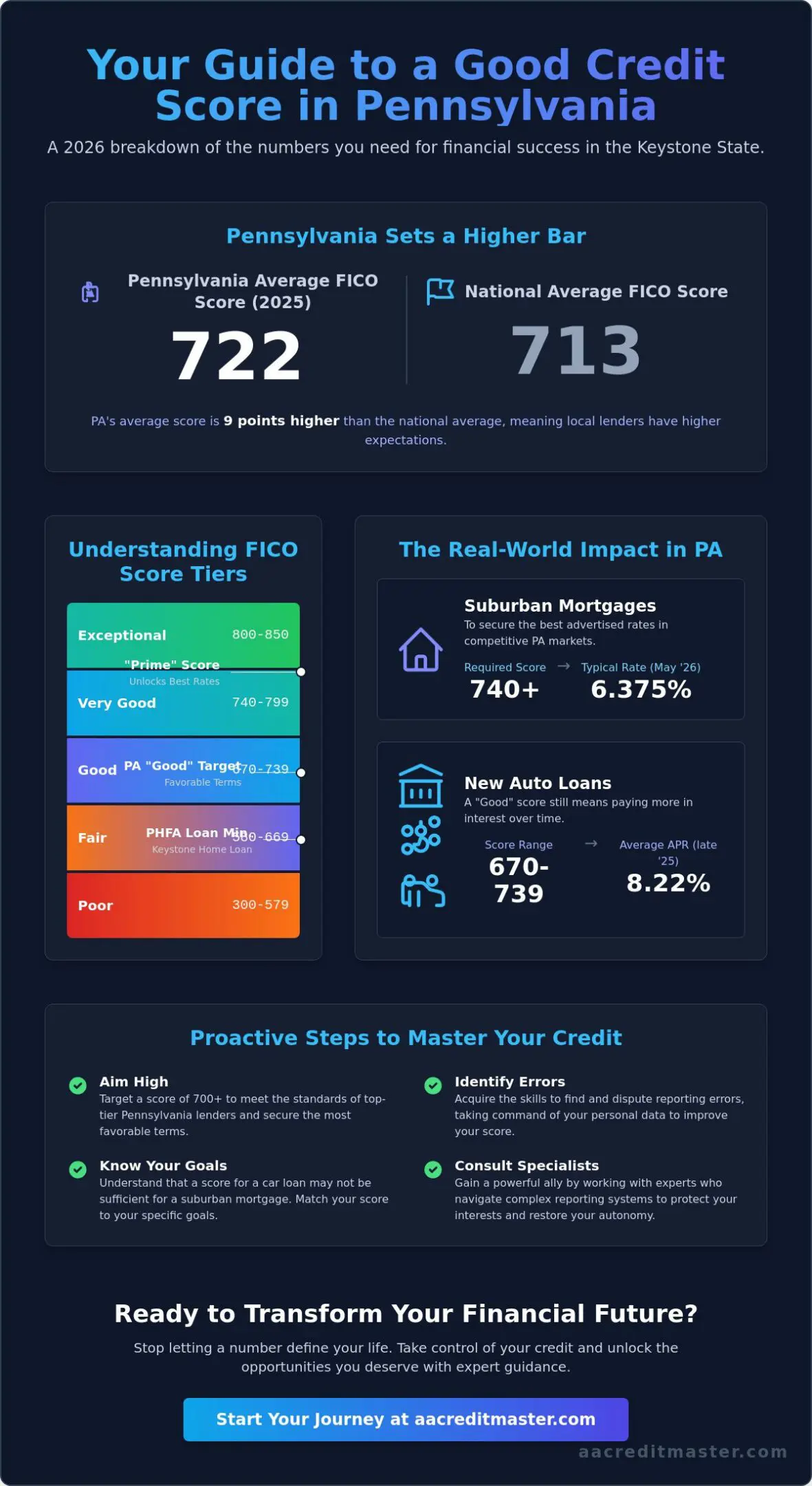
A score of 700 or higher generally serves as the gateway to favorable financial terms in Pennsylvania. While national models suggest a lower threshold, Pennsylvania lenders often hold residents to a higher standard because the state average reached 722 in 2025. This puts the Keystone State ahead of the national average of 713. If you want to know what is a good credit score in PA, look beyond the basic definitions. A “good” score gets you approved, but a “prime” score, typically 740 or above, unlocks the lowest interest rates and saves you thousands over the life of a loan. Understanding these tiers is the first step toward reclaiming your financial autonomy.
The FICO vs. VantageScore Tiers
Lenders use different models to judge your reliability. What is a credit score? At its core, it is a statistical analysis of your creditworthiness based on your history. In Pennsylvania, mortgage lenders almost exclusively prioritize FICO scores. If your score sits in the “Fair” range of 580 to 669, you’ll likely face higher premiums or be forced into specific government-backed programs. This range limits your options and keeps you stuck with higher monthly costs. Aiming for the 700+ tier ensures you aren’t limited to just one or two lenders. It gives you the power to choose the institution that treats you best.
Why “Good” is Relative to Your Financial Goals
A score that works for a used car loan might not cut it for a Philadelphia suburb mortgage. For example, a 660 is the minimum for the PHFA Keystone Home Loan program as of April 2026. However, to secure the competitive 6.375% mortgage rates advertised in May 2026, you typically need a FICO score of 740 or higher. Car loans follow a similar logic. Average APRs for new car loans in late 2025 hovered around 8.22% for those in the 670 to 739 range. If you fall below that, your monthly payment climbs quickly.
Local competition in markets like Allentown or Pittsburgh means lenders can afford to be selective. In the current economic climate, where mortgage rates remain in the 6% range, your score is your strongest negotiation tool. Understanding what is a good credit score in PA helps you navigate these local nuances with confidence. It is the foundation of your personal stability. Mastering this metric allows you to stop asking for permission and start making demands. You aren’t just a number; you are a consumer with the power to command better fiscal terms through proactive credit education.
How PA Credit Scores Compare to the National Average
Pennsylvanians generally take pride in their financial health. Historically, the state ranks in the top half of the country for credit health. While the national average FICO score saw a slight decline in 2025, Pennsylvania residents maintained a resilient average of 722. This resilience creates a unique lending environment. Local banks and credit unions in the Delaware Valley or the Lehigh Valley often set their “prime” thresholds higher than institutions in states with lower averages. When you research what is a good credit score in PA, you’re essentially measuring yourself against a high-performing peer group. You need to be aware that a score considered “good” in a lower-ranking state might only be considered “average” here.
Credit trends aren’t uniform across the state. In Philadelphia, high housing costs often lead to higher credit card utilization as residents manage their monthly cash flow. Conversely, rural areas may see lower scores due to limited access to diverse credit types. These regional nuances matter because local lenders understand the specific economic pressures of their zip codes. They look for borrowers who can maintain stability despite these localized challenges.
The Impact of PA Economic Trends
Statewide employment rates in sectors like healthcare, education, and manufacturing provide the stability needed for consistent payment histories. However, stability doesn’t always equal growth. Many Pennsylvanians find their scores stagnating because they haven’t mastered the technical skills of credit management. The real-world impact of your score is felt most acutely when these economic trends shift. In 2026, as mortgage rates hover in the 6% range, the difference between a 720 and a 760 can mean the difference between a comfortable home and a financial burden. Proactive credit education is becoming a necessity for those looking to stay ahead of rising costs.
Understanding Your Percentile
Sitting at a 720 score means you’re doing better than about half of your neighbors. In a competitive market, being “better than half” isn’t the ultimate goal. The best financial opportunities go to the top 25% of borrowers. Moving into that top tier requires a proactive approach to your credit report. You must learn to identify inaccuracies that quietly pull your numbers down. Taking command of your data is the only way to ensure you aren’t just another statistic in the state average. If you want to know what is a good credit score in PA for your specific goals, you have to look at the percentile that unlocks the lowest rates. If you’re ready to stop guessing and start growing, working with a credit score specialist can help you develop a tailored plan to reach the top tier.
The Real-World Impact of Your Score on PA Financial Goals
Your credit score acts as the primary price tag for your life in Pennsylvania. It determines whether you pay the standard rate or a “subprime penalty” that can drain your savings over decades. When you understand what is a good credit score in PA, you stop overpaying for the privilege of borrowing money. The interest gap between a “fair” score and an “excellent” one can exceed $100,000 over the life of a 30-year mortgage. This isn’t just a theoretical number; it’s money that could have stayed in your pocket for retirement or your children’s education. Beyond loans, many local PA insurance companies use credit-based insurance scores to set your premiums for auto and homeowners coverage. A lower score often results in higher monthly bills, regardless of your driving record or claim history.
Mortgages and Real Estate in Pennsylvania
Securing a home in the competitive Philadelphia suburbs requires more than just a down payment. While you can technically qualify for an FHA loan with a 580 score or a conventional mortgage with a 620, these minimums won’t get you the best terms. The Pennsylvania Housing Finance Agency (PHFA) generally requires a 660 for its Keystone Home Loan and K-FIT programs as of April 2026. However, to unlock the 6.375% fixed rates seen in May 2026, you’ll need a FICO score of at least 740. A higher score gives you a distinct advantage in tight markets like Montgomery or Bucks County. It signals to sellers and lenders that you’re a low-risk closer, which is essential when multiple offers are on the table.
Launching and Growing a Philly Small Business
Your personal financial health serves as the foundation for your entrepreneurial dreams. Most lenders require a personal guarantee when you first start looking for Philadelphia small business resources. If your personal score is weak, you’ll struggle to lease commercial space in Center City or secure equipment financing for a new venture. A strong personal foundation allows you to transition toward building a separate business credit score. This separation is vital for protecting your family’s assets while scaling your company. By mastering what is a good credit score in PA for business owners, you gain the leverage needed to negotiate better terms with suppliers and vendors across the Commonwealth. You aren’t just building a company; you’re building a legacy of financial stability.
Proactive Steps to Master Your Credit Health in PA
Mastering your finances requires treating credit management as a skill rather than a static metric. Determining what is a good credit score in PA is only half the battle; the real victory lies in knowing how to maintain and defend that number. You must move beyond passive monitoring and adopt a strategy of proactive intervention. This begins with understanding that your credit report is a living document. It often contains errors that can suppress your score by dozens of points. By focusing on removing inaccuracies from your credit report, you take the first step toward restoration and personal autonomy. Don’t settle for temporary quick fixes that offer a brief bump. Instead, invest in the foundational knowledge that provides a permanent solution to financial instability.
Strategic debt management is the next pillar of your plan. You should aim to keep your credit utilization below 30% of your available limits. If you have a total credit limit of $10,000 across your cards, ensure your reported balances never exceed $3,000. High utilization signals financial stress to lenders, even if you pay your bills on time. In the competitive Pennsylvania market, showing that you can manage credit without relying on it for survival makes you a highly attractive borrower. This discipline creates the momentum needed to move from a “fair” score to the “prime” tiers discussed earlier.
Reviewing Your Reports for Local Errors
Spotting outdated information from PA-based creditors is a critical capability. Regional banks and local credit unions sometimes fail to update records promptly after a dispute or a payoff. You must follow a methodical process for disputing this unverifiable data. While many people rely on automated credit tools, these generic platforms often miss the nuances of complex reporting errors. A personalized strategy beats automated tools every time because it addresses the specific pitfalls of your unique history. You deserve a mentor who knows exactly where these institutions hide their mistakes.
Building Positive Habits for 2026
Success is built on a rhythm of monthly credit check-ups. Use this time to verify that your “credit mix” remains healthy. Lenders in the Commonwealth look for a balance of revolving credit, like cards, and installment loans, such as auto or student loans. Consistent, on-time payment history remains the most influential factor in your score. If you automate your minimum payments, you ensure you never miss a deadline due to a busy schedule. This habit protects your progress and builds the long-term stability required for major life milestones. If you’re ready to stop feeling stuck and start making progress, a credit score specialist can provide the expert reassurance and clear path forward you need to conquer these systems.
Navigating the Path to Financial Restoration with AA Credit Master
Achieving financial restoration doesn’t happen by accident. It requires a deliberate strategy and a seasoned mentor who understands the specific hurdles of the Pennsylvania market. You don’t have to face the stress of credit uncertainty alone. Understanding what is a good credit score in PA is the starting point, but executing a restoration plan requires a partner who stands between you and large, impersonal credit institutions. We position ourselves as your protective guardian in Philadelphia, providing the authoritative guidance you need to move from a state of worry to a state of confident action. Our approach focuses on long term stability rather than temporary patches.
You only pay for results because our post-performance fee structure aligns our success directly with yours. This commitment ensures that every action we take is designed to move you closer to your specific financial milestones. Whether you’re targeting the 660 score required for PHFA programs or the 740+ needed for prime mortgage rates, we provide a tailored resource plan. This personalized strategy is essential because generic automated tools often fail to address the complex reporting errors found in local Pennsylvania records. By choosing expert credit repair services in Philadelphia, you gain an ally dedicated to your personal autonomy and restoration.
The AA Credit Master Difference
Moving from financial instability to a state of control requires a shift in mindset. Our consulting is non-judgmental and professional, acknowledging that many credit issues stem from reporting errors rather than personal failure. We act as a formidable barrier between you and the credit bureaus, ensuring your data is accurate and verifiable. This authoritative presence gives you the breathing room to focus on your future while we handle the technical complexities of the reporting systems. You gain the confidence that comes from having a professional navigator in your corner.
Your Next Steps Toward a Better Future
Taking back control of your financial narrative starts with a single, proactive decision. Your 2026 financial plan deserves the solid foundation that only expert credit education can provide. You should prepare for an initial consultation with a credit score specialist to identify the specific roadblocks in your current report. During this session, we’ll begin mapping out a route to the scores that unlock the best fiscal terms in the Commonwealth. By acquiring the skills to manage your credit effectively, you’re not just fixing a number; you’re securing your family’s future. Your journey toward restoration begins today, and the path to what is a good credit score in PA is one we will walk together.
Take Command of Your Financial Narrative
A score of 700 or higher serves as your key to the best opportunities in Pennsylvania. Whether you are aiming for a suburban mortgage or building business credit, your score dictates the terms of your future. You’ve learned that credit management is a skill you can master rather than a metric that happens to you. By identifying what is a good credit score in PA for your unique goals, you’ve already taken the first step toward restoration. You don’t have to navigate the complexities of credit reporting systems alone. Professional mentorship provides the clear path forward that generic automated tools simply cannot offer.
You can restore your creditworthiness with AA Credit Master in Philadelphia today. Our expert credit score specialists provide tailored, Philadelphia-based consulting designed to protect your interests. We operate with CROA-compliant post-performance fees, meaning our goals stay perfectly aligned with your success. You deserve a future defined by stability and personal autonomy. Take the proactive step to reclaim your financial standing and start building the legacy you’ve always envisioned. Your better future is waiting; you have the power to reach out and claim it.
Frequently Asked Questions
Is a 680 credit score good enough to buy a house in Pennsylvania?
Yes, a 680 score is sufficient to qualify for several home loan programs in the Commonwealth. The Pennsylvania Housing Finance Agency (PHFA) currently requires a minimum score of 660 for its Keystone Home Loan and K-FIT programs as of April 2026. While this score gets you approved, you’ll likely face higher interest rates than a borrower in the 740+ tier. Reaching that higher benchmark is the best way to secure the 6.375% rates seen in May 2026.
How often should I check my credit report for errors in PA?
You should establish a rhythm of checking your reports at least once a month. Federal law currently allows you to access free weekly reports from the major bureaus through AnnualCreditReport.com. Regular reviews help you spot outdated information from local creditors before it impacts a loan application. Catching these errors early allows you to take command of your data and protect your financial restoration.
Can I remove accurate but negative information from my PA credit report?
You cannot legally remove information that is accurate and verifiable. The credit reporting system is designed to provide a truthful history of your financial behavior. However, many reports contain inaccuracies or unverifiable data that pull your numbers down. Focusing on what is a good credit score in PA means learning how to identify these specific errors. Once identified, you can work to have them corrected or removed to reflect your true creditworthiness.
What is the average credit score for Philadelphia residents in 2026?
Philadelphia residents typically see scores that fluctuate around the state average of 722. High housing costs in the city often lead to higher credit utilization, which can suppress scores compared to more rural areas. Understanding where you stand in this urban environment helps you navigate local lending with more confidence. It’s helpful to compare your percentile to the state benchmarks to gauge your true borrowing power.
How long does it take to improve a credit score from fair to good?
Moving from fair to good credit generally takes six to twelve months of disciplined action. This timeline varies based on how quickly you can identify and dispute inaccuracies on your report. You’ll see progress faster if you maintain a utilization rate below 30% and ensure every payment is on time. Consistent habits transform credit management into a capability you can rely on for years.
Do Pennsylvania lenders use FICO or VantageScore more often?
FICO remains the dominant model for the vast majority of Pennsylvania mortgage lenders. While you might see a VantageScore on a free monitoring app, banks prioritize FICO when making high stakes lending decisions. Knowing what is a good credit score in PA requires you to focus on your FICO tiers. This ensures your expectations align with the clinical reality of the local lending landscape.
What is the minimum credit score for a small business loan in PA?
Most local lenders prefer a personal score of 680 or higher for small business financing. Your personal credit acts as the initial foundation for your company’s growth in the Philly market. Maintaining a strong personal profile allows you to access better terms while you work on building a separate business credit entity. This separation is a vital skill for any entrepreneur seeking long term stability.
How does Pennsylvania law protect consumers during the credit repair process?
Consumers are protected by the Credit Repair Organizations Act (CROA), which is strictly enforced in Pennsylvania. This law requires that credit consulting firms only charge fees after they perform the services they promised. It also mandates a written contract and grants you a three day right to cancel. These regulations stand between you and predatory practices, ensuring you have a safe path toward restoration.