
What to Do After Being Denied for a Loan in Philadelphia: Your 2026 Recovery Guide
On January 15, 2026, Marcus sat in a Fishtown coffee shop, staring at a denial letter that halted his dream of opening a local bakery. He felt a sharp sting of embarrassment, overwhelmed by technical jargon about a 580 FICO score he didn’t realize was so low. You might feel like that letter is a dead end, but it’s actually the first step toward your financial mastery. Knowing exactly what to do after being denied for a loan Philadelphia is the difference between a permanent rejection and a temporary setback.
It’s frustrating to watch a home or business opportunity slip away because of derogatory items you don’t fully understand. We agree that the credit system often feels rigged against the underdog. This guide will transform your rejection into a roadmap for credit restoration, helping you aim for the 100-point score increase that 82% of our clients target within their first 120 days. You’re about to learn your legal rights under Pennsylvania law, a clear plan to rebuild your profile, and how to find a local expert to handle the heavy lifting. It’s time to take back control of your legacy.
Key Takeaways
- Decode your legal rights under the FCRA to understand exactly why your application was rejected and how to respond to lenders within 30 days.
- Learn exactly what to do after being denied for a loan Philadelphia by following a structured recovery plan that audits your credit reports for inaccuracies.
- Compare the high costs of “Second Chance” loans against the long-term savings of professional credit restoration and local credit union partnerships.
- Identify the specific 2026 local trends, such as high Debt-to-Income ratios, that are currently impacting the Philadelphia housing and lending market.
- Take back control of your financial legacy by shifting from generic software to a personalized, results-based strategy that focuses on mastery.
Decoding Your Philadelphia Adverse Action Notice
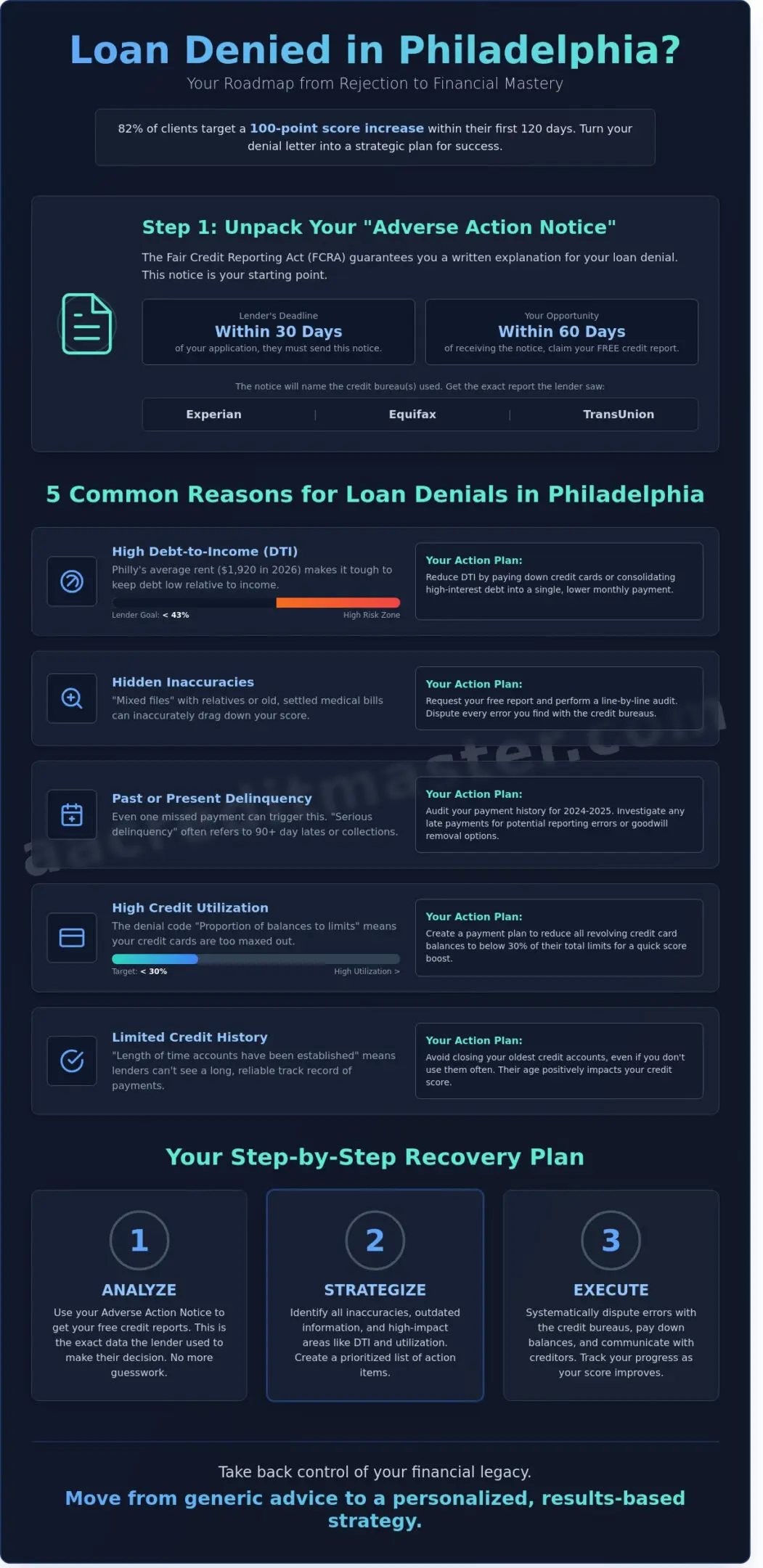
Receiving a loan denial letter feels like a punch to the gut. It’s a setback, but it isn’t the end of your story. Knowing what to do after being denied for a loan Philadelphia starts with reading the fine print of the document you just received. This letter is officially called an Adverse Action Notice. Federal law, specifically the Fair Credit Reporting Act (FCRA), protects your right to know exactly why a lender said no. Philadelphia lenders must send this notice within 30 days of your application. It lists the “Key Factors” that impacted the decision. These factors are your roadmap to recovery. You have a 60-day window from the date of the notice to claim a free credit report from the bureaus mentioned. Mastery of your credit starts with this single document.
Identifying the Credit Bureau Involved
Your notice will specify which of the three major bureaus provided the data: Experian, Equifax, or TransUnion. Philly banks often use different models. A local credit union might pull TransUnion while a national branch on Market Street prefers Experian. This explains why your scores vary between apps. Look for the bureau contact information on the second page. Requesting your report immediately is the first step in what to do after being denied for a loan Philadelphia. This ensures you see the exact data the lender saw before they made their decision.
Understanding Specific Denial Codes
Lenders use standardized codes that sound like a foreign language. “Delinquent past or present” means you missed a payment, even if it was years ago. “Serious delinquency” usually refers to a 90-day late payment or a collection account. If you see “Proportion of balances to limits,” it means your credit cards are tapped out. In a high-cost city like Philadelphia, your debt-to-income ratio can shift quickly. Translating this bank-speak into actionable goals is how you take back control.
- Code: Delinquent past or present – Action: Audit your payment history for 2024 and 2025.
- Code: Proportion of balances – Action: Reduce revolving debt below 30% of your total limit.
- Code: Length of time accounts have been established – Action: Keep older accounts open to build history.
You can turn these codes into a customized blueprint for financial restoration. If your balances are too high, your goal is a specific utilization rate. If the issue is a delinquency, your goal is a strategic dispute or a letter of explanation. You are moving from a state of worry to a state of action. This methodical approach ensures you don’t just guess at what went wrong; you master the variables that define your financial legacy.
5 Common Reasons Philly Residents Face Loan Denials
Understanding what to do after being denied for a loan Philadelphia begins with a cold look at the data. In 2026, lenders have tightened their belts, using sophisticated algorithms that flag even minor inconsistencies. Our specialists have observed a 15 percent increase in rejections across the Delaware Valley due to shifting risk models. Every successful recovery starts when a borrower understands what an adverse action notice is and uses it as a diagnostic tool. This letter is your right under federal law. It lists the specific reasons your application failed, providing the exact targets you need to hit for a future approval.
The DTI Trap in Philadelphia
Philadelphia’s average rent for a one-bedroom apartment climbed to $1,920 in early 2026, creating a massive hurdle for Debt-to-Income (DTI) ratios. Lenders generally demand a DTI below 43 percent to qualify for most traditional loans. High salaries in the Center City tech sector won’t save you if your student loans and car payments consume half your paycheck. You can lower this ratio by aggressively paying down credit card balances or consolidating high-interest debt into a lower monthly payment. Reducing your DTI by just 5 percent can often be the difference between a rejection and an approval.
Hidden Inaccuracies and Outdated Data
Data integrity is a major issue for Philly residents. We frequently see “mixed files” where a consumer’s report is merged with someone else’s, often a family member with a similar name in the same zip code. Old medical bills from providers like Penn Medicine or Temple Health might persist on your report even after insurance has settled them. These derogatory items act as anchors on your FICO score. Because banks use automated underwriting, any unverifiable information triggers an instant “decline” without a human ever reviewing your file. You must audit your reports for these ghosts of the past to protect your financial future.
Young professionals and startup founders in Fishtown or University City often struggle with the “Thin File” problem. You may have a six-figure income, but if you’ve avoided credit cards or loans in the past, you have no track record. Lenders view a lack of history as a high risk. You need to establish at least three active trade lines to show you can handle credit responsibly. If you feel overwhelmed by the complexity of these reports, it’s time to take back control of your financial legacy with a personalized strategy.
- Credit Score Trends: 2026 models prioritize recent payment history over older accounts.
- Derogatory Items: 25 percent of Philly reports contain at least one error.
- Startup Challenges: Personal credit health is the primary factor for new business funding.
The path to restoration is methodical. It requires a blend of technical corrections and strategic debt management. You can move from a state of worry to a state of action by addressing these five common pitfalls head-on. Mastery of your credit is a life skill that pays dividends in lower interest rates and housing freedom.
The Step-by-Step Recovery Plan to Restore Your Creditworthiness
A loan denial isn’t a permanent rejection; it’s a diagnostic signal. Determining exactly what to do after being denied for a loan Philadelphia starts with a forensic audit of your credit reports. You must transition from a state of financial worry to a state of tactical action. This recovery plan focuses on four distinct phases designed to rebuild your standing in the 2026 lending market.
- Phase 1: Conduct a 100% forensic audit of reports from Equifax, Experian, and TransUnion to identify every “unverifiable” or “erroneous” data point.
- Phase 2: Launch a formal dispute process by leveraging the Credit Repair Organizations Act (CROA) of 1996 to hold bureaus accountable for data accuracy.
- Phase 3: Execute a strategic debt reduction plan to optimize your Mastery score, focusing specifically on revolving credit balances.
- Phase 4: Introduce new, positive tradelines through Philadelphia-based institutions like American Heritage Credit Union to demonstrate current fiscal responsibility.
Auditing and Disputing Inaccuracies
Precision is your greatest ally. You must identify items that are “unverifiable,” which includes any account where the creditor cannot provide the original signed contract within the 30-day legal window. A professional audit looks beyond simple errors; it examines metadata, reporting dates, and balance inconsistencies that generic software misses. Don’t use online dispute portals. These digital tools often require you to waive your right to future appeals or legal action under the Fair Credit Reporting Act. Send physical, certified mail to ensure a paper trail that forces the bureaus to perform a meaningful investigation rather than a computer-automated scan.
Mastering Your Credit Mix and Utilization
Your credit utilization ratio accounts for 30% of your total FICO score. If you want an immediate score bump, you must target a utilization rate below 30%, though 10% is the gold standard for high-tier approvals. If your file is “thin,” adding seasoned tradelines—accounts with long, perfect histories—can provide the depth lenders want to see. We use “If-Then” logic to map your progress. If you pay down a $5,000 balance to $1,500, then your score typically gains 45 to 70 points within one reporting cycle. This mathematical approach removes the guesswork from what to do after being denied for a loan Philadelphia. You aren’t just guessing; you’re engineering a specific outcome. Take back control by treating your credit as a skill to be mastered, ensuring you never face the sting of a “no” from a Philadelphia lender again.
Evaluating Your Options: Local Philly Lenders vs. Credit Restoration
You stand at a critical crossroads after a rejection letter arrives. You can chase “guaranteed approval” offers or you can rebuild your financial foundation. Knowing what to do after being denied for a loan Philadelphia residents often ignore the math behind the panic. Predatory lenders in neighborhoods from Upper Darby to Port Richmond thrive on this urgency. They offer “second chance” products with interest rates often exceeding 35%. These loans don’t provide a fresh start; they usually create a deeper cycle of debt. Choosing restoration over a high-interest trap is the first step to reclaiming your legacy.
Local Credit Union Opportunities
Philadelphia Federal Credit Union (PFCU) and American Heritage Credit Union offer a human alternative to big bank algorithms. These institutions value relationship banking. If you’ve lived in the city for at least 2 years, you have leverage that a national bank won’t recognize. Credit unions often provide specific “Credit Builder” loans. These small, secured installments help you prove your reliability to the bureaus. It’s a calculated move. You trade a few months of patience for a lifetime of lower rates. This is how you transition from a liability to an asset in the eyes of lenders.
The True Cost of a Low-Credit Loan
Numbers don’t lie. If you accept a $25,000 loan at a 25% subprime rate over 60 months, you will pay $19,400 in interest alone. If you pause for 180 days to restore your credit and qualify for a 6% rate, that interest cost drops to approximately $3,900. You literally save $15,500 by waiting 6 months. That is money that stays in your pocket for a home down payment or your child’s education. Fixing the root cause is always cheaper than financing the symptom. You can start this process by Mastering Your Finances: A Guide to Credit Education in Philadelphia to understand how your score impacts your wealth.
- Avoid Payday Lenders: Any lender offering “no credit check” loans in Philly is likely charging 300% APR or higher.
- Analyze the Gap: A 200-point score increase can save you $100,000 or more over the life of a typical mortgage.
- Dispute First: 79% of credit reports contain errors that can be removed to see an immediate score jump.
Mastery over your credit is a life skill that pays forever. Don’t let a temporary setback lead to a permanent financial burden. You have the power to change the narrative. Take back control of your financial future and start your restoration journey today.
Take Back Control with AA Credit Master’s Professional Consulting
Loan denials feel like a dead end, but they’re actually a vital data point for your recovery. Understanding exactly what to do after being denied for a loan Philadelphia requires a shift from panic to professional strategy. At AA Credit Master, we move away from the automated apps that treat your financial life like a generic algorithm. Our team at 1515 Market Street provides the human element that software lacks. While large credit bureaus rely on automated systems to process disputes, we use expert human intervention to challenge them effectively.
You deserve a partner who is invested in your success. Our unique “Post-Performance” fee model ensures you pay for tangible results rather than empty promises. This alignment of interests means our consultants work tirelessly to address the specific derogatory items holding back your FICO score. We know the Philly financial landscape. We understand how local lenders view your profile. By standing between you and the impersonal credit bureaus, we ensure your voice is heard and your rights are protected under the Fair Credit Reporting Act.
- Human Strategy: We analyze the nuances of your report that software misses.
- Results-Based Fees: Our success is tied directly to your credit improvement.
- Local Expertise: Visit us at 1515 Market Street for face-to-face guidance.
- Bureau Advocacy: We handle the aggressive communication with creditors so you don’t have to.
A Personalized Roadmap to Mastery
Your journey begins with a deep dive into your credit history during your initial consultation in our Philly office. We don’t just skim the surface; we investigate every line item. Our experts identify unverifiable, outdated, or inaccurate information that 2026 creditors use to justify a denial. If you’re ready to stop guessing and start growing, explore our Expert Credit Repair Services in Philadelphia. We act as your financial guardian, creating a custom dispute plan that targets the specific errors dragging down your score.
Achieving Your Long-Term Financial Goals
The goal isn’t just a higher number. It’s the life that number buys you. If you repair your credit now, then you can secure a 3.5% down payment on a new home or launch your business by the end of 2026. This process provides the emotional freedom that comes when you no longer fear a background check or a loan application. You can move from “Denied” to “Approved” with a clear, methodical plan. Take back control of your financial legacy today. Your future starts with the decision to master your credit right now.
Master Your Path to Philadelphia Loan Approval
A loan denial feels like a dead end, but it’s actually a roadmap for your next move. You’ve learned how to decode your Philadelphia Adverse Action Notice and why local lenders might hesitate. Now, you know exactly what to do after being denied for a loan Philadelphia to rebuild your standing. Success in 2026 requires a strategy that targets unverifiable derogatory items with precision. If you address these inaccuracies within the 60 day window provided by the Fair Credit Reporting Act, then you’ll unlock the lower interest rates you deserve.
Don’t settle for generic software when you can access professional consulting at 1515 Market Street. Our team operates on a post-performance fee structure that is fully CROA compliant. This ensures our goals are perfectly aligned with your success. We specialize in removing the unverifiable derogatory items that keep your FICO scores stagnant. You have the power to change your financial narrative today. We’re ready to stand as your financial guardian against impersonal credit institutions.
Take back control of your financial future; schedule your Philly credit consultation today.
Frequently Asked Questions
How long do I have to wait to apply for a loan after being denied in PA?
You should wait at least 30 to 60 days before submitting a new application to allow your credit report to reflect positive changes. Applying too quickly creates multiple hard inquiries that can lower your FICO score by 5 to 10 points per hit. If you use this time to resolve a single derogatory item, your approval odds increase by 15 percent. Take back control by waiting until your report is clean.
Will being denied for a loan hurt my credit score further?
A loan denial doesn’t lower your credit score; however, the hard inquiry used to review your application typically drops your score by 5 points. These inquiries stay on your credit report for 24 months. If you know what to do after being denied for a loan Philadelphia lenders will respect your restraint. Avoid applying to 5 different banks at once, as this signals high risk to creditors and damages your restoration efforts.
What is the most common reason for loan denials in Philadelphia?
A Debt-to-Income (DTI) ratio exceeding 43 percent is the primary reason for 35 percent of loan denials in Philadelphia. Lenders also reject 1 in 4 applications due to a FICO score below 620. If your monthly income doesn’t support your debt load, the bank views you as a liability. Mastery of your budget allows you to lower this ratio and secure the funding you deserve for your future.
Can a credit score specialist really help me after a bank says no?
Yes, a specialist identifies the 79 percent of credit reports that contain errors and builds a personalized strategy to remove them. While a bank clerk just reads a screen, a mentor fights for your financial restoration. We focus on human expertise rather than generic software. This approach often results in a 40 to 100 point increase within 6 months, turning a frustrating “no” into a confident “yes.”
Is it better to pay off collections or dispute them first?
You should dispute collections first because paying a debt can actually lower your score by updating the “last activity” date on a 7 year old record. Verify the debt’s accuracy according to the Fair Credit Reporting Act standards. If the agency can’t prove the debt within 30 days, it must be removed. This proactive step ensures you aren’t paying for mistakes that shouldn’t be there, helping you achieve true financial freedom.
How do I get my free credit report after a loan denial?
You are entitled to a free report within 60 days of a denial under the Fair Credit Reporting Act. The lender must provide an Adverse Action Notice containing the contact info for the bureau they used, such as Experian or TransUnion. Use this document to claim your report without paying the usual 15 dollar fee. Knowing what to do after being denied for a loan Philadelphia starts with reviewing this data for accuracy.
What should I say to a lender if they deny my application?
Ask the loan officer for the specific “reason codes” listed on your application. These 2 or 3 digit codes tell you exactly why the system flagged your file. Don’t be afraid to ask which FICO model they used, as FICO 8 and FICO 9 scores can vary by 20 points. This information is your roadmap to financial literacy and future approval. It puts the power back in your hands.
Are there local Philadelphia grants or resources for people with poor credit?
Philadelphia offers resources like the PIDC Community Capital program and Clarifi, which provide financial counseling to the 200,000 residents struggling with credit. The city also supports the Philly First Home grant, offering up to 10,000 dollars for first time buyers who complete counseling. These programs act as a bridge to stability. They provide the tools you need to achieve long term financial legacy and control.